Ian Thomas Malone

Monday

6

May 2019

0

COMMENTS

Game of Thrones Season 8 Recap: Episode 4

Written by , Posted in Blog, Game of Thrones, Pop Culture

Last season presented a simple reason for why Daenerys’ first act in Westeros didn’t involve taking King’s Landing and killing Cersei. If Dany invaded King’s Landing, burning tons of people in the process, everyone would hate her forever and she’d be a bad queen. Except, this isn’t really the reason. Dany didn’t invade the capital because the show needed to keep Cersei around for the final season.

As a result, Cersei got stronger and made allies who could shoot dragons out of the sky with giant sea scorpions. Who knew that the show’s most ruthless villain was also very smart? Tyrion knew all of that and yet he gave Dany a lot of bad advice anyway. Despite this, we don’t get a scene where they hash that out, because apparently, we needed a few focusing on mutiny. So here we are, in a position where Cersei has the upper hand largely because no one else bothered to stop her.

Winterfell was mostly fun, minus the virgin jokes and the Sansa/Hound conversation. Brienne’s sexual past was a weird thing for Tyrion to joke about, having been forcibly married to the woman she’s sworn to defend, while also sitting at a table with his brother who’s only ever had sex with their sister. Strange.

Sansa’s comments about her trauma were easily the low point of the episode. Yes, she’s survived a lot to get where she is. No, she probably wouldn’t still be a “little bird” if that hadn’t all happened. It’s great that she’s become a key player, but it would’ve been nice if the show hadn’t tried to sugar coat rape and abuse like that.

Huzzah for Lord Gendry Baratheon, who apparently isn’t interested in claiming the throne now that he’s a legitimate heir of Robert Baratheon. I liked how Arya turned him down. They had their moment, but she’s not destined for that kind of life. Arya and The Hound should get a spinoff.

Dany and Jon’s bedroom scene was very bad. Mentioning Ser Jorah in a sexual context was gross, but then Dany looked all desperate begging Jon to stay in the bastard closet. Weird that the person who came to save the North now looks weaker than basically everyone else.

We finally got an R + L = J moment that wasn’t right at the end of an episode. Of course, Sansa told Jon’s secret. Why shouldn’t she?

As much as I’ve criticized the Dany/Sansa feud for feeling forced this season, it was at least in service to sensible moments of conflict. The North is tired. Yes, they agreed to help Dany, but that doesn’t mean it has to be done immediately. It’s okay to have conflict about logistics, demonstrating Sansa’s leadership abilities in looking out for her people first.

Bronn is back. Does anyone care? Me neither. Should’ve been killed off last season.

The second half of the episode felt weirdly rushed for a show that took its sweet time taking in the post-apocalypse high. Putting aside how bizarre it was that no scout ship sailed ahead to take a look at Dragonstone, this episode really didn’t need to have a Dany/Tyrion/Cersei confrontation at the end, especially before Jon arrived with the rest of the troops. Why wouldn’t Cersei just order her archers to shoot them all and be done with it?

How did anyone know that Missandei was captured? She could’ve have drowned just as easily. Equally weird that this specific news made it to Winterfell. It’s a shame that she had to die for seemingly no reason. Poor Grey Worm.

Euron is smart enough to shoot a dragon out of the sky, but apparently doesn’t question how Tyrion knows that Cersei is pregnant despite being in the North all season, a clear indicator that the baby isn’t his. Maybe he doesn’t care? Or the show doesn’t care about either situation? I don’t really care either.

R.I.P. Rhaegal. Guess the show’s budget got tired of two dragons. Only one to go.

Could Bran have warned Dany about Euron’s trap? Probably. The fact that he didn’t isn’t necessarily surprising, but it’s weird how no one in the show has tried to fully tap into his superhero powers.

Oh Varys. I’m glad he’s still alive, but these mutinies are a little tiresome. He’s supposed to be a spymaster, not the monarchy’s ombudsman. He should either serve Dany or step aside. No more scheming to switch sides.

Brienne and Jaime happened. Wish they’d left it at that without the whole Jaime leaving bit. I get that it makes sense to send him to King’s Landing, but the Jaime/Cersei plotline is one long-running element of the show I didn’t need to see resolved in these last few episodes.

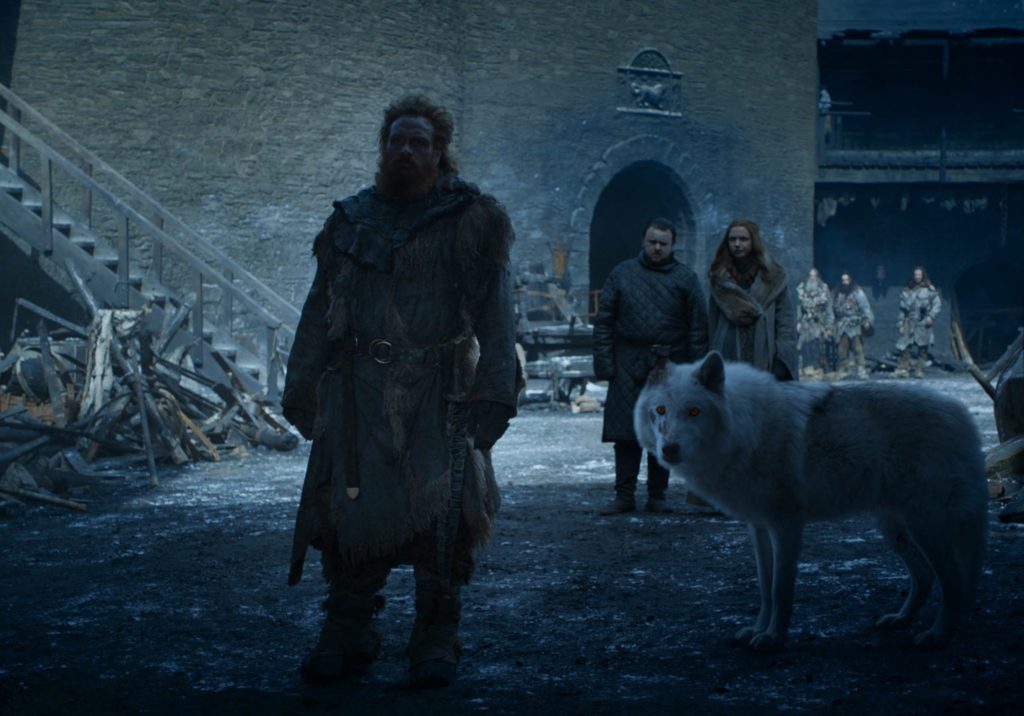
Tormund’s constant lusting over Brienne was beyond tiresome, but at least he gets to give Ghost a good home. Shame on Jon for not even giving him a pet on the way out. And they think this man should be king? Bah. A man who can’t even say goodbye to his direwolf is not fit to rule.

I hate how the show has portrayed Daenerys since she arrived in Westeros. Sure, something needed to happen to bring her massive army down a few pegs, but the writing for her character has been awful. She could be sitting on the Iron Throne right now if it wasn’t for bad tactical advice. Rather than explore that notion, instead the show’s been painting Jon as the reasonable alternative.

Between R + L = J and the lack of chemistry between Kit Harrington and Emilia Clarke, their romance has suffered a lot over the past few episodes. I just wish the show could figure out what to do with them rather than drag this monarchy quibble out for the whole season. It’s totally unnecessary and quite frankly, boring.

That’s it for this week. I actually mostly enjoyed the episode despite the numerous issues. There’s a lot of pacing questions that will certainly be answered in two weeks, but it’s hard to really get behind the way this episode decided to spend its time. See you next week!

Thursday

2

May 2019

0

COMMENTS

Knock Down the House Is a Powerful Showcase of Democracy in Action

Written by , Posted in Blog, Movie Reviews, Pop Culture, Reviews

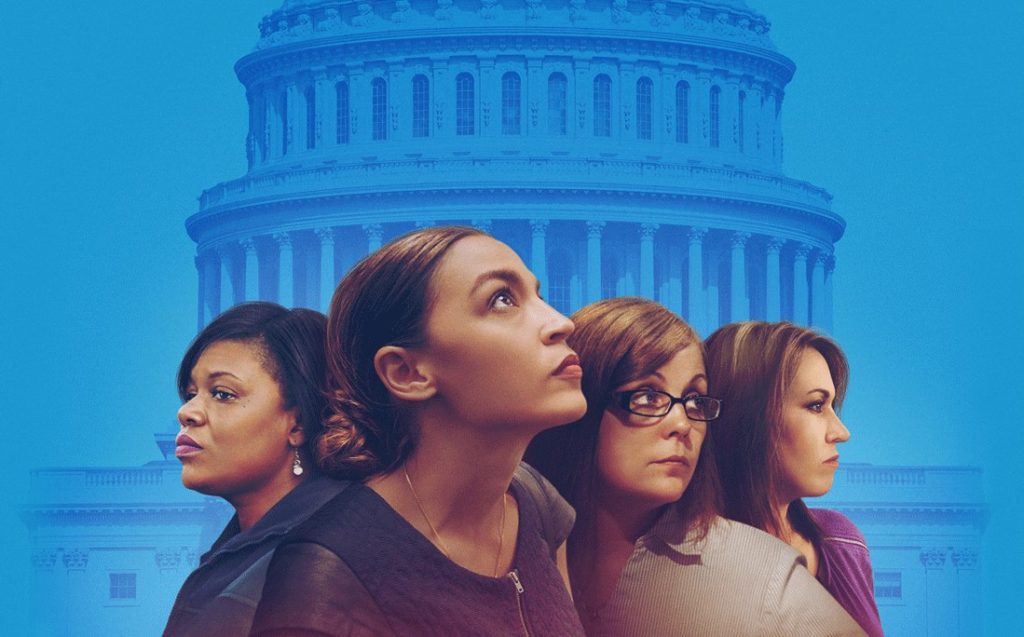
A documentary like Knock Down the House faces two narrative challenges that can be difficult to overcome in a ninety-minute runtime. Showcasing four separate women putting up primary campaigns against incumbent Democrats, the film has to not only tell multiple stories, but ones with widely known outcomes. It should hardly be a surprise to anyone that Alexandria Ocasio-Cortez went on to beat incumbent Congressman Joe Crowley.

One of the appeals of political documentaries is the behind the scenes perspective they provide, a chance to know the candidates beyond their cable news appearances. The grassroots nature of the four campaigns highlighted in Knock Down the House gave the documentary a much more intimate feel than films focused on larger efforts by established candidates. Without massive staffs or even office buildings, the film spotlights each of the candidates’ best assets, namely being themselves.

Amy Viela, Cori Bush, and Paula Jean Swearengin came up short in their efforts to unseat their Democrat incumbents. Bush and Swearengin both managed to pull in over 30% of the primary vote, very impressive totals for unknown grassroots campaigns running against established politicians with all the benefits that entail. The documentary showcases their individual motivations for getting in the race, women with deep emotional stakes at play to change a system that isn’t working for too many Americans.

Knock Down the House does a great job explaining the many roadblocks put into place to impede primary challengers, a system that makes it about as a difficult as possible to even get on the ballot. There are a few scenes highlighting the work of groups like Justice Democrats and Brand New Congress, grassroots organizations seeking to recruit and support candidates for office. All the stereotypical notions of polished politicians are thrown out the window in favor of real people seeking to create real change.

Unsurprisingly, the documentary spends much of its time on Alexandria Ocasio-Cortez, whose successful campaign has captivated the nation for much of the past year. The footage from her campaign presents a stunning contrast between grassroots efforts and the establishment, frequently painting Crowley as out of touch, representing a district he no longer even called home. AOC fans might have enjoyed a documentary completely dedicated to her meteoric rise, but the film makes great use of all its subjects to present Washington as out of touch with the nation at large.

Refreshingly absent from the bulk of the narrative is the man in the White House. For all the media attention that Trump gets, much of America simply doesn’t care about his Twitter feed. Even in deep red West Virginia, Swearengin’s campaign focuses on the bread and butter issues affecting her state and not as a referendum on his every move. AOC also goes out of her way to criticize Crowley’s Trump-heavy campaign literature, reframing the “us vs. them” debate in a context better suited to her community.

Knock Down the House is an uplifting documentary that highlights the power of democracy in action. Only one of the film’s four subjects managed to win her race, but their efforts offer more than just inspiration to future candidates. Democracy isn’t always fair, but it’s always worth fighting for.

Thursday

2

May 2019

0

COMMENTS

Bonding Is a Succinct New Comedy With a Ton of Heart

Written by , Posted in Blog, Pop Culture, Reviews

One of the beautiful things about the streaming era is that no show has to look like any other, at least in theory. Without weekly timeslot obligations, programs can air for as long or as little as they want. Many streaming comedies take the former approach, with episode runtimes that occasionally double their commercial TV counterparts.

Netflix’s new comedy Bonding is a fascinating case study in “less is more.” With episode runtimes that never go past seventeen minutes, the show is a complete anomaly on the major streaming networks, one of the few series that doesn’t seek to pad out its inaugural season. The seven-episode first season does fly by, but it carries itself with such purpose that you can’t help but feel good about wanting more.

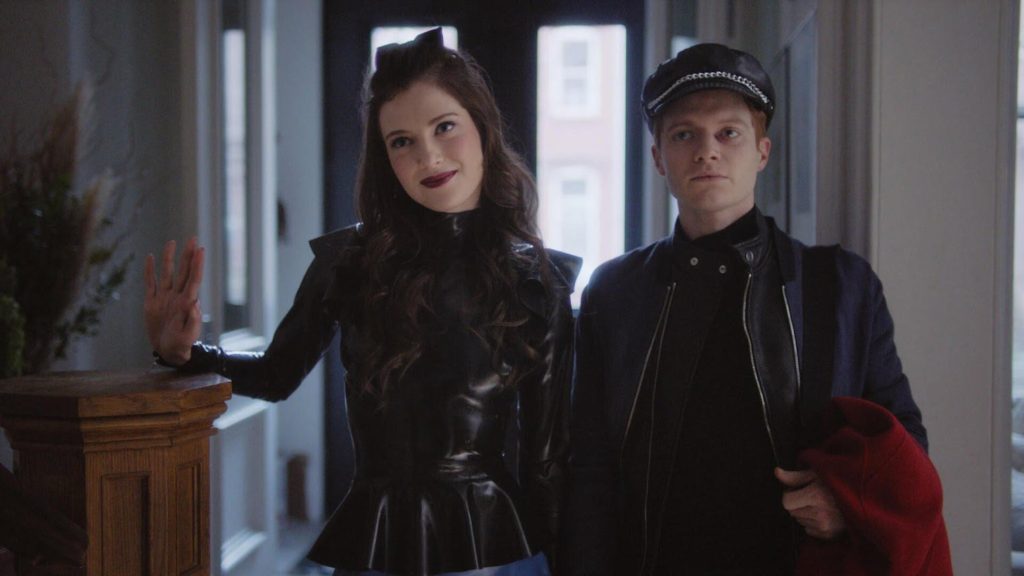
Bonding has a fairly simple premise. Tiffany is a grad student who works as a dominatrix under the alias of Mistress May to pay the bills. Pete, her gay best friend, serves as her initially reluctant assistant. Most of the episodes center around their work in Tiffany’s dungeon, though we do learn a lot about their personal lives over the course of the season.

The show is largely carried on the chemistry of leads Zoe Levin and Brendan Scannell. The angsty millennial trope is well played out in comedy, but Levin and Scannell are charming enough in their interactions to put aside the clichés. The show has a heavy helping of absurdist humor, often leaving the audience cringing as the credits start to roll.

Fifteen-minute episodes don’t leave a lot of time for character growth, but Bonding does a fairly good job of giving its leads something to build toward over the course of the season. The individual episode plots are generally pretty entertaining, a strong blend of absurdist and cringe comedy. The narrative occasionally stumbles over its own ambition, but it doesn’t really have any filler either.

Those looking for an accurate portrayal of BDSM should definitely look elsewhere, a point perhaps best illustrated through Mistress May’s ill-fitting corset. Mistress May’s own understanding of BDSM doesn’t come across as particularly professional either, something that will undoubtedly turn off a lot of viewers. The show does often look like it would benefit immensely from additional perspectives from those in the sex worker community to give it a sense of realism.

Powered by two strong lead performances from Zoe Levin and Brendan Scannell, Bonding is a succinct new comedy with a ton of heart. Each episode could be double its runtime and the seven-episode season might still not feel like enough. The whole flies by in the blink of an eye, a refreshing change from the sheer amount of shows that drag their feet with needless exposition. It’s better to leave viewers wanting more than to drain away any desire to continue by the time the final episode credits start rolling. Bonding has a few kinks of its own to work out in subsequent seasons, but its freshman effort was a very enjoyable one.

Wednesday

1

May 2019

0

COMMENTS

Avengers: Endgame’s Gay Moment Is an Insult to the Notion of Progress

Written by , Posted in Blog, Pop Culture, Social Issues

Note: This article contains minor spoilers for Avengers: Endgame

Like many, I enjoyed Avengers: Endgame. The movie was a well-executed send-off to the first era of the Marvel Cinematic Universe. Unfortunately, directors Joe & Anthony Russo decided to include a moment of seeming LGBTQ inclusion that highlighted the broader diversity issue that has hovered over the MCU for much of its existence.

If you missed Endgame’s gay character, it’s probably because he wasn’t on the screen for very long. The character, nameless in the film, appears in the grief counseling session with Captain America, where he mourns the loss of his lover. This character just happens to also be played by Joe Russo himself, an openly gay man. The MCU’s first cinematic gay character (there have been a few on TV) appeared via blink-and-you-miss-it cameo.

What are we supposed to celebrate about that? Joe Russo gave a lengthy explanation to Deadline, saying, “It was important to us as we did four of these films, we wanted a gay character somewhere in them.” Apparently, the “somewhere” in this broad multi-film landscape is more in the vein of Where’s Waldo than as a matter of genuine, thoughtful inclusivity.

Russo also added that, “It is a perfect time, because one of the things that is compelling about the Marvel Universe moving forward is its focus on diversity,” perhaps highlighting the core issue with this creative decision. He’s correct to note that Marvel has made significant improvements on the diversity front. It was only last year that we got Black Panther, the MCU’s first film with a predominantly black cast. It’s only been a few months since Captain Marvel became the first in the MCU to have a female lead.

While it’s clear that Marvel is becoming more inclusive, how much praise Disney deserves for that is an entirely different question. Black Panther and Captain Marvel are the eighteenth and twenty-first entries in the series respectively. It’s hard to call Marvel trail-blazing when it took that long to cast someone other than a white man in the lead role. Now isn’t really “a perfect time,” as Russo notes, considering the rather needlessly long route Disney took taking diversity seriously.

Russo’s sense of self-gratification for his cameo appearance as a nameless sad gay man comes across strikingly tone-deaf for a franchise that hasn’t found space for a single other LGBTQ character in its near-two dozen films. It is, quite literally, the least he could do while still being able to say he did anything at all. The idea that this moment should receive praise is utterly laughable.

It would be unfair to suggest that Joe Russo alone could force Disney to add an inclusive superhero against their will. The Russo brothers may be responsible for directing a few of the most profitable films in history, but that doesn’t mean they have complete autonomy over their work. Joe Russo’s personal success is a great story for the LGBTQ community at large and it’s a good thing that people like him occupy positions of power in a place like Disney.

Simultaneously true is the notion that Joe Russo has not brought meaningful LGBTQ inclusivity to the MCU, at least not yet. The best he could do from his great position of power is to include himself in a throwaway cameo appearance. We can understand why these circumstances exist, but we shouldn’t celebrate these pathetic attempts at forward motion either.

Massive corporations like Disney forces LGBTQ fans to embrace a culture that fundamentally rejects the normalcy of our existence. I’ve visited Disneyland over a dozen times this year, treated with respect by their staff on almost every single occasion in that timespan. It is one of my favorite places on the planet earth, and yet that’s also a place where I can’t find a single character who looks like me, a transgender woman in a homosexual relationship.

Of course, I don’t have to support a corporation that does stuff like this. I could divorce myself from a mass culture that projects inclusion through events like “Magical Pride,” but keeps LGBTQ characters locked away, the storytelling equivalent of “Don’t Ask, Don’t Tell.” I hardly belong to the only marginalized group that’s been shunned by Disney over the years.

I could let my inner Disney princess go and move on with my life, but I also genuinely believe that popular culture matters. These stories make profound impacts on people’s lives, from children to adults. Look at the reactions to Endgame. People weep in theatres over the loss of fictional characters. There is, in fact, magic in the air.

Movies like last year’s Love, Simon, distributed by a studio recently bought and shuttered by Disney, are important because they help show a generation of LGBTQ youth that there’s nothing wrong with who they are. Gay kids deserve stories that empower them, not ones that try and ignore their very existence. Cameos like Russo’s only seek to shed light on Disney’s failure in this regard.

There will come a day, likely in the next few years, when the MCU finally features a gay superhero. Such a moment will undoubtedly be cheered as progress, just as Joe Russo wishes to celebrate Avengers: Endgame’s gay moment. Disney didn’t introduce a single noteworthy gay character in the first twenty-two movies of the MCU. Anything above that is a step forward, but that doesn’t change the embarrassing legacy of Marvel’s pathetic effort at LGBTQ inclusion. Table scraps aren’t a cause for celebration.

Monday

29

April 2019

0

COMMENTS

Game of Thrones Season 8 Recap: Episode 3

Written by , Posted in Blog, Game of Thrones

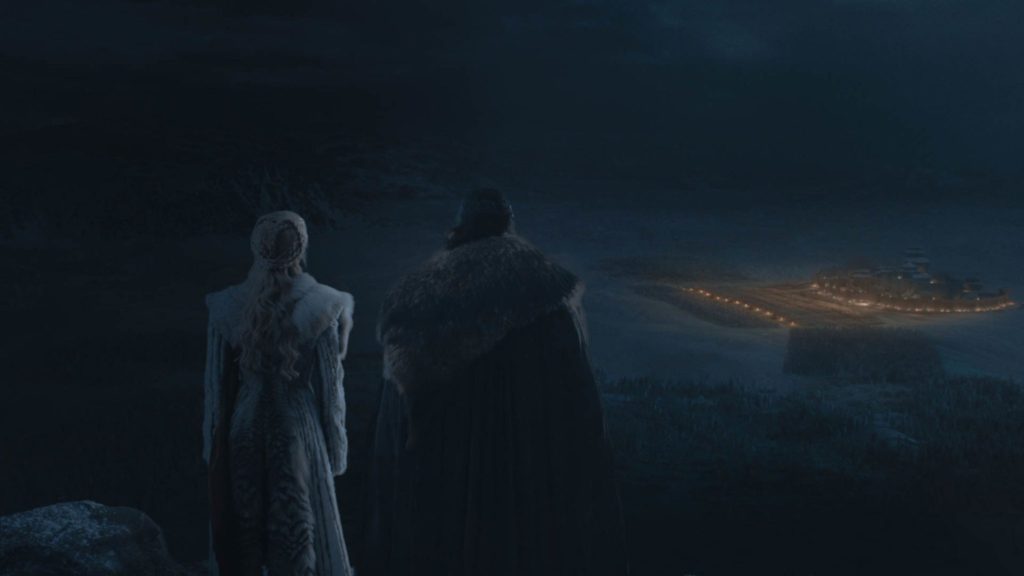
The Battle of Winterfell happened, in case you couldn’t tell because of how dark it was. Funny how this was the third big battle the show has done, but for some reason “Blackwater” and “The Watchers on the Wall” both managed to put some extra torches around. You know, for people to actually be able to see what’s going on.

Why is a battle that takes place at the Wall far less blurry than one at Winterfell? The dead might not need to see, but the living sure do. Doesn’t seem like the front line had any sort of a plan until Melisandre showed up to work some R’hllor magic on their hardware.

Why did the Dothraki charge into the abyss? How did Ser Jorah make it back alive after the first wave? How did all those main characters survive the big attack, R.I.P. Dolorous Edd of course. Does Daenerys have more than a dozen troops left?

That battle was bad. It was boring, hard to see, and lacked a sense of narrative drive behind its various sequences. A viewer could, of course, follow along, but too often the characters seemed to be going through the motions, until the time came for them to do something out of left field.

Last episode really could have used a scene where the characters explain how the battle is supposed to unfold. That doesn’t mean this episode needs to actually follow the plan, but it would’ve made Jon & Dany’s dragon ride seem a little less spontaneous. I’d say maybe they were looking for the Night King, but the part of the plan that we do know involved luring him to to the Godswood. Why were they flying around instead of covering their own troops? Who knows.

The Arya library scene, in particular, reeked of something the writers thought would be cool, so they threw in a whole suspense sequence right in the middle of a battle for the entire north. Where was everyone else? It’s not even a bad scene, but one that felt weirdly out of place as the entire castle was being overrun.

Did we need that scene in the crypts where Sansa complains to Tyrion about Dany? The show’s been trying to sell the Starkgaryen feud for three episodes now, but it’s simply not that compelling. Obviously there needs to be some kind of drama for the remaining episodes, but it’s been a hard sell with the whole potential end of the world looming.

The crypts turned out to not be a very safe place to hide. I get that no one really wanted to bring up the idea of burning all the old Stark corpses, but the carnage was utterly predictable. Very surprised that Varys survived.

Poor Beric. He died a noble, predictable death. Book Beric has been dead since just after the Red Wedding, so it’s been good to have some extra time with the character. He can be with Thoros now.

Ser Jorah is dead!!!! Finally. Longtime readers of these recaps know how much I hate that creepy disease-riddled pervert. It’s too bad we never got to see ice zombie Jorah so someone could have killed him again. Seeing Dany’s tears of joy over not having to deal with his nonsense anymore was my favorite part of the episode.

Lyanna Mormont had the saddest death. The breakout star of season six went out with a bang, taking a zombie giant down with her. Too bad she won’t be around to become Hand of the Queen when Sansa takes the crown from her odious brother/cousin.

Theon has never been one of my favorite characters, but Reek got an ending that was fitting for his character. His last hurrah fell kind of flat, but so did that whole sequence. At least his storyline got a sensible conclusion.

Arya snuck pasts hundreds of white walkers to catch the Night King by surprise! Great moment, sure. Great writing, absolutely not. The whole Godswood scene fell pretty flat, perhaps suffering under the weight of all the hype. I’m glad Arya got to be the one to stick him with the pointy end, but I’m also oddly glad that it’s over.

Sam looked pretty dead, but maybe he was just hiding in the dead bodies. Jon battling zombie Viserion while all the major characters fought to their last breaths made for some great cinematography, but it is a bit weird to think that all the major players from that sequence ended up surviving. The death count did kind of look a little low by the end of things.

Melisandre finally got her time to shine, even if it involved dying in the snow after removing her jewelry. For a character the show hasn’t known what to do with since she brought Jon back, Mel’s sendoff was pretty well-executed. It was a weird choice to try and tie in all the Arya/Mel stuff from season three, but it was pretty enjoyable to watch.

Episode three was preceded by two full episodes dedicated to building up the battle. Half of the entire final season was given to making sure this battle made TV history. That’s a lot of stock to put into one battle where no one seemed to have a clue what was going on. The setup ended up being far better than the execution.

The final battle with the ice zombies was always going to have to deal with a lot of hype. It’s something we’ve pretty much known about since the prologue of A Game of Thrones more than twenty years ago. That’s a long time to wait for something that ended up being basically a riff on The Phantom Menace’s ending, blowing up the Night King control ship to destroy the battle droid ice zombies.

While this probably isn’t going to be the last battle of the whole show, it was hyped up as the big one. It might have been the most expensive TV battle ever shot, but it wasn’t a particularly good one. It’s a good thing the writers realized Cersei made for a much better villain than the Night King, because it’s up to her to get the season back on course. Hopefully she gets some elephants. Something needs to live up to the hype.

That’s it for this week. If you’re looking for more Game of Thrones coverage, you can check out my new podcast’s recap tomorrow. See you next week!

Monday

29

April 2019

0

COMMENTS

War and Peace Remains One of Cinema’s Crowning Achievements

Written by , Posted in Blog, Movie Reviews, Pop Culture

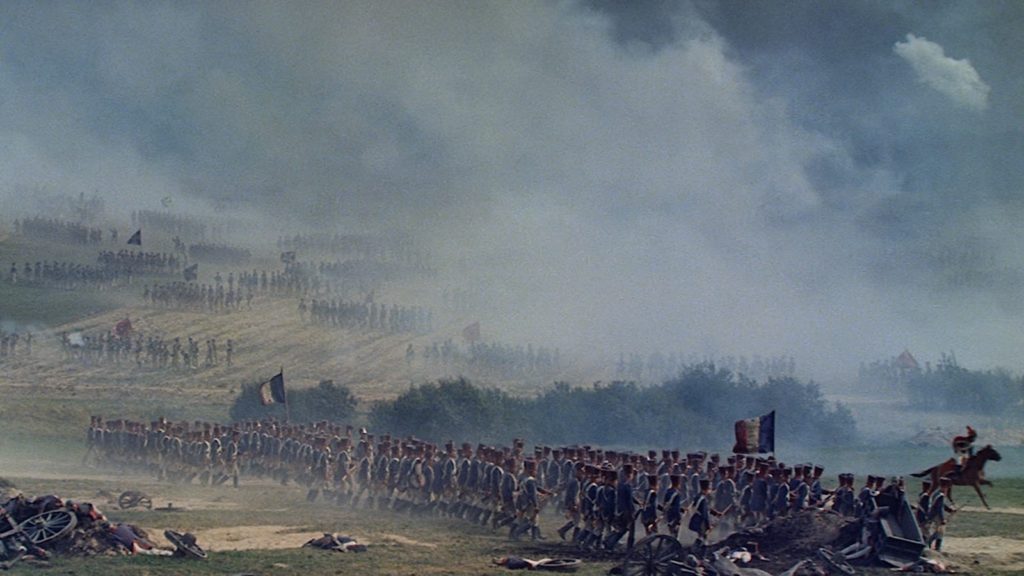
There are many ways for a reader to approach a massive text such as War and Peace, but I tend to recommend the method I used. By shooting for a hundred pages a days and accepting that I’d often miss that mark, I made it through Tolstoy’s magnum opus in eighteen days. The chance to see the remastered four-part Sergei Bondarchuk version screened in its entirety on a single day appealed to me as someone who got through War and Peace through total immersion in the material. The story is not so much consumed as absorbed, an adventure that’s never truly over because the characters feel too real to ever fully fade from memory.

The seven-hour runtime covers a surprisingly small portion of Tolstoy’s epic, instead concentrating its attention on the major events throughout the text. Appropriately titled, the four parts largely center around Count Pierre Bezukhov, Prince Andrei Bolkonsky, Countess Natasha Rostov, as well as the War of 1812, which takes up much of the book’s second half. As a result, the philosophical journeys that Pierre and Andrei embark on are considerably condensed, and the stories of supporting characters such as Princess Marya Bolkonskaya, Count Nikolai Rostov, Sonya, Denisov, and Antole Kuragin receive only minimal attention. While it’d take a few seasons of a TV show to adequately cover all the major plotpoints of the book, it is certainly interesting to see that even one of the world’s longest films can’t fully encapsulate one of history’s longest celebrated novels.

The film itself is nothing short of a masterpiece. The sets are gorgeous and elaborate, from the grand balls to the expansive battlefields. The actors give immersive performances that highlight the personal growth of their characters over the few years of the narrative. Not only does Bonarchuk direct all four parts, he also plays a lead role as Pierre, bringing out the complexities of the good-hearted buffoon trying to make the most of circumstances seemingly always beyond his control.

While Pierre’s coming of age story is the most palpable of the three leads, Prince Andrei’s journey is a far more reserved transformation as he grapples with the beliefs he’s grown up with, rejecting the grand ambitions instilled by his father. Vyacheslav Tikhonov manages to capture the essence of Andrei’s journey without the benefit of the narrator’s eloquent depiction of his internal struggle. Film Andrei is undoubtedly less likable than his book counterpart, but Tikhonov puts so much emotion into his performance that you can’t help but feel compelled by his journey.

Having the least to do with war of the three major characters, Natasha doesn’t get as much screen time in War and Peace, but Ludmila Savelyeva gives perhaps the most compelling performance of the entire film. Her Natasha is so vibrant and full of life, contrasting tragically with the horrors that war brought to the characters’ doorsteps. Savelyeva brings out in the innocence in Natasha, grasping to understand why her vision of the future had to be senselessly altered by acts seemingly contradictory to human nature.

As much as War and Peace embodies the very definition of the word epic, the film is often at its most powerful in the quieter moments. Singular events are not as important as the broader effect that follows, something continually on display as Pierre, Andrei, and Natasha try to make sense of the world around them. Beautifully showcasing rural Russia, the film often uses its lush scenery to highlight the contemplative thoughts of the narrator. Tolstoy’s commentary throughout the book serves essentially as a character in its own right, and the film does a good job incorporating the spirit of the text’s broader philosophy into its overarching narrative. So much happens in seven hours, but Bondarchuk constantly makes sure that his viewers have the time to fully take it all in.

The restoration is absolutely beautiful. The film is crisp and clear, as if it was plucked out of time only yesterday. Up on the big screen, it evokes just about every emotion the human soul is capable of experiencing over the course of its runtime, an adventure that, while tiring, never letting go of one’s attention.

The 2019 remastered version of War and Peace offers a singular cinematic experience, a profoundly moving theatrical tour de force. Seven hours might be a lot of time to commit to sitting in a single seat, but there’s simply nothing else like it out there. This restoration carefully enhances one of the greatest films in history, an adventure well-worth making the time to see on the big screen.

Saturday

27

April 2019

0

COMMENTS

Tater Tot & Patton Is a Moving Exercise in Indie Minimalism

Written by , Posted in Blog, Movie Reviews, Pop Culture

The indie genre has developed quite a few clichés over the past few decades. The subject of grief often meets its match by the two-pronged approach of quirky love interests and a mellow score. Tater Tot & Patton exhibits much of the typical fare you’d expect from the indie genre, but the film finds a quiet sense of grace in its minimalistic narrative.

Tater Tot & Patton starts off in that same manner as many indie films. A millennial is sent to live in a small country town to find that things are not quite as glamorous as big city living. Andie, aka Tater Tot, can’t find cell service, Wi-Fi, or even a fresh vegetable. Turns out South Dakota doesn’t share all that much in common with Los Angeles.

Her uncle Erwin, aka Patton, is a simple man. He likes beer. He doesn’t like technology and certainly doesn’t understand why a young woman wouldn’t want to eat baked beans for every meal. His wife is in the hospital, leaving Erwin and Andie on their own to deal with each other in spite of their differences and their addictions.

Most of the film is set on Erwin’s farm, with the interactions between Erwin and Andie making up the bulk of the narrative. Jessica Rothe and Bates Wilder each give compelling performances in the title roles, keeping things interesting throughout the ninety-minute runtime. Despite having only two other characters with actual names, you never really get tired of Tater Tot & Patton’s interactions. The two actors work very well together and director/screenwriter Andrew Kightlinger made a smart decision to largely let them handle the narrative.

Kightlinger also makes great use of the South Dakota setting, using the natural beauty of the sparse locations as a perfect companion for his minimalist cast. We don’t get a ton of insight for what’s driving Andie’s demons, but it’s easy to feel for her frustration with being out in the middle of nowhere with no sense of forward motion. Kightlinger’s obvious affection for the state shows, highlighting it in the narrative without forcing any of the typical clichés the media likes to toss around regarding the Midwest.

There are, however, plenty of other clichés in the narrative. While the lead actors give strong performances, there’s little either can do to change the simple fact that they’re essentially playing stock characters from any run of the mill indie movie. Andie is a self-centered millennial seemingly lost without her phone and Erwin is pretty much that emotionally detached awkward uncle no one wants to sit next to at Thanksgiving dinner. There’s also the weird sense of destiny that brought these two damaged people together to “fix” each other that’s certainly been played out by countless other films.

Despite a few narrative issues, Tater Tot & Patton is certainly worth a watch if you’re a fan of indie movies. It hardly breaks new ground in the genre, the film sustains itself off two strong lead performances and stellar production values. Too many movies try to overstuff their runtimes, but Tater Tot & Patton finds power in the quiet moments, perhaps a timely movie for an era where everyone seems to be moving a mile a minute.

Saturday

27

April 2019

2

COMMENTS

Avengers: Endgame Sends the First Era of the MCU off with a Bang

Written by , Posted in Blog, Movie Reviews, Pop Culture

Even with a three-hour runtime, Avengers: Endgame set out with goals that seemed impossible to accomplish within a single film. The twenty-second installment in the Marvel Cinematic Universe had to provide satisfactory conclusions for not only the storyline left unfinished with last year’s Infinity War, but also the broader Infinity Saga arc as well as those belonging to many of the original Avengers. This film was the moment the whole connected universe spent over a decade building toward.

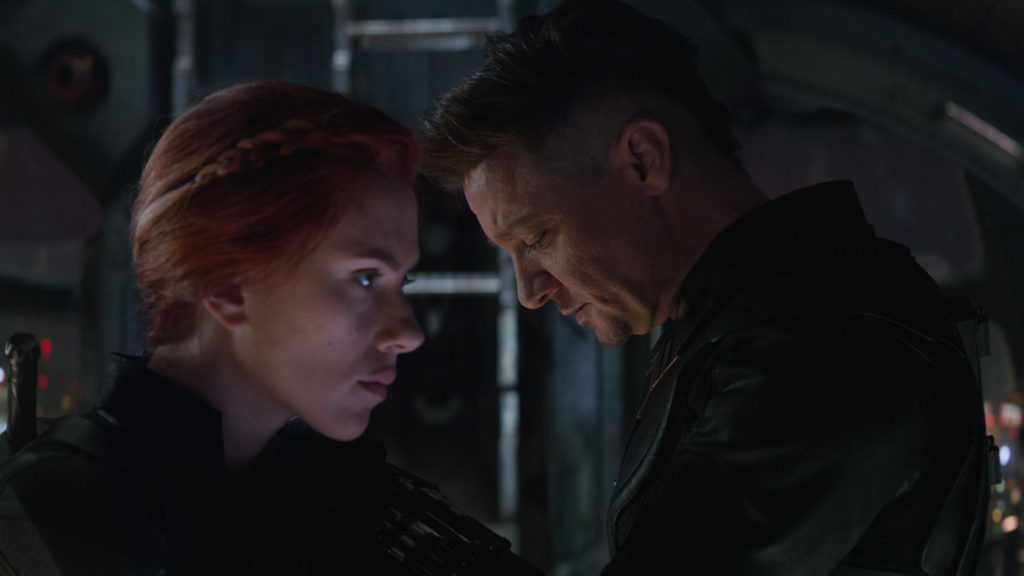
With those intentions in mind, Endgame gives the most attention to the heroes that built the franchise. Captain America, Iron Man, Thor, the Hulk, Black Widow, and the recently returned Hawkeye all get plenty of moments to shine. This being the end of the era, departures were certainly expected, and Endgame functions well as a conclusion to their narratives without necessarily forcing any arbitrary reunions.

As for the snap, well, no spoilers on that front. With the programming announcements for the upcoming Disney+ service and trailers for Spider-man: Far From Home all over the internet, it shouldn’t come as much of a surprise to hear that the characters expected to lead the MCU going forward aren’t necessarily going to remain dust. Endgame isn’t their movie, though.

As promised at the end of Infinity War, Thanos does return. The purple menace plays an unexpected role in Endgame, not as ever-present as he was the last time around, but the film deploys him in a way that will seem especially fitting to longtime MCU fans. A movie with a title like Endgame wouldn’t feel complete without an epic battle for the ages, and the film includes many of the franchise’s best action sequences.

Perhaps the most impressive thing about Endgame is the way it managed to incorporate so many elements from its twenty-one predecessors. There have been dozens of lists highlighting which movies are important for casual fans who haven’t seen them all, but Endgame has some throwbacks to some ones that many have written off as unnecessary to watch. That’s not to say that you need to go back and watch all the ones you’ve missed in order to follow along, but hardcore MCU viewers will be rewarded with numerous throwbacks.

The three-hour runtime is a challenge to one’s bladder, but the movie itself flies by in the blink of an eye, or perhaps more appropriately, the snap of the finger. The pacing isn’t quite as frantic as Infinity War, which had to juggle a much larger cast, but there’s surprisingly little downtime. If anything, the film could have actually benefited from a few more quiet scenes with the original Avengers, but it’s hard to say that Endgame didn’t make the most of every minute.

Endgame is a spectacular conclusion to the Marvel Cinematic Universe’s first era. The notion of such a complex story spread out over twenty-two films is pretty impressive, but Endgame ups the ante by serving as a fitting ending to just about every corner of that connected franchise. The MCU will live on with plenty of superheroes around to carry the torch, but it’s hard to imagine anything coming close to the sheer magnitude of Endgame’s ambitions.

Wednesday

24

April 2019

0

COMMENTS

A Ranking of Every Ride at Disneyland

Written by , Posted in Blog, Pop Culture

Disneyland knows how to give people a good time. You don’t earn the moniker, “the happiest place on earth” without doing at least a few things right. From the parades to the costumed characters to the delectable desserts, there’s so much to do in Disneyland, but one element of the park experience reigns supreme above all others: the rides.

There are many great rides at Disneyland. While it’s pretty hard to fit them all in a day, perhaps even harder was the effort to rank them all in a cohesive manner. This list attempts to do so, providing a complete ranking of every ride Disneyland has to offer.

While any list like this one carries with it a fair degree of subjectivity, it was compiled with every attempt made to use a consistent rubric for each ride. A roller coaster, of course, differs in experience from a traditional dark ride, but each attraction leaves visitors with a certain sense of satisfaction for having ridden it. However quantifiable a concept like “wonder and awe” is remains to be seen, but this list represents an effort to gauge the satisfaction garnered from each ride, irrespective of ride type.

This list does not take external factors such as average wait time, Fastpass availability, or sentimental value into consideration. I encourage to share your thoughts on the ranking in the comments section. We’ve also recorded a three-part companion series on my podcast, Estradiol Illusions, to break down each selection. A separate ranking for the rides in California Adventure will be released next month.

Note: This list will not be updated to include either ride from Galaxy’s Edge until at least a year after their opening. Given that most Disneyland rides are well over a decade old, it seems fair to give both Smuggler’s Run and Rise of the Resistance time to have their merits properly evaluated.

All pictures taken by Ian Thomas Malone

Honorable Mentions

The Enchanted Tiki Room

As someone who loves visiting The Enchanted Tiki Room, I thought long and hard trying to come up with a reasonable rationale to justify including it in the official ranking. Of all the shows throughout Disneyland, it feels the most like an actual ride, possessing a wait time rather than a set show time. Dancing along to the numerous catchy songs is an experience that closely mirrors Star Tours, with the only substantive difference being the absence of any mechanical force propelling the motion.

Trouble is, any case you could make for The Enchanted Tiki Room’s inclusion on the list essentially also holds true for Great Moments with Mr. Lincoln, which decidedly feels more like a show than a ride. For that reason, The Enchanted Tiki Room has been kept off the official ranking, though the singing birds of Adventureland are always worth a visit, preferably with a Dole Whip in hand.

Main Street Vehicles

The inclusion of the Disneyland Railroad and Monorail set the pretext for the inclusion of the Main Street Vehicles on the official rankings, but a few issues precluded the Jitney, Omnibus, Fire Engine, and Horse-Drawn Street Car from truly qualifying for the list.

If we accept the definition of an amusement park ride as a mechanical device that carries passengers along a fixed route or course for the purposes of enjoyment, all four Main Street vehicles are essentially disqualified. The only one to explicitly follow a fixed route is the Horse-Drawn Street Car, pulled by an animal rather than a machine. The other three follow the same loop, but not on rail. The Fire Engine, for example, could make a turn and drive down Adventureland if it wanted to, which it obviously doesn’t, but the mere ability to do so sets it apart from the attractions listed in the official ranking.

The Rafts to Tom Sawyer Island

The question of whether the Rafts to Tom Sawyer Island should be classified similar to the Main Street Vehicles or their fellow inhabitants of the Rivers of America boiled down to authenticity. Unlike the Mark Twain Riverboat and the Sailing Ship Colombia, the Rafts do not follow an underwater rail. Instead, they’re manually operated by their operators. As such, they better qualify as transportation than as actual rides.

Tom Sawyer Island has its fans, especially young children who are the appropriate size to venture into the caves. The 2007 remodeling, which added Pirate’s Lair based on Pirates of the Caribbean, gave the island a broader connection to the Disney lore. For first-time park-goers, it’s hard to recommend visiting Tom Sawyer Island with so much else to do, but on an especially crowded day, it’s not a bad way to spend an hour.

Dishonorable Mentions

Davy Crockett‘s Explorer Canoes

You won’t see the canoes in the picture because you probably won’t see them in the park either. Davy Crockett’s Explorer Canoes are almost never open. The attraction is also powered by human labor, disqualifying it from the list even if it was open.

Unless you want to be splash by someone’s oar, or disappointed by the people who won’t row their paddles, Davy Crockett’s Explorer Canoes should be avoided at all costs. The real Davy Crockett would assuredly have been disappointed by the state of his attraction. A Disneyland original, Davy Crockett’s Explorer Canoes has been intermittently open since 1955, providing a mediocre experience to generations of park visitors.

Tarzan’s Treehouse

Guaranteed to leave your knees feeling creakier than if you took a ride down Matterhorn Mountain, Tarzan’s Treehouse is among the most skippable attractions in the park. While some Disneyland purists might still lament the loss of its predecessor, The Swiss Family Treehouse, my personal ill feelings are typically reserved for days when the park is so crowded I feel compelled to make the trek up all those stairs.

The treehouse itself is a pretty good recreation of the one from the film, complete with a few throwbacks to its Swiss Family predecessor. While the attraction does a decent job trying to tie itself to its source material, it’s hard to recommend for any reason other than needing to kill time before an Indiana Jones Adventure Fastpass starts. The Hong Kong Disneyland version is situated on its own island, quite cooler than the California setting.

The Disneyland Ride Ranking

31. Sailing Ship Colombia

If you get a chance to ride it, Sailing Ship Colombia provides a very pleasant journey around Tom Sawyer Island. Trouble is, it’s almost never open, usually anchored in its spot near The Haunted Mansion. Originally opened in 1958, the Colombia’s biggest role nowadays seems to be as part of the Fantasmic! Show. The Colombia isn’t a bad way to explore the Rivers of America, but don’t expect to be able to actually go aboard.

30. Disneyland Monorail

The first monorail system to operate on a daily basis in the entire Western Hemisphere, the Disneyland Monorail has been in operation since 1959. The monorail gives visitors a ton of great views of the park, but it has limited usefulness as a transportation vehicle. Unlike the elaborate monorail tracks throughout Walt Disney World, Disneyland’s version only has stops in Tomorrowland and Downtown Disney.

29. Autopia

Young children who grew up going to Disneyland may have a special place in their hearts for Autopia, which offered many their first chance to get behind the wheel. For just about anyone else, the whole ordeal is a tedious slog through an unremarkable section of the park while the smell of gasoline fills the air.

Autopia offers multiple tracks, giving passengers plenty of theoretical reasons to return that diminish once you’re freed from the slow-moving hell. The ride doesn’t offer the driver enough control or excitement to be an improvement on the standard carnival bumper-cars. As such, it’s best value likely comes from the photo-opportunity at the beginning of the ride, perfect for an Instagram picture that no one will ever be jealous of.

Though the signs say to not bump the car in front of you, the prospect of a slow speed collision is about the only thrill Autopia has to offer. A Disneyland original, Autopia certainly holds some nostalgic value to longtime super-fans, but longevity is hardly enough to save it from the bottom of the list.

28. Finding Nemo Submarine Voyage

Nemo-aficionados will surely be angry by the low ranking, but the Submarine Voyage is among the most unpleasant experiences Disneyland has to offer that doesn’t involve a turkey leg. The dank smell of the submarines is enough to make one nauseous without the prospect of a nearby passenger who forgot deodorant. The ride covers an extensive amount of Nemo lore, but there’s something wrong about the idea of viewing cartoon fish underwater. The viewing windows are small and often dirty, giving riders a view of various algae-riddled sculptures underwater.

Submarine Voyage is the rare ride that is ill-served by its long length, as the air inside grows stale quite quickly with 40 passengers a vessel. While the submarines have been a fixture at Disneyland since 1959, Nemo enjoys far superior attractions at Epcot, which includes real fish, and at Tokyo Disneyland. Young children may enjoy the sight of Nemo, but the claustrophobic submarines offer little joy to just about anyone else.

27. King Arthur Carrousel

Carrousels occupy a special place in Disney lore, as the Griffith Park merry-go-round in Los Angeles served as inspiration for Walt Disney to create Disneyland itself. It seems only natural that the King Arthur Carrousel would occupy a place of prominence in Fantasyland when the park opened in 1955.

As far as rides go, it’s easy to dismiss the King Arthur Carrousel in a park full of attractions you can’t find anywhere else. The carrousel’s central location and fast-moving line make it a quick enjoy experience, especially if you’re lucky enough to have the Pearly Band on board playing live music. On an especially crowded day, it also gives one a great view of all the slow-moving lines, full of people who probably wish they were also riding the carrousel.

26. Gadget’s Go Coaster

For those of us who grew up with The Disney Afternoon, there’s something special about the idea that Disneyland still possesses a ride based off a television show from that era. Many of Disneyland’s youngest attendees may not have a clue who Gadget is, but the inventor extraordinaire from Chip n’ Dale: Rescue Rangers still has a place in the park with her junior roller coaster. How much longer it stays open remains to be seen, as it’s hard not to look around the dilapidated grounds it sits on and think the ride is part of the park’s long term plans.

Clocking in at 44 seconds, Gadget’s Go Coaster is the shortest ride at Disneyland. As far as rides geared toward young children go, it provides a great introductory experience to roller coasters, with a couple sharp turns that will get young thrill seekers in the mood for Big Thunder Mountain. The long lines it tends to accumulate diminish its value as a nostalgia ride for older fans who grew up with The Disney Channel, but the chance to take one’s children on adventure originally geared to them is an experience Toontown is able to deliver in abundance for millennial parents.

25. Disneyland Railroad

Rather appropriately, the Disneyland Railroad is the definitive rail experience the park has to offer. In a park full of trains, this is the only one that can be used to provide practical transport, with four stops conveniently located around the park. Beyond just merely being a good way to get around, the Disneyland Railroad also features several dioramas, including the Audio-Animatronic dinosaurs from the 1964 New York’s World Fair. My personal favorite part of the trip is when the train passes through Splash Mountain, offering passengers a great view of the critters singing “Zip-a-Dee-Doo-Dah.”

Tip: If you’re looking to ride the railroad at night, the Toontown and Tomorrowland stops are the way to go as they’re far less crowded than Main Street and New Orleans Square.

24. Mark Twain Riverboat

Unlike the Sailing Ship Colombia, the Mark Twain Riverboat makes voyages around the Rivers of America on a consistent basis. A Disneyland original, the Riverboat is a great way to get some spectacular views of the park while enjoying a relaxing boat ride. The narration can be a bit annoying, praising the beauty of nature while sailing around an artificial river, but there’s a good chance you’ll see some real-life ducks swimming around.

23. Astro Orbiter

Essentially a faster version of Dumbo the Flying Elephant, one could argue that the Astro Orbiter is the better ride. The Astro Orbiter does take passengers higher up in the air than Dumbo, but there’s something decidedly not as fun about spinning around in a vessel that isn’t a cute elephant. The view from the Astro Orbiter certainly isn’t as good, offering a glimpse at Main Street and the section of Tomorrowland in between Star Tours and Buzz Light Year Astro Blasters. Unless there’s a parade going on, there simply isn’t as much to look at as Dumbo’s Fantasyland perspective.

Astro Orbiter occupies a unique place in Disney-park lore, with six separate versions built around the world, though Tokyo Disneyland’s closed in 2017. Disneyland’s version is actually the fourth oldest, only built in 1998, giving it a far less important place in the park’s history than its Magic Kingdom counterpart. It might do a better job spinning you around in a circle than Dumbo, but that doesn’t necessarily make for a more worthwhile experience.

22. Mad Tea Party

A staple of practically every Disney park, the Mad Tea Party is one of Fantasyland’s definitive experiences. For many, the magic of Disneyland is best encapsulated in the ability to spin around in teacups as fast as you possibly can.

While not as thrilling as many other rides, the Disneyland original remains a classic that must be enjoyed at least once. Disneyland’s version differs from its successors in not having a roof, which renders the ride inoperable in the rain. My heart goes out to all the nausea-prone parents who have had to ride aboard a cup piloted by their adventurous children, determined to spin the cup to its max.

21. Dumbo the Flying Elephant

A Disneyland original, Dumbo is as iconic as it is unremarkable. Countless parents have waited upwards of an hour to spin around in a circle for a few minutes. The ride does offer a spectacular view of Fantasyland, but Dumbo is only worth riding for either nostalgic purposes, or because you have a young child who wants a ride in the adorable elephant.

20. Buzz Lightyear Astro Blaster

Call me lazy, but part of the joy of a ride is not having to do anything for your thrills. With Buzz Lightyear Astro Blasters, the experience is largely decided by one’s ability to shoot a laser at the ride’s many targets. The attraction is actually a pretty good dark ride, capturing the spirit of the underrated if not largely forgotten Buzz Lightyear of Star Command TV series that aired in the wake of Toy Story 2.

It’s hard to criticize the accuracy of the blaster without inviting claims of mere incompetence, but regardless, the ride is hardly worth the long lines it often accumulates. Disneyland’s version debuted in 2004, six years after the Magic Kingdom’s original. The California take is vastly superior, with a lot more dialogue and blasters that can be removed from their mount, but Astro Blaster is one of the more skippable rides in the park and easily its weakest attraction to offer a Fastpass.

19. Casey Jr. Circus Train

Right out of Dumbo, Casey Jr. Circus Trains comes roaring down the track to take visitors on an enchanted journey through Storybook Land. For those who want to experience the miniatures from a more vertical angle, or simply don’t want to wait in the Canal Boat line, Casey Jr. offers a great alternative perspective of all the scenery. The first half of the ride is hands-down the best as you can sing along to the title song while taking in all the views.

There are a few choices of seating to pick from. The monkey cages tend to go first, a favorite for young children. My personal favorite spot is the back of the caboose, which gives you a completely unobstructed view of Storybookland as well as the broader Fantasyland. Most certainly not just a children’s ride, grab your lemonade and cracker jacks, because Casey Jr.’s back!

18. Pinocchio’s Daring Journey

Fantasyland’s youngest dark ride, Pinocchio’s Daring Journey was added in 1983 as part of a larger overhaul of the area. It’s a pretty cute ride that covers an extensive chunk of the Disney classic. Pinocchio’s Daring Journey also has some of the park’s best Audio-Animatronics, including Lampick’s transformation into an adorable sad donkey.

Sadly, unlike Snow White’s Scary Adventures or Mr. Toad’s Wild Ride, Pinocchio’s Daring Journey doesn’t include a needlessly terrifying scene in a forest or an idiosyncratic trip through Hell. The ride is a Disneyland exclusive in North America, with additional versions in Disneyland Paris and Disneyland Tokyo. The line rarely gets too long, making it a worthwhile experience through one of Disney’s most iconic films.

17. Storybook Land Canal Boats

On the purely adorable scale, Storybook Land Canal Boats rivals it’s a small world for cutest ride in the whole park. The boat voyage through miniature recreations of many of Disney’s beloved classics is always a magical experience. Covering an eighty-year stretch of Disney history from The Three Little Pigs to Frozen, the Storybook Land Canal Boats has something for fans of all ages to enjoy. My personal favorite is the Toad Hall, complete with Mr. Toad’s famous motorcar.

Unlike the Jungle Cruise, the Storybook Land guides rarely ad-lib, reciting a relentlessly upbeat script that starts to sound eerily similar to state-run propaganda the more you hear it. The ride queue is a strong contender for worst in the park, an overly cramped slow-moving slog made much worse by unavoidable eavesdropping and nearby body odor.

Despite the peripheral issues, Storybook Land Canal Boats is an adorable ride that shouldn’t be missed, especially since its only other version resides in Disneyland Paris. The Paris version includes its own eclectic mix of miniatures from a wide spread of the Disney canon and doesn’t include guides, leaving the question of which is better up for debate.

Tip: If you ride at night, the audio from the guides is a bit harder to hear and you’ll also see plenty of sleeping ducks lining the sides of the canal.

16. Jungle Cruise

If you appreciate the humor, the Jungle Cruise is a pretty pun-derful experience. A Disneyland original, the Jungle Cruise has been taking passengers on voyagers through Asia, Africa, and South America since 1955, though the jokes were only added in 1962. The journey itself remains largely the same despite numerous changes, most notably in 1994 to accommodate the construction of Indiana Jones Adventure.

Moreso than any other ride, The Jungle Cruise experience is largely determined by the human touch, with each guide delivering their own take on the standard script. The scenery is quite well maintained, with quite believable animatronics. The Jungle Cruise is a relaxing ride that often doesn’t have too bad of a line, making it a great opportunity to squeeze a quick rest in. The puns might grow stale after a little while, but the experience is not one to miss if you haven’t yet gotten a chance to board the world-famous Jungle Cruise.

15. Snow White’s Scary Adventures

A Disneyland original, Snow White’s Scary Adventures is so terrifying that the Magic Kingdom actually toned down its version. Combined with Mr. Toad’s Hell segment, the haunting forest in Snow White are more than enough to give any child nightmares, rather surprising for the part of Fantasyland most geared toward young visitors.

Disneyland’s version received some renovations in 1983, adding Snow White to her titular ride, though the Evil Queen remains the focus of the journey. I often wonder how many children were turned off to apples because of the ride, intertwining its scariest parts with frequent suggestions to consume the fruit. The ride possesses perhaps the most abrupt ending of any attraction in the park, forcing passengers to invert their heads in order to catch a glimpse of the lightning bolt that sends the Witch to her death. The line rarely gets too long, making Snow White’s Scary Adventures an easy attraction to check off one’s list.

14. Star Tours – The Adventure Continues

Disneyland’s only motion simulator ride, the original Star Tours also possesses the distinction of being the park’s first attraction to be licensed off a non-Disney owned intellectual property, though the 2012 acquisition of Lucasfilm brought both Star Wars and Indiana Jones officially into the Disney family.

Star Tours’ major 2011 renovation officially added “The Adventure Continues” to its title, bringing with it a bunch of changes that significantly enhanced its value as an attraction to visit multiple times. With 384 possible ride variations, it’s unlikely passengers will experience the same sequence twice. New segments based on The Force Awakens and The Last Jedi include original footage recorded by the cast members themselves, a rarity for Disneyland.

The ride itself can be a little nauseating as you’re jerked back and forth, but the segments are pretty spectacular. My favorites are the podracing sequence, the battle over Coruscant, and the journey through Naboo, the latter of which features a cameo from everyone’s favorite gungan Jar Jar Binks. Meesa thinks Star Tours is muay muay fun.

13. Indiana Jones Adventure: Temple of the Forbidden Eye

Few rides successfully immerse their passengers in the lore of their franchise better than Indiana Jones Adventure. The journey through the Temple of the Forbidden Eye could’ve easily ended up being the subject of its own film, an idea that’s almost certainly crossed someone’s mind as the ride is often one of the park’s most popular attractions. Consistent with the other rides built in the 1990s, Indiana Jones Adventure possesses an elaborately impressive queue, taking visitors through numerous eerie passageways on their way to the ride.

The adventure itself is a bit more of a mixed bag. The scenery inside the temple is spectacular and the journey across the bridge is always a delight, but the ride under-delivers on the thrills you’d expect from an Indiana Jones attraction. The military vehicle journey tends to fall more under the category of unpleasant than exciting, jerking passengers back and forth without a ton of thrills. The middle row, in particular, is decidedly mild, almost like a slightly bumpier version of The Many Adventures of Winnie the Pooh. Of the three rows, the third is the most exciting, though those riding on the corners seats can expect to be jerked all over the place.

Indiana Jones Adventure certainly has its fans and is usually one of the park’s busiest attractions. As a Disneyland exclusive, it’s certainly worth visiting, but as a thrill ride it leaves too much to be desired to earn a spot in the top ten.

12. Roger Rabbit’s Car Toon Spin

Though the Disney Renaissance produced far more lucrative films, Toontown owes its origin to the film that jumpstarted the era. It seems unlikely that we’d have a ride based on Who Framed Roger Rabbit if Disney waited even a couple of years to develop an entire land based off the film, considering the sheer amount of blockbuster hits that followed in its wake. Though Toontown closed in the Magic Kingdom back in 2011, never possessing a Car Toon Spin of its own, Roger Rabbit lives on in Disneyland and its Tokyo counterpart.

Car Toon Spin is among the most elaborate and impressive dark rides in either California park. Taking passengers on a journey through Toontown, the experience can be tailored to the individual rider’s preferences through the ability to control the steering wheel, allowing the cab to be spun around as fast as your arms can spin. While the ride doesn’t follow the film very much, the trip through the power plant is quite exciting.

Car Toon spin also possesses one of the best ride queues in the park, immersing standby passengers in the lore of the film. The ride is available for Fastpass, so I’d only recommend waiting if the line is short, something that’s hardly a guarantee as standby frequently runs close to an hour. While many of Disneyland’s young visitors likely have no idea who Roger Rabbit is, it’s great to see his legacy live on in Toontown through this spectacular ride.

11. Peter Pan’s Flight

For a ride that’s been in operation since Disneyland opened in 1955, Peter Pan’s Flight still attracts hordes of crowds, almost always possessing the longest wait time of any ride without a Fastpass. It’s not hard to see why. Even after decades of technological improvements, few rides can top the joy of sailing through London on a flying ship.

Peter Pan’s Flight features numerous elaborate scenes, including a marvelous replica of Neverland in all its detail. The rail the boats follow moves in a way that really gives each passenger a full view of everything, while Peter Pan’s timeless score plays in the background. The animatronics are also quite impressive, though the ride only covers a brief portion of the story. The sight of Peter Pan battling Captain Hook is always a treat, even if you have to endure a long line to experience it.

Tip: While you can expect to always wait at least twenty minutes to ride Peter Pan’s Flight, the best case scenario for the line is to jump in when the queue is only one or two rows past the indoor section.

10. The Many Adventures of Winnie the Pooh

The perfect way to unwind after a drop into the briar patch, The Many Adventures of Winnie the Pooh gives park visitors another great reason to make the journey to Critter Country. The motion-enhanced dark ride takes passengers on a journey through A.A. Milne’s iconic novel. It’s practically impossible to ride through the Hundred Acre Wood without a smile on your face as that silly old bear tries to find some hunny.

Some people may never forgive The Many Adventures of Winnie the Pooh for replacing the Country Bears Jamboree, but at least it didn’t take the spot of Mr. Toad’s Wild Ride like its Magic Kingdom counterpart. Though not as elaborate as the Florida version, Pooh offers plenty of delights, especially the trippy recreation of Heffalumps and Woozles.

The Many of Adventures of Winnie the Pooh ends on an immensely fitting note, with the silly old bear proclaiming, “Well, that was fun” just before the beehive transport returns outside. I find myself consistently agreeing with him.

9. Haunted Mansion

With lines like, “Your cadaverous pallor betrays an aura of foreboding,” The Haunted Mansion represents the pinnacle of fun one can have in a ride queue at Disneyland. Scaring visitors to New Orleans Square since 1969, The Haunted Mansion offers passengers a chilling challenge through an antebellum-style manor. The slow-moving dark ride covers every nook and cranny of the ghost-infested estate, with plenty of songs and incantations guaranteed to become stuck in your head for the rest of the day.

In terms of narrative, the ride provides one of the best experiences in the park, presenting a complete story from the moment the floor starts to stretch all the way to the sight of a hitchhiking ghost in your “Doom Buggy.” My personal favorite section is the balcony over the Great Hall, where passengers can enjoy a great view of the dancing ghosts. The ride undergoes an extensive overhaul each Halloween modeled after The Nightmare Before Christmas, telling a story of Jack Skellington’s visit to the mansion. One of Disneyland’s most iconic rides, The Haunted Mansion thankfully offers a Fastpass to skip the lines that tend to accumulate by midday.

8. it’s a small world

Never go to Disneyland with a scrooge who hates on it’s a small world. The happiest cruise that ever sailed ‘round the world is a must do no matter what Disney park you visit, a nonstop parade of joy. There are those who hate on the repetitive nature of the titular song, failing to appreciate the achievements of its easily translatable verses.

Originally constructed for the 1964 New York World’s Fair, the ride has called Disneyland home since 1966. A 2008 refurbishment saw the additional of 29 Disney characters spread throughout the ride, a feature that distinguishes it from the Magic Kingdom version. One of the most relaxing rides the park has to offer, it’s a small world is a great way to rest your legs while still being able to take in the wonder of the ride. The ride receives a holiday overhaul each year, swapping out its main theme for “Jingle Bells,” and “Deck the Halls,” to give passengers some new songs to have stuck in their heads.

Hating on it’s a small world does not make you cool, it just makes you a bad person.

7. Alice in Wonderland

Alice in Wonderland consistently possesses one of the worst lines in the park without a Fastpass, but it’s not very hard to see why. Among the most technically impressive dark rides in the park, Alice is also one of its longest. After taking passengers through Wonderland, the ride moves outside onto the building’s roof, giving riders a great glimpse of all the people waiting in the queue.

The ride has undergone many renovations since its opening in 1958, updated to include animations from the film itself. The animatronics are elaborate and colorful, guaranteed to put a smile on your face as you follow Alice’s adventure. The final scene gives everyone a chance to celebrate their “unbirthday” with Alice and the Mad Hatter. A Disneyland exclusive, Alice is a must visit for first-time park-goers, though I’d recommend making it your first ride of the day, as the line rarely lets up.

6. Big Thunder Mountain

Originally built to provide a more thrilling experience than the older Mine Train Through Nature’s Wonderland, Big Thunder Mountain has been taking passengers on a fast speed train rides through Frontierland since 1979. A less daunting alternative to Space Mountain and The Matterhorn Bobsleds, Big Thunder is a perfect stepping stone for young children eager to experience the more adventurous side of Disneyland. The “wildest ride in the wilderness” offers some of Disneyland’s most exciting sharp turns while keeping the drops to a minimum.

The scenery in Big Thunder Mountain is also pretty spectacular, full of cute critters and dynamite-loving skunks. There is a saloon toward the end of the ride that states, “We serve the finest corn whiskey,” a claim that’s rather bizarre for a park that doesn’t sell alcohol outside of Club 33. The perfect thrill ride for passengers of all ages (at least those that pass the height requirement), Big Thunder Mountain is one to ride multiple times a trip, especially to enjoy the eeriness of a nighttime train ride. The younger Magic Kingdom version is a bit bigger, but Disneyland’s original take offers more than enough thrills.

I often joke that the train could perhaps be the elusive “Casey Sr.,” but one thing’s for sure, it’s one of Disneyland’s best rides.

5. Pirates of the Caribbean

As the last ride to have its construction overseen by Walt Disney himself, Pirates of the Caribbean holds a lot of sentimental value to Disneyland super fans. The ride has been taking passengers through the pirate-invaded Isla Tesoro since 1967, though the attraction has seen numerous renovations over the years. After serving as the source material for the wildly popular Pirates of the Caribbean film franchise, the ride saw itself remodeled in the likeness of Johnny Depp’s Jack Sparrow. Recent years have seen a few reversions to the ride of old, particularly the return of Paul Frees’ original audio tracks.

The only theme park ride to have been caught up in the #MeToo movement, Pirates did away with its “Wench Auction” in 2018 in favor of a female pirate, who reminds visitors of the importance of rum in any seafaring diet. While some Disneyland originalists might welcome the removal of Depp years after the peak of the franchise, the ride continues to be one of the park’s most popular attractions. With a whopping fifteen-minute runtime, practically double the length of the Magic Kingdom version, the journey is well worth the wait. No trip to Disneyland is complete without a boat ride through the Caribbean.

4. Space Mountain

Often possessing the longest line in the whole park, Space Mountain is well worth the wait (though a Fastpass is certainly recommended). The indoor roller coaster would be thrilling enough with the lights on, but the darkness adds a whole layer of excitement to the experience. The sharp twists and turns make you feel like you’re being blasted through outer space, rarely slowing down until it’s time for the lights to come on enough for a totally unnecessary picture.

Disneyland’s Space Mountain isn’t as long or as thrilling as its older sibling in the Magic Kingdom, but the California version is a must-do for adventure seekers. The countdown at the beginning of the ride is perhaps Disneyland’s most effective suspense building, putting passengers in the perfect mood for an adventure.

3. Mr. Toad’s Wild Ride

A Disneyland original, Mr. Toad’s Wild Ride has been taking visitors on motorcar adventures since 1955. Based on Disney’s adaptation of the classic children’s novel The Wind and the Willows, the queue gets you right in the spirit, from the courtyard into Toad Hall itself. The dark ride takes travelers on a journey through the weasel infested estate, through London, and finally, for some reason … Hell!

Mr. Toad’s Wild Ride earns its high ranking off the sheer idiosyncrasy of the experience. Where else can you find a children’s ride eager to take its passengers through the fiery depths of hell, absent from all versions of its source material? The ride itself remains impressive, full of sharp turns and colorful scenery, and unlike Indiana Jones Adventure and Radiator Springs, the steering wheel actually moves!

While many of the young visitors may not be familiar with The Adventures of Ichabod and Mr. Toad, the ride remains popular, often challenging Peter Pan’s Flight and Alice in Wonderland for longest wait in Fantasyland. With the 1998 closure of the Mr. Toad’s Wild Ride in the Magic Kingdom, the Disneyland version is the only one still in operation. A trip to Disneyland is most certainly not complete without a trip to Toad Hall.

2. Matterhorn Bobsleds 

The world’s first tubular steel roller coaster is an enduring classic and Disneyland’s finest exclusive ride. If the thrills of riding down the mountain don’t supply enough adrenaline, the sight of the Abominable Snowman is sure to give you a shock as you speed by. The aged bobsleds offer quite the bumpy experience, but that’s all part of the fun.

With two separate tracks providing slightly different experiences, the Matterhorn Bobsleds if one of my favorite rides to do multiple times a visit. The side facing Fantasyland is the more thrilling of the two with sharper drops, but the Tomorrowland track gives you a longer ride. The front seat offers the best views, but the fifth and sixth seats are the best if you want the full bumpy experience. The Matterhorn is best enjoyed at night, when the darkness accentuates the scariness of the Abominable Snowman’s bright red eyes.

1. Splash Mountain

The perfect combination of thrills and artistry, Splash Mountain best encapsulates the Disneyland experience. The log flume pairs Disneyland’s animatronic craftsmanship with the high octane rush of its three drops, destined to get at least the front seat completely drenched. Based on the banished Song of the South, the ride faithfully recreates the non-offensive cartoon portions of Br’er Rabbit’s adventures, including many of its iconic songs.

It’s almost hard to believe how accurately the ride follows the source material considering how few of its passengers are familiar with the work that Disney has never officially released on home video. Of all the thrill rides at Disneyland, it’s by far the longest, giving riders the best bang for their time spent in line. While the younger Magic Kingdom adaptation is a bit longer, the original Disneyland version is the only one to include the haunting “Burrow’s Lament,” making it the definitive Splash Mountain.

The steep drop into the briar patch is counterbalanced by the charm of many animals singing “Zip-a-Dee-Doo-Dah” as the ride comes to a close. Perfect for hot days, Splash Mountain is always a treat. No trip to Disneyland is complete without a trek to Critter Country to visit the Laughin’ Place. Br’er Rabbit might be one of the more obscure Disney characters, but he always leaves you with a wonderful feeling on a wonderful day.

Monday

22

April 2019

0

COMMENTS

Game of Thrones Season 8 Recap: Episode 2

Written by , Posted in Blog, Game of Thrones, Pop Culture, Reviews

Ideally, final seasons of long-running series seek to achieve two objectives, to remind fans why they fell in love with the show in the first place and to provide a satisfactory conclusion for the narrative arcs of their characters. Game of Thrones has had its eye on fan service for a few seasons now, perhaps best illustrated through Gendry’s reintroduction last year, when Ser Davos acknowledged the long-running “still rowing” meme. Episode two, appropriately titled “A Knight of the Seven Kingdoms” was an episode chock full of fan service.

Death is coming to Winterfell. Characters we’ve spent the last eight years with are going to die. As much as the show has emphasized the role of death with its high body count, Game of Thrones has usually done a good job emphasizing the larger narrative arcs of its key players. Season six serves as perhaps the one exception, where numerous characters were unceremoniously killed off in what looked like an effort to clear pieces off the board.

Episode two featured a lot of hanging out, waiting for the world to end. Like the premiere, reunions were in abundance. Moments that fans have wished for over the past decades finally came to fruition.

Ser Brienne has a nice ring to it. After all she’s been through, it was great to see Brienne finally get the recognition she’s long deserved. Women catch a lot of crap in Westeros, but it was great to see her receive the title that best suits her abilities. Gwendoline Christie handled the scene masterfully, letting the typically stoic Brienne take in her moment with plenty of emotion.

Ever since the first episode, fans have wondered what would happen to Jaime if he ever saw that boy he pushed out the window again. Turns out, not much, as was to be expected. I don’t love the idea that he still didn’t tell anyone about what happened, but such a revelation would’ve called for actions that the episode clearly didn’t care about. Bran’s not angry, might as well let that be that.

Bran also isn’t a very helpful battle strategist. I get that the show doesn’t want to fully deploy Bran ex machina, but this whole “use Bran as bait to lure the Night King” seems kind of ridiculous. We’re still not 100% sure what Bran knows about everything, but the idea of having Theon protect you seems fairly half baked.

Arya and Gendry. What a pair. No more “will they, won’t they.” They did it. Is there anything more to say? Probably not. For a girl who’s been as consumed with death as Arya has, it was great to see her have a moment like that with someone she cared about. Hopefully Bran wasn’t watching.

Davos cooked soup! Is there anything this man can’t do? Expert battle survivalist, master chef, all-around great guy. Hoping for the best for new Shireen.

Daenerys and Sansa are seemingly destined for conflict. Why? Because there’s time to fill, of course! Not the greatest conflict, two people fighting over a monarchy when the army of the dead is right at their doorstep, but the show does need a few conflicts to carry it to the end once that’s all finished.

The Dany/Tyrion conflict also seems quite born out of an interest to have something to argue about after next episode. Yes, Cersei lied to them. No, that’s not surprising to anyone. Does that make Tyrion a bad Hand? Sort of, but there isn’t really anyone else up for the job, a job that hasn’t really seemed all that important at all. His judgment isn’t really at fault here, other than the fact that he didn’t stop that idiotic quest beyond the Wall last season.

Ser Jorah got a few great moments. He got told off by Lyanna, received a fancy new toy from Sam, and had Dany tell him that Tyrion took his job. Hopefully this means he’ll die next episode! What else is there for him to do?

Beric Dondarrion sure looks like a goner. Great voice. What a man. He’ll be with Thoros soon.

We got to see Ghost again too! Direwolves haven’t been a big part of the show in recent years, likely a casualty of the CGI budget, but it’s great to see him around for the big battle. Somebody should give him a dragon glass retainer to bite white walkers with.

One of either Grey Worm or Missandei appears quite destined for death next episode. My money’s on Missandei, since I think Theon and Varys are also unlikely to survive the battle. Can’t kill all the eunuchs is one fell swoop!

R + L = J has been the definitive fan theory to rule all fan theories for the past twenty years. In the two episodes since its reveal in the season seven finale, we’ve seen it treated as essentially a footnote. Jon wasn’t in this episode much, but when he was, he sure wasn’t talking about his new parents. At least, not until he took Dany into the crypts of Winterfell.

Was the eve of a massive battle the right time to tell her? No. Obviously not.

The show has had close to a decade to figure out how to handle its biggest secret. The method it’s decided on appears to be to walk things as slowly as possible, something it’s done in tandem with all of Bran’s Three-eyed Raven powers. The result created this weird situation where Dany questions how Bran knows this stuff, putting aside the fact that no one appears to have told her what’s going on with the middle Stark child. The show just needs to pull the R + L = J band-aid off once and for all.

No scenes in King’s Landing this week, which I guess is fitting given that the next episode is going to be taken up mostly by the battle. Overall, this was a very enjoyable episode. We got to see many of our favorite characters interact for what could be the last time. Some of it was a little forced, but that’s okay. After all these years, a little fan service is not a bad way to spend an episode, especially since next week looks to be pretty brutal.

That’s it for this week. Tune in tomorrow to the Estradiol Illusions podcast to hear our roundtable analysis. See you next week!