Ian Thomas Malone

Pop Culture Archive

Monday

18

January 2016

2

COMMENTS

What Marvel Can Learn from Star Trek

Written by , Posted in Blog, Pop Culture

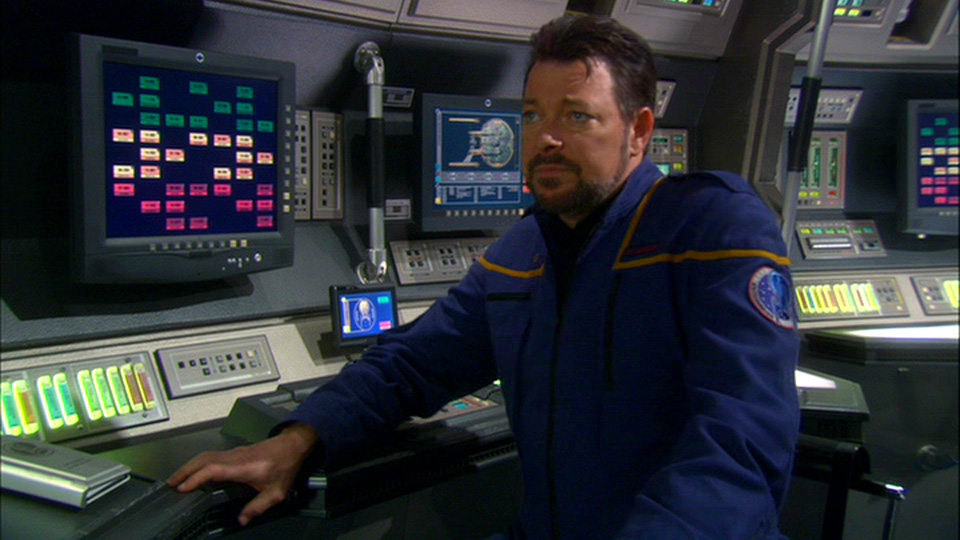
Though the Star Trek franchise will soon celebrate its fiftieth anniversary, much of its on screen canon was released in one decade. The 90s were a great time to be a Trekkie (Trekker) with three different TV series (The Next Generation premiered in 87 and Voyager ended in 01) and four movies out in such a short time span. It would have been hard to fathom in ‘96, with Voyager on network television and First Contact proving that the film franchise could thrive without the original cast, that the franchise would soon be in decline. By 2005, Star Trek was nowhere to be found except for a hundred times a day in re-runs and on DVD and VHS at old yard sales.

Though the franchise would make a comeback just a few years later with the 2009 reboot and will be returning to TV in 2017, it’s hard to imagine a world where Star Trek reaches the same level of prominence it enjoyed in the 90s. Star Trek Beyond is already under fire from fans and members of its own cast for its action heavy trailer and the decision to place the TV series on CBS All Access will severely limit its exposure. The status of entertainment behemoth belongs to a different franchise.

The Marvel Cinematic Universe is the most ambitious shared universe ever attempted. Since 2008, we’ve seen twelve films and four television series released with plenty more on the way. To put things in perspective, the Star Trek franchise has released twelve films and six series in a fifty year span, though Marvel’s TV series have a long way to go before they come close to Trek’s combined total of 30 seasons and 726 episodes.

It’s clear that this is a total that the MCU would like to eventually surpass, along with more films than one can possibly imagine. Backed by Disney, it’s hard to imagine a world where the MCU doesn’t blow that total away. Then again, it was once hard to imagine a world without a weekly Trek series either.

Though the MCU is in little danger of not being a multi-billion entity, there are some reasons to be concerned with its overall longevity. The status of the main Avengers cast post Infinity War is unclear and it seems highly unlikely that all will stay with the franchise. Age of Ultron may have grossed 1.4 billion dollars, but was met with significantly less critical praise than its predecessor. Jessica Jones has been a critical gem, which helps to soften the near irrelevance of its other three series, Agents of S.H.I.E.L.D., Daredevil, and Agent Carter. Recent estimations done by NBC Universal place the viewership of Jessica Jones as competitive with the middle pack of network TV dramas with an impressive performance among the key 18-49 demo, though Netflix disputes these reports.

Not even Chicken Little would say that the MCU is in any danger of imploding anytime soon. Their schedule looks to packed with bankable box office draws all the way to 2019 and a team up of the Netflix superheroes in The Defenders should elevate their smaller screen presence. If the MCU was the seemingly unsinkable Titanic, making its voyage through an ocean of cash, there is one thing to be worried about.

Apathy.

Star Trek: Nemesis and Enterprise didn’t kill the franchise because they were terrible. The chief complaint against Nemesis was that it felt tired and the poor box office can realistically be blamed on stiff competition from Harry Potter and Lord of the Rings. Reviews of Enterprise got better with time and the series’ cancellation has more to do with a shift in UPN’s demographic rather than a ratings implosion given the series’ modest decline in ratings when moved to a Friday timeslot opposition Stargate SG-1. I’m not a big fan of Nemesis or Enterprise and certainly don’t want to come across as an apologist for either, but it’s important that we understand that neither can strictly be blamed because of quality. Fans stopped caring. Do you like movies about Thor? Thor Hammer Time is a new slot from Nolimit City provider that was released in 2019. Here the gambler will have to get acquainted with the Vikings and the gods of Scandinavia. Thor Hammer Time online slot https://50-spins.com/thor-hammer-time-slot/ can be played for free if you include it in the demo version. Launch the machine, spin the reels for virtual credits, learn the rules of bonuses and the price of winning pictures, and develop a betting scheme.

The MCU will inevitably face the same problem down the road. There will come a time when more of the same simply won’t cut it anymore. Granted, a chief problem with Age of Ultron was that it wasn’t particularly memorable, but that isn’t likely to have any long-term impact on the franchise unless Captain America: Civil War is a complete bomb, which seems about as likely as a Star Trek: Deep Space Nine film (a man can dream).

Variety will be the factor that keeps the MCU relevant when the post-Downey Jr. era inevitably arrives. The MCU has already shown a willingness to take risks with Guardians of the Galaxy, Ant-Man, Daredevil, and Jessica Jones which all could’ve been expensive flops. The Benedict Cumberbatch led Doctor Strange will be a further deviation from their standard superhero offerings later this year.

Unlike Star Trek in the early ‘00s, the MCU is well protected against bombs. A person who stops watching Agents of S.H.I.E.L.D. isn’t necessarily not going to go see Thor: Ragnarok. Agent Carter fanatics may not be interested in Guardians of the Galaxy 2. Few mainstream franchises have such diverse assets that don’t collide with one another.

Failure is okay for the MCU as long as the fans care. It’s when the indifference settles in that Disney should start to worry. Maybe Paramount would’ve shifted gears if there had been fiery outrage to Star Trek: Enterprise. Instead, it just powered down.

Tuesday

5

January 2016

0

COMMENTS

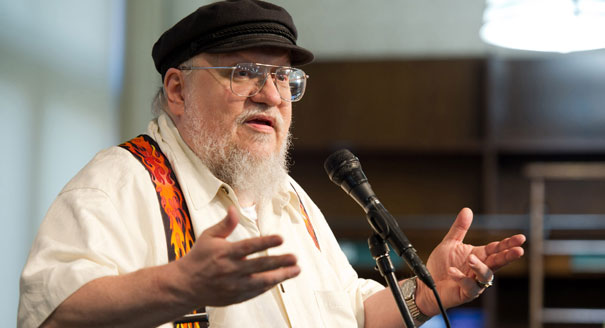
The Martinese Knot: Can We Fault George R.R. Martin for Not Finishing The Winds of Winter?

Written by , Posted in Blog, Game of Thrones, Pop Culture

It’s official. The Winds of Winter will not be out before the sixth season of Game of Thrones. George R.R. Martin recently put out a lengthy blog post explaining the delays and apologizing to the legions of angry book fans. Many writers, most prominently Neil Gaiman, have rushed to his defense, urging book readers not to berate Martin’s slow creative process.

As a dedicated fan of A Song of Ice and Fire as well a published author, I know that the delay is both frustrating and understandable. I find it horrifying that a TV show would overlap a book series, but I can’t fault a fellow author for taking his time and enjoying the spotlight. I’ve written about the important work GRRM does with his anthologies, using his star power to help dozens of sci-fi and fantasy authors gain much needed exposure. Few, if any, mainstream authors do more to promote their genre than GRRM and I’ll always respect him for that.

Fans of ASOIAF know that the show and the books are two completely different entities. Season five bore little resemblance to A Feast for Crows and A Dance With Dragons. There is the risk that big storylines in the books will be spoiled by the show and that’s certainly legitimate. With that in mind, I don’t think it’s necessarily unreasonable for fans to be mad at Martin for the delay.

Two things about Neil Gaiman’s blog stick out to me that I don’t agree with. He titles the post, “Entitlement Issues” and then goes on to italicize the phrase, “George R.R. Martin is not your bitch.” While he’s certainly right about the second part, I do take some umbrage with the notion that wanting to see a book released before it’s spoiled by television somehow reflects entitlement.

Gaiman is right to point out that by buying a book, you aren’t signing a contract where you then get to control the author’s whole life. The audience cannot force an author to write something and if they could, it would probably be terrible. Writers need creative freedom.

GRRM can take as much time as he wants. Should he? Entitlement is one thing, but what about obligation?

An author is nothing without fans. Fans made GRRM. I may have maybe .01% of GRRM’s fanbase, but they’ve helped me get to where I’m at today and I won’t have much of a future in this business without them. We may not owe our fans our firstborn children (or dragon in GRRM’s case since he doesn’t have kids), but there is a sort of moral obligation to the people who got you to where you are. If Davos were real, I’m sure he’d say something similar.

There is also the fact that ASOIAF is not a new series. The first book came out twenty years ago. In the new foreword to The Gunslinger written after The Dark Tower was finished, Stephen King wrote about how he’d receive letters from fans who were terminally ill or on death row asking how the story ends. I don’t mention this to suggest that GRRM should hurry up because his fans are dying, but rather to point out the obvious. Fans invest in stories.

ASOIAF matters to many people. It matters to me. I’ve made many friendships through a common love of these books. I’ve spent countless hours obsessing over them. GRRM doesn’t owe me anything, but I’m also not going to call anyone who’s a little miffed at him entitled either.

Books matter. We’re supposed to feel something when we read. If people are angry that a TV show may ruin a book, that should be taken as a compliment for it shows what a marvelous job GRRM has done over the years.

Sunday

20

December 2015

3

COMMENTS

Star Wars: The Force Awakens Might as Well Be Called “Disney’s A New Hope”

Written by , Posted in Blog, Pop Culture, Star Wars

The moment we’ve all been waiting for since the Revenge of the Sith capped off a six year long butchery of one of the most treasured cinema franchises in history is finally here. The characters we grew to love: C-3PO, Chewbacca, Nien Nunb, and Admiral Ackbar are back to make us forget about tax negotiations, midichlorians, Hayden Christensen, and Jar Jar Binks. While the internet has done a good job of hiding the spoilers, unless you’ve been living in a Wampa cave on Hoth, you’ve heard that this is a good movie. I’m not going to dispute that.

Is a great movie? No.

The bar for The Force Awakens was set pretty low. After bringing back the original trilogy’s three leading stars, it would have essentially been impossible to make a movie worse than any of the prequels. Disney and J.J. Abrams knew which mistakes not to make and wisely listened to the past decade’s worth of criticism levied against Darth Lucas.

The problem is, J.J. Abrams spent so much time trying not to be the prequels that he forgot to give the film a plot. Between the nostalgia factor and the ridiculously adorable BB-8, it can be a little hard to notice, but this isn’t really a film concerned with being a movie. Instead, it wants to give the fans what the last three entries failed to provide while it sets up the franchise for the next dozen entries or so.

Given that Disney is planning to release a Star Wars film every year from now on to presumably the end of time (alternating between the main timeline and standalone films), it’s not completely horrible that the film doesn’t really explain anything. We don’t know how the bad guys came into power or what’s happened since Return of the Jedi, but we do have explosions and Han Solo. The film doesn’t waste a minute of its two hours and fifteen minute runtime so the decision to exclude a plot might not be the end of the world. This just looks like a movie so preoccupied with not being terrible that it comes at the cost of greatness.

The Force Awakens plays it safe in many ways. Without diving into any detail, there’s quite a bit of familiarity to the film that feels more derivative than nostalgic in many ways. I’d say that wasn’t a bad thing, but this isn’t a film that ever tried to make the Kessel run in under twelve parsecs. It settles for around eighteen.

The new cast does shine. Daisy Ridley, John Boyega, and Oscar Isaac seamlessly transition into a franchise that doesn’t deserve the benefit of the doubt when it comes to new characters, having burned fans too many times before with the Ewoks, Binks, Watto, Nute Gunray, Jango Fett, and the fat diner owner from Attack of the Clones. The old cast fits in as well and their presence never feels obligatory. This movie works on many levels. Just not all levels.

There is one casting choice that was a clear mistake. I won’t say much for fear of spoilers, but Adam Driver is just terrible. Every fear I had from the decision to cast Girls’ leading man as the main villain came to fruition. Kylo Ren isn’t quite the next Jar Jar Binks, but he’s dangerously close.

Was the film going to satisfy everyone? Never. There will always be fans who mourn the death of the Expanded Universe (I wrote an article on that last year). You might want to lump me in that category and you’re certainly welcome to do so.

When Disney bought Star Wars, we knew the franchise wasn’t going to carry on as George Lucas intended. That’s a good thing for the most part, except Disney owns another huge, flawed franchise that mass-produces blockbusters, which presents a question you’ll have to answer for yourself.

Would you rather have George Lucas’ Star Wars or Disney’s Star Wars?

My main complaint with the Marvel movies is that they never fully live in the moment. They’re always thinking about the next installment. You’re watching a series; you’re never actually just watching a movie. First movies aren’t supposed to have all the answers, but A New Hope hardly withheld such obvious information from moviegoers.

The notion that I might just be one of those angry fans who will never be satisfied doesn’t really swirl around in my head. I’m not really annoyed. I grew up obsessed with Star Wars. I’ll always be grateful to Star Wars. Some of my closest friendships blossomed through a common infatuation with the world George Lucas created.

Now I see a franchise that aims for satisfaction instead of innovation. That’s what mainstream movies want and I’m okay with that. I just don’t see myself memorizing entire films or buying backpacks based off the new characters (and that’s not because I’m too old either. You’re never too old for Yoda). I’ll still go to see them. I’ll probably still write about them, but part of me longs for the days of Jar Jar Binks. I may have hated him, but at least he made me feel something. There used to be a time when Star Wars tried to convey emotion.

Saturday

14

November 2015

0

COMMENTS

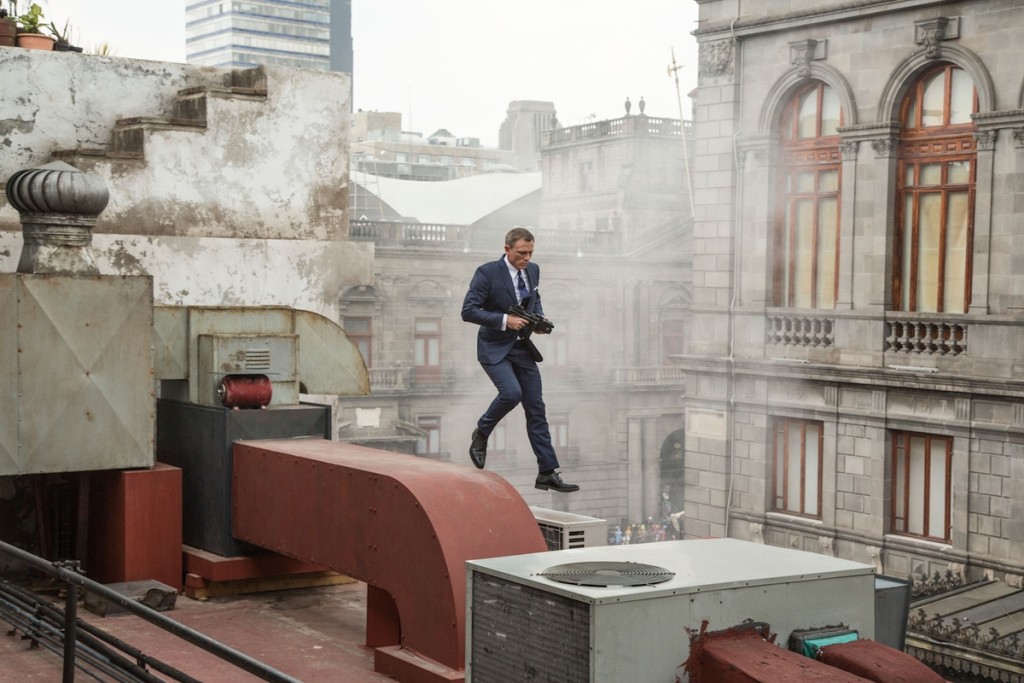
Spectre Is Daniel Craig’s For Your Eyes Only

Written by , Posted in Blog, Pop Culture

What are action movies supposed to be in the year 2015? There’s the Mission Impossible and The Fast and the Furious series which defy age and logic to introduce one exciting installment after another. There comes a point where mere excitement simply isn’t good enough. How else can we explain the lukewarm reaction to Avengers: Age of Ultron, a painfully uninspired entry into the increasingly uninspiring Marvel franchise? With James Bond, we have the task at hand to determine where the gold standard of long running franchises fits into the modern age.

Unlike many critics, I hated Skyfall. While the film was largely praised for deviating from the standard 007 mold, I disliked M’s prominence in the central narrative. As much as a I like Dame Judi Dench, I’m a purist in the sense that I don’t believe any actor is larger than their role. Such a sendoff was most unnecessary and came at the expense of Javier Bardem’s theoretically interesting Raoul Silva.

Craig’s 007 films have cared more about continuity than the rest of the Bond canon. Spectre awkwardly tries to tie the events of the past three films together and largely falls flat with those efforts. Like Bardem before him, Christoph Waltz is tethered to an unnecessary need to be more than a standard Bond villain. By tying his backstory into Bond’s, the film attempts to heighten his emotion impact, but the results are merely distracting. For the second consecutive film, the Bond series has cast an Academy Award winner as the villain only to waste them in senseless clutter.

Around the halfway marker, I started to make the connections to For Your Eyes Only, Roger Moore’s fifth entry into the series. Both films have well put together action sequences and neither passes up a single opportunity to interject humor into the dialogue. Critical reception of For Your Eyes Only varies, with “fun” and “forgettable” accurately summarizing both sides of the equation. Also worth noting that FYEO features a “cameo” of sorts for Waltz’ character, though legal issues prevented the film from acknowledging the character as Ernst Stavro Blofeld.

Coming off of Skyfall, it might have been unreasonable to expect Spectre to raise the bar in terms of the plot. Adding complexity to Bond can produce dangerous, or rather painfully boring, results. The real question is, did it even try?

The film isn’t without its redeeming qualities. Besides the well crafted action scenes, Lea Seydoux shines as Dr. Madeline Swann. Ralph Fiennes, Naomie Harris, and Ben Whinshaw all put in fine efforts, but none top their Skyfall performances, which is disappointing at least for Fiennes, who takes over for Dench as M and fails to bring even half of Dench’s commanding energy to the role.

As for Craig, it’s hard to criticize him. He’s comfortable, but he should be by his fourth go around. Uninspiring could be a word used to describe his performance, but that also speaks to the film in general.

Spectre’s biggest crime isn’t that it’s conventional. It falters because it doesn’t fully commit to being a fun movie. The film tries too hard to justify its legitimacy as a post Die Another Day Bond film that it forgets that it’s okay not to be revolutionary. Traditional and boring are two different things. I’m not sure Spectre could tell the difference.

Friday

6

November 2015

0

COMMENTS

Breaking Down Why The Bastard Executioner Is So Unwatchable

Written by , Posted in Blog, Pop Culture

We’re living in a wonderful time for the action/fantasy costume drama. There’s never been so much to choose from. Regardless of whether you want to watch something that’s going to be a Emmy contender (Game of Thrones, Penny Dreadful, hopefully Outlander next year), something with well choreographed fight scenes (Vikings, The Last Kingdom, Black Sails), or merely something to fall asleep to after a second nightcap (Olympus), there’s something for everyone.

The Bastard Executioner should have been a welcome addition to the second tier. A historical drama created by Kurt Sutter, the man who brought us Sons of Anarchy, had all the makings of a show that would fit in well with the current mix of offerings.

It doesn’t. It’s not just a bad show, it’s a downright unwatchable travesty. Calling it worse than Marco Polo is almost insulting to the underwhelming Netflix entry to the genre.

It took me a few weeks to figure out why this show is this bad and it’s not because the show had perhaps the worst name in television history. It’s not even that the show has bland characters and feels highly derivative. The Last Kingdom has essentially the same plot as Vikings and is still an excellent new show (worth noting that TLK is based off of a series of novels by Bernard Cornwell, which makes the similarities more acceptable).

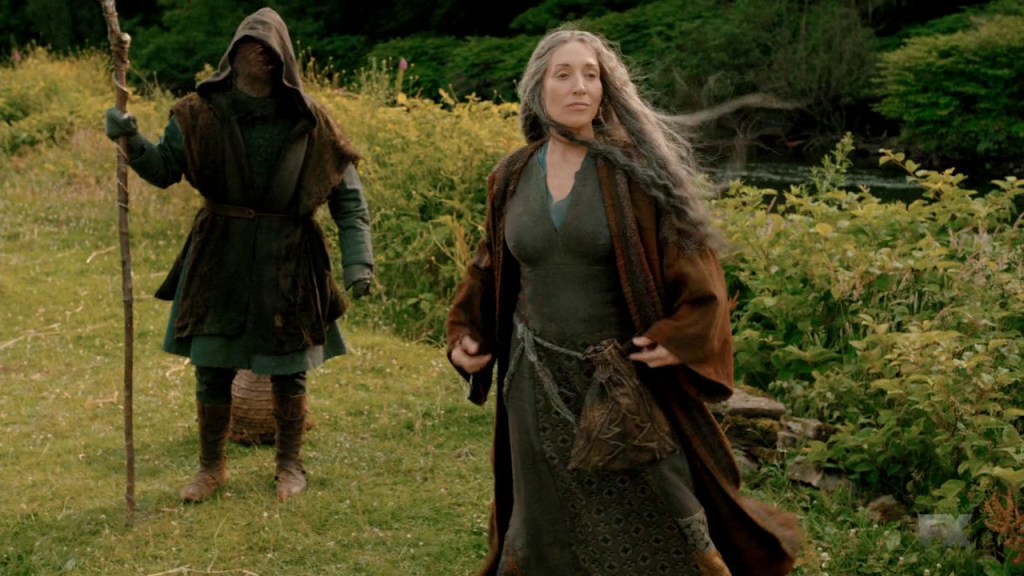
I’ve seen four episodes of the show and I’ve found it hard to care about anyone on the program. Even Stephen Moyer, who can’t seem to make anything work with the bland writing. As much as I enjoy Katey Sagal, her character is unbearable with that completely baffling accent. Her character looks like something out of The Legend of the Seeker, which is hardly a compliment for a show on a network like FX (though I enjoyed Seeker and The Sword of Truth books its based on).

The show has no obvious likable characters. No Tyrion, no Jon, no Ragnar, no Floki. Just a bunch of crappy generic characters with generic names. There’s no fun to be had at all with this lot.

Some shows take time to develop, even the ones that were good from the get-go. Game of Thrones, Vikings, and Outlander are all different programs now than when they started (which would be a bit unusual in Outlander’s case if it wasn’t following its source material). Problem is, The Bastard Executioner makes it downright impossible for you to actually get through the episodes.

As we learned with the last few seasons of Sons of Anarchy, Kurt Sutter is not a man who likes to be edited. Since 2012, SOA episodes almost always ran for at least 90 minutes on commercial TV, often longer. This trend has unfortunately continued with The Bastard Executioner.

It takes the saying “too much of a good thing” to a whole new level. It’s too much of a terrible thing. A show trying to work through its growing pains doesn’t need to air episodes that are longer than most HBO shows on a regular basis. I assume Sutter has a fair amount of pull at FX. Unfortunately, it doesn’t work to the benefit of the show.

While I’d say the long run times are the show’s biggest problem, the fight scenes are very subpar. They’re sloppy and have way too much gore. You can’t exactly blame the budget either, when fellow non-premium cable show Vikings produces the most consistently great fight scenes on television.

I’d imagine that Sutter set out to beat Vikings at its own game. I don’t think he seriously expected a show with the title, The Bastard Executioner, to be an Emmy contender. While Vikings isn’t going to challenge for Best Drama either, it has grown into one of the best shows on TV with amazing visuals, great action, and most importantly, compelling characters.

The Bastard Executioner has no redeeming qualities and that’s a shame. Sutter should have been able to do better than this. If his ego is half as bloated as his show’s run time, it’s possible he’s oblivious to how terrible the finished product is.

Sunday

13

September 2015

5

COMMENTS

I Hate Mr. Bates

Written by , Posted in Blog, Downton Abbey, Pop Culture

I recently rewatched most of Downton Abbey in preparation for season six, which starts a week from today. Being known for its soap operatic value, one shouldn’t step into Highclere Castle expecting plots that make sense or robust character development. Julian Fellowes doesn’t hit his mark every time, but there’s certainly a reason why the recent trailer tugs at many people’s heartstrings and it’s not just because of the music. It’s because we’ve grown to love these characters.

There’s one man I used to love (as one loves a fictional character) once upon a time, but that affection has vanished. Like many, I started to feel it in season four and that continued as questions regarding his morality surfaced yet again. As you probably gathered from the title of this article, I am, of course, referring to Mr. Bates.

At first glance, he’s a tough guy to hate. Misery seems to follow him everywhere, tracking him by the sound of his cane thumping on Downton’s creaky floors and yet, he’s a pretty decent guy. He gave Molesley some money and saved Barrow from ruin at the hands of O’Brien/Jimmy. So why hate his Lordship’s valet?

The Mr. Green plotline has been almost universally panned. Many articles have been penned about how Fellowes has no idea as to what to do with either Bates. I’ve found that the problem goes even beyond Mr. Green. To put it simply, Mr. Bates is terrible.

I’ve gotten into several arguments regarding the Bates/Barrow feud. People say I’m horrible or contrarian for taking Thomas’ side, usually because they forget what’s important. It’s not about who’s the most morally altruistic person. It’s about who’s fun to watch.

There’s a scene in season five where Barrow acknowledges the simple fact that the two do not like each other. This gave me a bit of an “aha” moment as I realized that I don’t like Mr. Bates either. In season three, I was firmly on team #freeBates. Now when I watch season three, I usually skip his scenes (along with Edith’s, which makes it easier for me to keep watching the same show over and over).

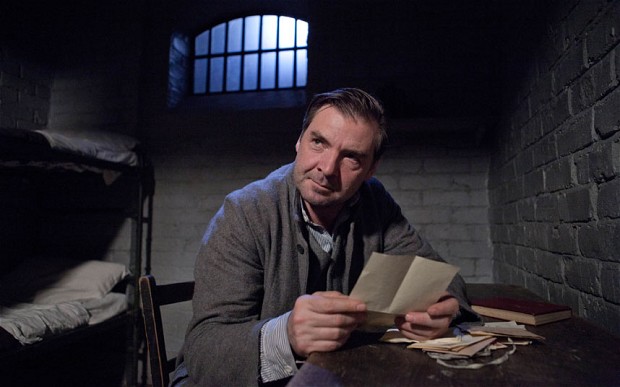
Think about how many episodes of the show feature a happy Mr. Bates. He’s sad when he first gets there because no one likes him. He spends the rest of season one feuding with the O’Brien/Barrow dream team and sad about his leg. We also find out he was in trouble for being a thief, which was the first red flag.

Season two brings even more bad news. We find out he has a wife who he doesn’t like. He has a brief moment of happiness when he marries Anna, but then he goes to jail, where he spends most of season three.

He’s happy for a little bit at the end of season three and the beginning of season four, though we find out that he’s also a forger in addition to being a thief. What a standup guy! He’s also always moody. Sure, he’s had rotten luck, but so has Molesley. Downton’s cricket champion never lets the world get him down.

The reason for this sadness is simple. He has nothing else to do. Fellowes never tried to give him any storyline that didn’t involve horrible things happening to him. It got boring. I left the #freeBates team in favor of #killBates. At least then, Molesley could take his place as valet.

Downton Abbey is a drama. We expect characters to endure hardships. It’s generally considered reasonable to expect to be given a reason to like the character as well.

Bates and Barrow contrast well in this regard. Both are generally pretty moody and we know why. Bates is a crippled creep and Barrow is gay at a time when that was not only completely unacceptable, it was criminal.

Their unpleasantness manifests itself in different ways. Barrow takes his anger out on others while Bates is just a grump. We can probably assume that Bates is the better person (unless he actually killed Mr. Green or more gruesome details about his past turn up), but what does that really matter?

As a character, Bates lacks depth. Even his romance with Anna seemed a bit rushed. More importantly, he doesn’t make for good television.

Reports for season six suggest that not everyone will have a happy ending. It’s hard to tell where Bates will fit into this. One would think Fellowes would throw a curveball and let him limp off into the sunset with Anna on his arm. Problem is, I don’t care.

Friday

28

August 2015

1

COMMENTS

Game of Clickbait: A Song of “Journalists” and Thieves

Written by , Posted in Blog, Game of Thrones, Pop Culture

I saw something unfortunate on Twitter this morning as I looked through my friends’ tweets. The Huffington Post’s Bill Bradley put out an article on Wednesday claiming to have a “new” Game of Thrones theory regarding the parentage of Jon Snow and Meera Reed. Given that A Clash of Kings, the first book to feature Meera, was released in 1998 and that this series can be called a worldwide phenomenon since at least 2005, when A Feast For Crows hit #1 on the New York Times bestseller list (a rare feat for a fantasy novel), it is more than safe to say that this theory is anything but new.

If you google “Jon Meera twins,” tons of posts come up that are earlier than Wednesday. Without even clicking on a single link, I see one from asoiaf.westeros.org from 2012. I doubt that’s the oldest either.

It’s embarrassing that HuffPo calls this journalism. The site has been praised by many for ushering in the modern day era of the news. While there’s plenty of truth to that, things like this thievery aren’t just a disgrace, they’re sad.

It’s sad because there are countless ASOIAF/GOT fans who have put in thousands of hours of research and discussion who then go uncredited by major news websites. This goes even beyond that. You have a guy who pretends they don’t even exist and that he’s the first to make this groundbreaking revelation.

We know why. Game of Thrones has over a hundred million fans. Articles like these are cash cows, especially when the research only takes a three-word Google search. It’s free money.

Dishonest money. I’m lucky to consider many of the top ASOIAF commentators to be friends. I’ve featured many of them here in my “Interviews of Ice and Fire” feature. I haven’t featured Bill Bradley and don’t plan to. I wouldn’t want to go through the trouble of finding someone to answer his questions for him.

The people who work hard to produce new content whether it’s articles, podcasts, or even just posts on the subrebbit or other the forums play a crucial role in Game of Thrones’ worldwide popularity. They’re the reason why genuinely new theories are still being discovered years after the last book in the main series was released. Without them, Huffington Post and Buzzfeed would have no one to steal from.

Here’s the thing that really bugs me and the reason I decided to write this. The top commentators in the ASOIAF/GOT fandom are good people. Beyond that, they’re not difficult to get ahold of. If they answer my tweets and e-mails, I imagine they’d respond to requests for paid freelance work.

I imagine this article will be discovered by a crony of one of the clickbait websites at some point in time. If you feel ashamed reading this, good. You should be ashamed. There used to be a code that journalists abided by. Just because you’re behind a computer writing for an online publication rather than a print newspaper doesn’t mean there shouldn’t be integrity in your work.

For you, the reader, check out the work of this expansive fandom. It’s good stuff and you won’t have to wait years for mainstream media to find it.

Tuesday

25

August 2015

1

COMMENTS

Interviews of Ice and Fire: Ashaya of History of Westeros Podcast

Written by , Posted in Blog, Game of Thrones, IOIAF, Pop Culture

It is a pleasure to welcome Ashaya of History of Westeros Podcast to the site. History of Westeros is one of the most in depth ASOIAF resources available; creating episodes that piece together the series’ confusing timeline along with commentary on the houses, theories, reviews of Game of Thrones, and just about anything else imaginable. HoW recently wrapped up an in-depth series on Summerhall. You can support HoW through their Patreon campaign.

HoW just wrapped up two podcasts on the Tragedy of Summerhall, one of the series’ strangest mysteries and certainly one that’s overlooked by casual fans. Given how little information there is on the topic, can you tell us a little bit about how you approached it? In terms of difficulty, how did it compare to some of your other series?

 The episodes in our Religion & Magic series are generally the hardest to put together, specifically the episodes on weirwoods. The possibilities of magic are just so wide open, and that tends to make it harder to decide how to frame the narrative of the episode, and how to organize and present everything. The Tragedy of Summerhall episodes weren’t part of that series, but they obviously deal with magic as well, and so they did have some extra difficulty. We speculated about the magical aspect of it a bit, but more so focused on the role of prophecy and on the impact Summerhall had on characters like Aerys, Rhaella, and Rhaegar (and the realm).

 One thing that’s stuck with me since listening is the potential involvement of the pyromancers and how Jaime had a particular hatred of them. Given that they had seemingly no friends in court during Robert’s reign and plenty of people who don’t seem like they would be particularly fond of their line of work (Robert, Jon Arryn, Stannis), why do you think they were kept around at all?

I don’t think Robert or Jon Arryn would have felt any particular motivation to outright end the Alchemists’ Guild, which is a rather drastic course of action. If we’d had Jaime in a position of power, he likely would have, though! That said, their power has waned and waxed over time, so they weren’t as prominent during Robert’s time as they are currently in the series or (obviously) during Aerys’ reign.

One thing you mentioned that I’ve never even thought about was Aerys II’s lack of known bastards. Do you think that is an oversight on GRRM’s part or could something larger be at play?

 Questions like these are difficult because well, I do often find myself debating whether something can be explained sufficiently in-universe or whether the Doylist method is more appropriate. I know that there are a lot of fans who are pretty firmly Watsonian, but I enjoy both types of explanation, though I favor the Watsonian view overall. So often obscure things in A Song of Ice and Fire make perfect sense, and you don’t have to look at things from an out-of-universe perspective. My answer, then, is that while I think it’s possible that it was an oversight, I think there are a number of in-universe explanations, namely a) Aerys had issues with fertility (my pick) or b) Varys dealt with his bastards.

One more Summerhall question as you mentioned Shiera Seastar and she’s one of my favorite tertiary characters. I’ve often viewed her as a parallel character to Bloodraven. As unanswerable as this is, does her being Quaithe preclude her from being somehow involved in Summerhall?

No, though I personally don’t subscribe to that theory myself.

My favorite HoW episodes are the ones you did on the Battle of Ice. Granted, the two are completely different but have any of your thoughts changed since season 5?

The landscape (hah get it) of the show is indeed entirely different from the books; for instance, we theorized about the ice lakes (now you get it) having a role in the battle, with Stannis laying a trap for the Freys (we also theorized that it might backfire and get the Manderlys, but let’s ignore that). I would say that it had an effect on me, but I strongly feel that if Stannis is going to be the one to burn Shireen in the books, it will be for something far direr, and so I still don’t think that the Battle of Ice is the end for Stannis in the books. In the podcast, I said I thought that Stannis would win, and I still feel that way (with a touch more doubt, admittedly).

Since Euron = Daario seems to be unanswerable, I shall ask, how do you feel about that theory in general? Do you think there are too many identity theories floating around?

There are definitely too many identity theories! Why, I’ve even seen theories that Amin of A Podcast of Ice and Fire is my very own Aziz of History of Westeros. I try to be diplomatic about most theories, but I can’t do it for theories about Euron being Daario, Rhaegar being Mance, Arthur being Mance, etc.

If you could pick the topic for the next The Princess and the Queen or The Rogue Prince style novella, what would you pick?

Fun question! My answer for this is different than what it would be if it were for a more traditional style rather than the masterly historical style of those novellas. I would love to read an account of the Rhoynar migration and find out more specifics about the people Nymeria traveled with and so on…that might be a bit large for a novella, though, even in the history style. Alternatively, the Conquest of Dorne.

What is the craziest theory you think might actually be true.

I’m not a big theorist, especially not crazy theories, but I’m fond of the Citadel Conspiracy theory, Jojenpaste, and, (our own idea), the theory (more of a hypothesis really) that weirwoods have some sort of connection to genetics, with family looks sticking for thousands of years due to their influence. In the case of the Citadel theory, I don’t think there’s a mass conspiracy, but I think their bias is clear and should always be considered in analysis. In the case of Jojenpaste, I just like it and think it’s (deliciously) dark. The third is pretty crazy for us, but given the length of time that the appearances of these families have remained in stasis, and that we know magic is involved in the genetics, I still find myself liking the idea.

I know HoW has been to many fan conventions over the years. Can you think of a highlight that you’d like to share?

Not as many as I’d like! Though we have plans to go to Mysticon and Balticon next year, so soon there will be more under our belt. It was a huge honor to meet George, talk to him, give him our card, etc., but I think hearing him read the History of the Westerlands from The World of Ice and Fire was the highlight for me. This was prior to the release of the book, and so we were particularly hoping for material from TWOIAF. When we met GRRM the day before and told him that our podcast was titled ‘History of Westeros’, he told us that we should be excited for the reading the next day, then, so we knew in advance that we would for sure be getting new material. Let me just say…it was so hard to sleep! But then at least it was very easy to get up early due to my excitement. We frantically took notes at the reading, and were able to publish it on our website, which brought us some good publicity, which was a nice bonus. But! The day got even better, because during the Q&A after the reading, GRRM picked me to ask him a question….I was able to ask a long-burning question (what is the Unnamed Princess of Dorne’s name?), which was a dream, even if he didn’t have an answer (boo). One day I’ll have a name for her!

What shocked you the most about season 5?

That Tyene used the phrase “bad pussy”, which is, by the way, a non-canon piece of slang that has never been used in A Song of Ice and Fire, save for once in the term “pussy willows” in The Mystery Knight.

How many times a day do you get asked if Jon Snow is still alive?

Me, personally? Hardly ever. How many times a day do I have to read other people speculating based on things like his hair? Often. As an aside – it’s always the wrong question, anyway, he’s obviously dead, the question is whether Jon Snow will be brought back to life.

Will HoW do book to show episodes next season?

Definitely! They were a lot of fun, and it was great to have more opportunities to have guests like Radio Westeros on. I myself will likely be in the first few and then drop out for the rest of the season, as I did this past season. I like talking about the characters when they are first introduced, and speculating on where the season will take us, but, at least last season, I quickly got burnt out and frustrated. We’ll see, though, for all I know, I’m going to love every episode of next season! (I crack myself up)

Generic question, but who is your favorite character? Is the same true for the show?

I’ve actually done this great ASOIAF character sorter, which takes hours and hours, and I found that my number one is Sansa Stark for both A Song of Ice and Fire and Game of Thrones (the GoT sorter…yes I did both). It’s difficult to compare POV characters with minor characters, but some of my other favorites are Arianne Martell, Samwell Tarly, Maester Aemon, Varys, Wylla Manderly, Alys Karstark, and of course the usual suspects like Arya, Tyrion, and Jaime. I need a historical character sorter still, but I am particularly fond of Rohanne Webber, Egg/Aegon V, Nymeria of Ny Sar, and of course our patron saint, Septon Barth.

What’s next for HoW?

We are continuing our series on the Blackfyre Rebellions as well as preparing episodes on a few different houses like House Dayne and House Royce, and preparing an episode on Nymeria of the Rhoynar. We will also have live Q&A episodes more often as we are close to hitting that milestone on Patreon.

Saturday

22

August 2015

0

COMMENTS

Aqua Teen Hunger Force Is Difficult To Eulogize When It Doesn’t Feel Like The End

Written by , Posted in Blog, Pop Culture

Aqua Teen Hunger Force is supposed to end tomorrow. I should say, Aqua Teen Hunger Force is ending tomorrow since it is actually ending, but I can’t really bring myself to accept it. This is after all, a show that’s changed its own name four times.

I shouldn’t say ending. It’s being cancelled, which is baffling. It even feels weird to type that blasphemy.

Maybe it’s because it’s the last Adult Swim original to call it day, with a run that was longer than the other three combined (Sealab 2021, The Brak Show, and Harvey Birdman: Attorney at Law). ATHF is practically synonymous with the network itself, which ushered in a new era of animated excellence and for better or for worse, gave us more Family Guy (and Futurama, though that was mostly a good thing).

It could be because popular, long running animated comedies don’t really end. The Simpsons, Family Guy, and South Park are older and still going strong in certain ways. The ones that did end, King of the Hill and Futurama, were cancelled. While it would be silly to suggest that ATHF ever reached the worldwide popularity of the first three mentioned, it is the flagship program of its own network, which certainly should mean that cancellation shouldn’t be an issue.

Its fifth and final title, Aqua Teen Hunger Force Forever might seem ironic since it’s the last one, but it is rather appropriate. With co-creator Dave Willis remaining at Adult Swim, it seems plausible that the show could, and probably will, resurface at a later date, considering Adult Swim’s antics (Perfect Hair Forever anyone?) and the current trend in TV to bring old stuff back, which I doubt is going away anytime soon.

Patti Smith has recorded a somber elegy for ATHF. I’m not sure what else should be said since I refuse to believe this is actually the end. Call it denial, but it’s more than that.

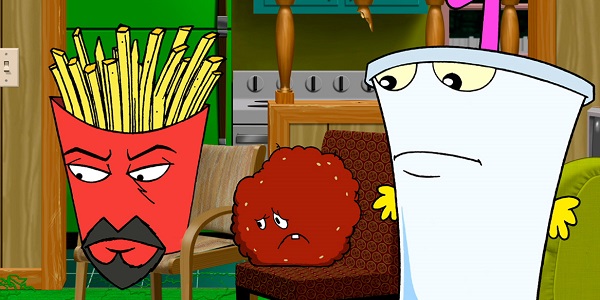
We know at some point in time, Master Shake, Frylock, Meatwad, and Carl will show up. Whether it’s another season, movie, or an April Fool’s Day gag, we haven’t seen the last of anyone’s favorite cartoon “detectives.” I’m not even fully convinced we won’t see them next year with another season.

I could point out that TV hasn’t always been kind to the surreal and the unconventional. Shows that dare to be different often get cancelled, though normally not after fifteen years. That’s what I can’t seem to wrap my head around.

ATHF has never been an easy one to assess from a critical standpoint, making it hard to say whether or not it’s gone downhill in recent years. Adult Swim President Mike Lazzo said he was ready to move on. Was that for good reason?

I’m going to go ahead and say no. Recent years have probably had more hit or miss episodes and the same is true for nearly every long running series. Aqua TV Show Show’s ninth episode “Piranha Germs” remains one of my favorite of the whole series. With humor like that and a will to continue, I think it’s safe to say ATHF had plenty left in the tank.

So it ends. For now, or maybe not. Perhaps I’m wrong and we’ll never see those guys again. I hope not.

I’ll end this “eulogy” with this, Aqua Teen Hunger Force is one of the greatest animated comedies of all time. I suppose some will disagree and I hope Master Shake throws those people on the ground before going back to his reclining chair. Why didn’t he have a bedroom?

Monday

17

August 2015

0

COMMENTS

Wet Hot American Summer: First Day of Camp Succeeds Where Arrested Development Failed

Written by , Posted in Blog, Pop Culture

As someone who enjoyed Wet Hot American Summer, but not to the same degree as much of its cult fanbase, I was skeptical of how the Netflix prequel series was going to turn out. It’s highly doubtful that this would’ve been made had cast members like Amy Poehler, Bradley Cooper, and Paul Rudd not become huge stars fourteen years down the road, but that also presents a problem. Huge stars typically don’t have much time for projects like these.

This was the problem with Arrested Development’s fourth season. Its cast was busy, so the show filmed around them which didn’t really work that well. It’s hard to recapture the magic when half the people who helped make it in the first pace are only in it for two seconds and rarely at the same time.

WHAS: FDOC had a couple things going for it right from the start. Creators David Wain and Michael Showalter were obviously locks for every episode, but the series benefitted from the fact that a good chunk of the cast hadn’t necessarily gone on to “bigger better things.” In actors like Michael Ian Black and Ken Marino’s case, they were pretty much doing the same sort of stuff of Comedy Central and Adult Swim.

Which isn’t to say that WHAS: FDOC solely relied on cast members that weren’t appearing in blockbuster films. Rudd, Poehler and Elizabeth Banks have ample amounts of screen time. Mad Men’s John Slattery was brought on to aid Poehler’s scenes in cases where Cooper wasn’t available and you don’t necessarily feel like anyone’s missing.

The series also added numerous big stars to its cast. In addition to Slattery, Jon Hamm, Jason Scharztman, Chris Pine, Kristen Wiig, Josh Charles, Jordan Peele, and Michael Cera aid the show tremendously, giving the viewer the idea that this isn’t merely a harebrained scheme that Wain and Showalter managed to trick Netflix into funding. WHAS isn’t strictly back for nostalgic value, it also has something new to bring to the table.

It’s hard to write this sentence about WHAS, but much of the humor in the series is actually pretty subtle. It’s filled with quotable moments, but the metahumor is what really sucked me in. Most of the cast looks phenomenal, but this is a prequel starring a cast that’s now a decade and a half older than when the first was made. Some of them do look pretty old, which definitely plays into the wackiness of the series as a whole. A lot has changed and yet much of it looks the same.

Is it accessible for people who weren’t fans of the original film? Probably not, but it earns points for not trying to be. The show managed to have a pretty A list cast for a Netflix mini-series based off a box office bomb. I think it’s doing just fine.

This could have been really terrible, which isn’t to say that it hits its mark 100% of the time. The show does fall flat a little bit in the middle episodes, but it’s never awful, unless you hated the show to begin with.

We’re going to see a lot of revivals in the coming months. Even Coach is coming back. Many of these will suck, like Arrested Development’s fourth season and for many, that will tarnish the legacy of the source material.

Wet Hot American Summer: First Day of Camp chose not to rest on its laurels. It’s a worthy successor that enhances one’s enjoyment of the original in many ways. I never went to summer camp, but I hope most of them are exactly like Camp Firewood, talking cans of vegetables and all.