Ian Thomas Malone

Pop Culture Archive

Monday

12

November 2018

0

COMMENTS

BritBox’s Dark Heart Shows Promise After An Uneven Debut

Written by , Posted in Blog, Pop Culture

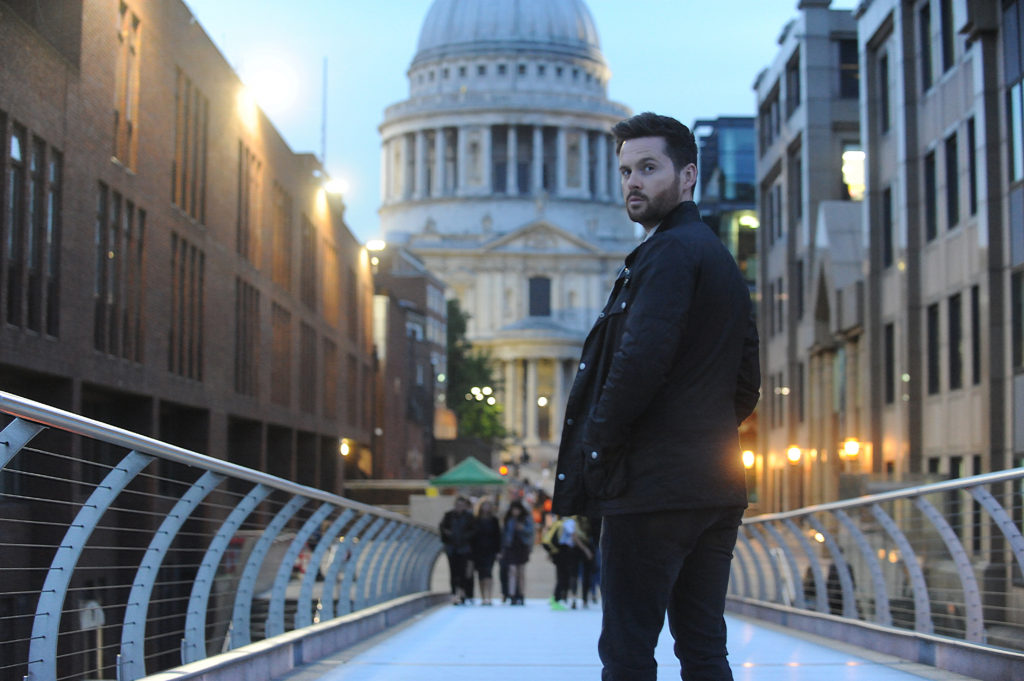
Unlike their real-life counterparts, television cop shows have the luxury of avoiding handling controversial victims. Police investigate the murder of an un-convicted pedophile because the law has no place for vigilante justice, putting aside any broader moral questions an individual might care to raise. Whether those cases make for compelling television is a completely different matter, one that Dark Heart chooses to address in its opening episodes.

DI Will Wagstaffe is haunted by the unsolved murder of his parents that occurred when he was a teenager. He’s a moody detective who approaches his job with unrivaled concern for the victims, regardless of their life circumstances. Wagstaffe’s home life is complicated by the arrival of his sister Juliette, who shows up at their parents’ house with a black eye, creating an interesting dynamic between two siblings with issues neither wants the other to meddle in.

Dark Heart is largely carried on the strength of lead actor Tom Riley, who brings a sense of nuance into the well-trodden territory of TV procedurals. Wagstaffe is a rare character among the broader trope of tortured detectives. He shows a strong desire to move past the grief that haunts him. His grief isn’t some superpower to be wielded in the broader sense of justice, but an acknowledged problem that needs to be dealt with. The character’s sheer humanity is compelling because it’s relatable. Trauma isn’t something that can be wished away.

The series has had a turbulent production schedule, previously premiering on ITV back in 2016. As a result, much of the cast of the first two episodes were unable to return for the rest of the show’s six-episode first season. The need for a soft reboot creates a bit of a bumpy experience, as the show has to introduce new characters in episode three alongside ones who were barely developed themselves. Wagstaffe’s partner Josie Chancellor, played by Anjli Mohindra, stands out in particular as an interesting character who doesn’t get much time to shine.

The move from ITV to BritBox Original might suggest an effort to salvage a show that wouldn’t otherwise be worth airing on a major network, but Dark Heart’s narrative certainly seems better suited for a niche audience that wouldn’t be put off by the grim stories it wants to tell. It’s rough around the edges, but Riley delivers a strong enough performance to keep the viewer interested in seeing what happens to his character. The series isn’t likely to make enough waves to draw new subscribers to BritBox, but fans of the service will find Dark Heart worth checking out. Hopefully it won’t need another two years to find its rhythm.
Sunday

11

November 2018

0

COMMENTS

Omnipresent Is a Timely Commentary on the Temptations of Technology

Written by , Posted in Movie Reviews, Pop Culture

For all the ways in which technology has improved the world, such as making thousands of miles seem much smaller through the lens of a Skype call, the idea of abuse of this incredible power never ventures far from the broader discussion. Surveillance is an especially hot-button topic, as the ease with which one can record an entire room can create the ever-looming sense that one is being watched. Omnipresent (originally titled Vezdesushtiyat) is a Bulgarian film about what happens when a man decides to make that fear a reality.

Emil lives a comfortable life. He has a nice family, a beautiful home, and a great job running an advertising agency to supplement his respected but stagnant career as a novelist. His situation would be the envy of many creative types, except something isn’t quite right with Emil’s paradise. He wants something more.

A ploy to catch a thief plundering his bedridden father’s antique treasures leads Emil to discover his passion for surveillance. He sets up cameras in his office, his home, his wife’s office, even his bathroom. He sits and watches for hours, sometimes using the footage to his advantage, but sometimes just out of a sick sense of pleasure. His motives are never really made all that apparent to the viewer because Emil himself doesn’t really seem to know why he enjoys invading other people’s privacy.

Omnipresent juggles a delicate balance between its plot and its protagonist, knowing that the further Emil dives into his spying, the more alienated he’ll become from the viewer. Emil isn’t particularly likable, Velislav Pavlov delivers a captivating performance that circumvents any need to identify with his character’s abhorrent behavior. The film allows Emil to be a flawed man without offering excuses, providing important commentary on the dangers of surveillance. People can venture down dark roads without even stopping to consider the risks at hand. There doesn’t always have to be an easy answer for why people do bad things.

The film juggles an impressive number of subplots for a two-hour movie. Teodora Duhovnikova stands out as Emil’s unhappy wife Anna, whose performance stretches across the ground the film would otherwise be too constrained to cover, wearing years of turmoil in every expression. Mihail Mutafov also delivers a compelling performance as Emil’s father Kirill, a man resilient against the many hardships aging brought to his doorstep. The strong acting drives home the stakes at hand, showcasing the many people on the receiving end of Emil’s selfish treachery.

Director Ilian Djevelekov did a superb job in managing the various threads of his work, fully fleshing out his storylines while never losing sight of the major force driving the narrative. XANNONCE Omnipresent could have gotten by playing to the viewer’s own fears of being watched, but the intimacy it gives to its characters makes the narrative all the more powerful when it stops to consider the ramifications of Emil’s behavior.

Technology is a powerful tool that’s all too easy to abuse. Omnipresent conveys the wreckage that can be created in the wake of a decision made without considering the God-like power at one’s fingertips. Bulgaria’s selection for Best Foreign Language Film at the upcoming Oscars tells a tale that transcends language, a powerful story for today’s environment.

Saturday

10

November 2018

1

COMMENTS

Nesting Comfortably in Braveheart’s Shadow, Outlaw King Is an Action-Packed Delight

Written by , Posted in Blog, Movie Reviews, Pop Culture

As unfair as it seems to compare Outlaw King to an unrelated film made nearly twenty-five years earlier, Braveheart’s presence looms heavily over the narrative. The story, mostly set in the immediate aftermath of William Wallace’s death, functions essentially as a sequel, continuing the First War of Scottish Independence. Rather than partition his film off from a previous Best Picture Winner, director David Mackenzie utilizes his viewer’s likely familiarity with the history to his advantage, crafting a narrative unburdened by needless exposition.

At its core, Braveheart was a story of hope in the face of brutal opposition, fighting for that freedom that should be bestowed on every human as a birthright. Outlaw King is far more grounded in the brutal reality of Robert the Bruce’s uphill battle. War is ugly. Guerilla warfare against a well-organized foe leads to a lot of casualties and heartbreak. There’s little romance to be found in constantly being on the run, hoping your enemy spares those who harbored your resistance for a night or two.

Chris Pine’s Robert the Bruce is not a particularly inspiring figure. He’s totally beleaguered under the weight of his sense of duty. His face is perpetually sullen, the grey in his beard conveying the losses he’s endured in the name of a fight few think he can win. His best moments are brought out in scenes with Florence Pugh, who anchors the film’s emotional core as Bruce’s wife/queen consort Elizabeth de Burgh, delivering a compelling performance that greatly raises the stakes of the personal conflict at hand.

Outlaw King spends very little time on the macro-politics of the era. The viewer is never really given a firm grasp of the underlying cause of the animosity between Robert the Bruce and King Edward I. Much of this seems to be the result of about twenty minutes of footage, which dove more into the history of the story, being cut from the film between earlier screenings and the version released on Netflix. The film assumes the viewer knows enough about war and oppression to follow along, resulting in a narrative that rarely stops to take a breath.

The two-hour runtime passes by in the blink of an eye. Mackenzie has a firm sense of pacing, injecting just enough plot development to buoy the film between action scenes, all of which are incredibly well-crafted. The supporting cast is largely under-developed, perhaps the product of the film’s shorter runtime, but Robert the Bruce’s companions make up for the charisma lacking in their leader. Aaron Taylor-Johnson and Tony Curran particularly stand out as Scottish commanders James Douglas and Angus MacDonald, making the most of the few scenes their characters are given to stretch their legs. echoua.com

I came away from Outlaw King incredibly impressed with Mackenzie’s directing. The film is meticulously well-crafted, always aware of when a scene has outstayed its welcome, while never allowing itself to be bogged down by a desire to explain the mechanics of war. It isn’t as good as Braveheart, but it knows its hero doesn’t possess the same heroic larger than life sense of grandeur as William Wallace. The film is an excellent companion to its cultural predecessor, giving Robert the Bruce’s story a worthy adaptation of its own.

Tuesday

6

November 2018

0

COMMENTS

Outlander Brings Its Scottish Charm to the New World

Written by , Posted in Pop Culture

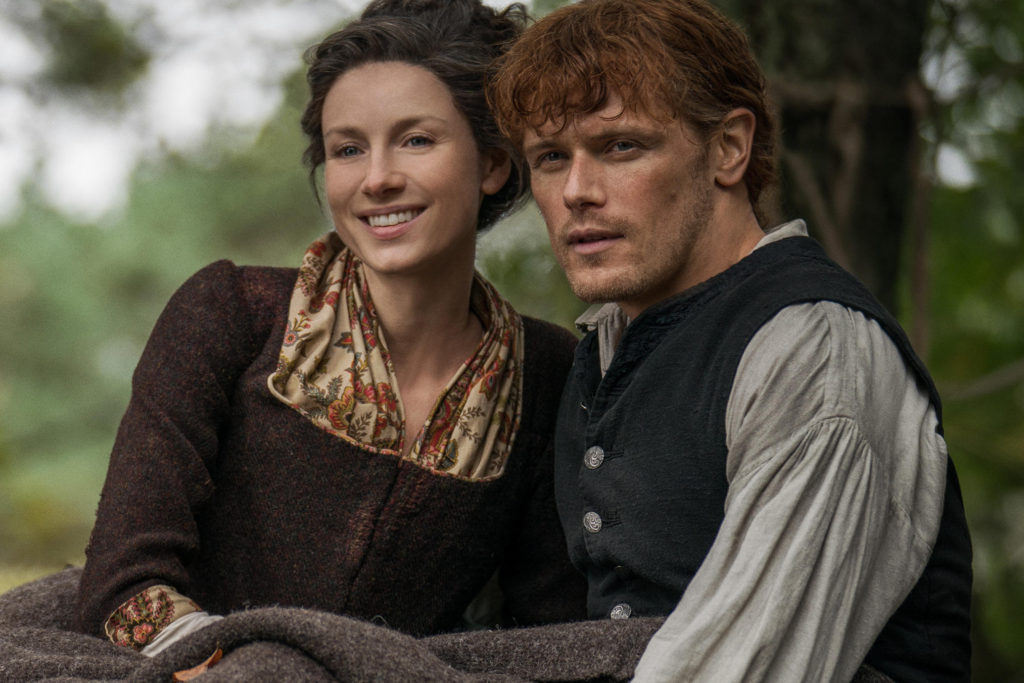
Season four marks a new beginning of sorts for Outlander. With the end of the Jacobite risings, the deaths of Black Jack/Frank Randall, and the reunification of Claire and Jamie Fraser, the show finds itself heading into colonial America having resolved most of its longstanding conflicts. One does not need to spend much time wondering what the show could possibly do next, as Diana Gabaldon’s bestselling book series ensures that the series will have at least six more seasons worth of material, putting aside the numerous spinoff works.

For all of the geography that its story covers, Outlander remains remarkably grounded in its best asset. The show constantly presents new beautiful landscapes for its characters to explore, but it never forgets that romance lies at the very heart of its appeal. The palace of Versailles can captivate the eyes, but Claire and Jamie’s love penetrates deeper into the soul, deserving precedence over whatever new destination comes into play.

Twenty years have passed since the stones of Craigh na Dun first brought Claire to eighteenth-century Scotland. Perhaps it shouldn’t be surprising for a show about time travel, but Outlander handles the literal passage of time quite well. Four seasons in, Claire and Jamie genuinely act like an old married couple. Caitriona Balfe and Sam Heughan have had to adapt to a lot of different circumstances over the years, including the ways their characters are supposed to be perceived. The raw passion of the early years has evolved into a refined maturity, an impressive feat for a show that owes much of its early success to carnal indulgences. Their love feels genuine.

Season four takes its time before settling into another history shaping conflict. The stakes hardly feel lowered, as America is hardly kind to Claire and Jamie for long, but the show benefits from giving their romance a break from the heartache of prolonged separation. After all the time spent apart in season three, it’s nice to have a few scenes where the two simply stop to take in the journey they’ve been through just to be together.

The strength of Balfe and Heughan’s acting allows the show to get away with some of its persistent problems. There’s rarely an episode of Outlander that couldn’t be one or two scenes shorter, a weird dynamic considering the amount of source material each season has to adapt. The show gives inconsistent time to its supporting cast, making it harder for the viewer to bond with any of them in the same way as fan favorite Murtagh, who was absent from most of season three, though the show broke from the source material which killed him off in the Battle of Culloden. Outlander has never been a perfect show, but it knows how to utilize its best assets, letting Claire and Jamie dominate the narrative set against the backdrop of beautiful scenery and impressive set designs. Outdoor wooden saunas, Baths, BBQ grills and wood fired hot tubs WoodenSpaSolutions.co.uk

TV shows often head into their fourth seasons with an eye on the eventual endgame. The sheer number of books left to be adapted takes Outlander past the natural lifespan of many cable offerings, making it hard to tell where this story will end up. Like the romance at the heart of its narrative, Outlander looks ready to withstand the passage of time.


Sunday

4

November 2018

0

COMMENTS

Gearing up for Its Final Musical Number, Crazy Ex-Girlfriend Remains One of TV’s Best Portrayals of Mental Health

Written by , Posted in Movie Reviews, Pop Culture

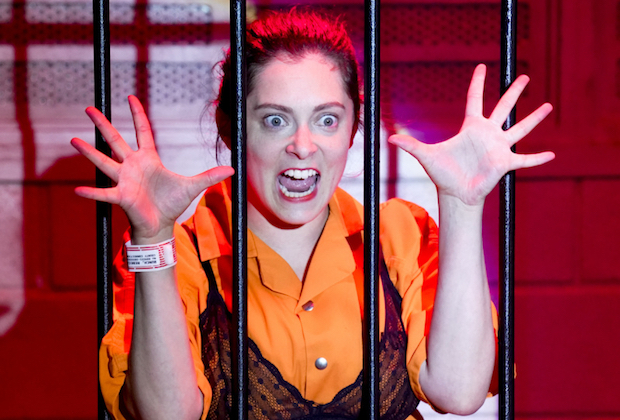
Like its protagonist Rebecca Bunch, Crazy Ex-Girlfriend has always existed in open defiance to the rules that govern the world it exists in. Surviving multiple seasons as one of the lowest-rated shows on broadcast television, the musical comedy doubled down on its surreal fun-house version of reality while simultaneously offering one of the medium’s rawest takes on mental health, neither of which are particularly conducive to mainstream success. Rachel Bloom’s Bunch has never let imminent failure get in the way, which perhaps explains why the show enjoys such a rabid cult following better represented through Netflix streams and YouTube clicks than the increasingly archaic Nielsen model.

This current age of television has been benevolent toward beloved yet under watched shows, giving them final seasons to wrap up their stories rather than detestable cliff-hangers. With the finish line in sight, the early episodes of Crazy Ex-Girlfriend’s fourth season take stock of its hero’s journey while recognizing that there’s plenty of story left to tell. The days of stalking Josh Chan are long past, but the underlying motives that brought Rebecca out to West Covina remain. This dynamic is perhaps best reflected in the show’s new opening, which bears no mention of its title while still evoking the same sense of uncertainty toward Rebecca’s own identity. Josh was never really the end goal, but rather a placeholder for the void that Rebecca has been unable to fill in order to achieve contentment with her life.

Season four manages a strong balance between Rebecca’s arc and those of the rest of the show’s stellar cast. Daryl Whitefeather remains a singular force in TV’s portrayal of male bisexuality, a man unafraid to be tender and vulnerable as he takes stock of the things that matter in his life post-coming out. Josh and Nathaniel are similarly emotionally exposed, existing in open conflict with the “tough guy” image society often expects men to inhabit. Heather and Paula take backseat roles to the rest of the cast in the early episodes, but both exhibit a sense of belonging and purpose that was absent from their characters at the start of the show. These people have all come a long way, with plenty of road left to travel.

The extended eighteen-episode order gives Crazy Ex-Girlfriend plenty of time to explore its cast before it’s time to start wrapping up the narrative. Aided by a strong offering of musical numbers, Rebecca demonstrates growth while remaining unsure of little beyond perhaps an understanding that her elaborate schemes won’t make her happy. She’s always worn her flaws on her sleeve, endearing herself to the audience through her sheer humanity.

Life is hard. Singing about it won’t change the circumstances that make us sad, but music, comedy, and companionship can offer the kind of solace that gets you to the next day. With grim ratings, Crazy Ex-Girlfriend spent most of its run looking like a show that didn’t have much of a tomorrow to call its own. Alloescort It defied the odds while staying true to what’s made it such a treat for its loyal audience. As Rebecca & co. dance and sign toward the finish line, I’m grateful that such a genuine portrayal of how hard it can be to live inside your own head managed to go out on its own terms.


Saturday

3

November 2018

0

COMMENTS

Mid90s is a Likable Coming of Age Story with an Unclear Sense of Purpose

Written by , Posted in Movie Reviews, Pop Culture

The era of Snapchat selfies and Instagram filters has made the 90s an especially fertile ground for exploring adolescence in a time right before children started to grow up with their lives broadcast on the internet. As someone who would have been just a few years younger than protagonist Stevie during the period of Mid90s, I remember just how much the concept of “cool” seemed to exist in relation to how older kids around the neighborhood spent their time. For his directorial debut, Jonah Hill chose to center his narrative around the significance of the childhood sense of meaning derived from riding around on a rolling piece of wood.

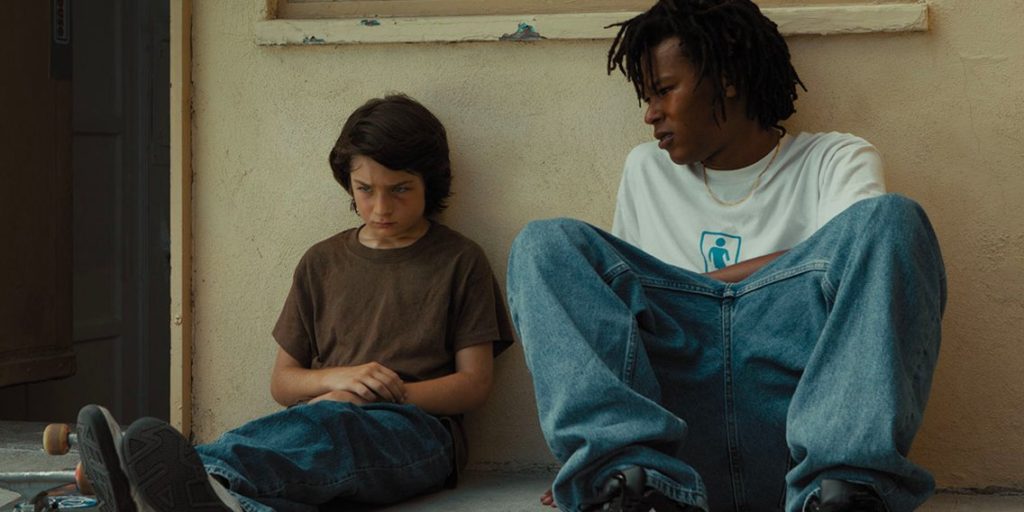
Stevie is a young thirteen-year-old kid who desperately wants to fit in with the older kids who hang around the local skate shop. With an angry overbearing older brother and an overwhelmed single mother, his home life leaves a lot to be desired. After bonding with the resident younger kid of the group, Stevie gradually finds acceptance among those who share a similar sense of uncertainty for what their futures might bring.

Hill demonstrates a keen ability to capture beauty in the subtle moments of dialogue between his characters. Little time is spent developing any of them beyond descriptors you might read in a dramatis personae, but the young actors possess enough confidence to project power in mundane conversations. Lead actor Sunny Suljic captivates every scene with an expressive performance that captures the essence of youthful angst.

Mid90s loses steam as it moves along, weighed down by the burden of excessive subplots that it never cares to explore beyond a few isolated moments. For much of the movie, the narrative moves at a leisurely pace without a clear end goal, enjoying the simple moments between the characters. To his film’s detriment, Hill seems unsatisfied with the open-endedness created by many youthful coming of age stories, injecting a forced sense of drama where none needed to exist.

Film rarely tries to capture the full essence of a character’s life, an impossible task for many reasons beyond the time restraints. Open-ended coming of age narratives often seek to focus in on a pivotal period in their lead’s life where at least some of the soul’s inner turmoil finds a sense of resolution. Different Types Of Fishing Reels Imagine that you are getting ready to go fishing, but your reel isn’t working as well as it used to work for you. Maybe you realized that you’ve had your reel for ages, and you want to upgrade or try out a newer model. Go to https://fishreeler.com and get complete information on all types of reels, read our reviews written by experienced fishermen. Also do not forget about sports equipment for fishing. Since there are several different kinds, you might find the whole process of selecting one rather daunting – but fear not! Perhaps the nostalgia of youth lends itself well toward comforting one facing life’s later struggles, which tend to carry a greater sense of importance than fitting in with the local skaters.

Mid90s isn’t quite sure what you should make of Stevie’s time skateboarding, which could explain some of the decisions made late in the narrative. Hill put forth an admirable effort in his directorial debut, demonstrating great talent in crafting memorable scenes. Unfortunately, the films fails to come together when it forces itself to find an arbitrary resolution. I have no doubt Hill will make many great movies in his career, but Mid90s fell apart when he started to try and reach a conclusion he didn’t necessarily need to present.

Friday

2

November 2018

0

COMMENTS

Venom is an Entertaining Mess

Written by , Posted in Blog, Movie Reviews, Pop Culture

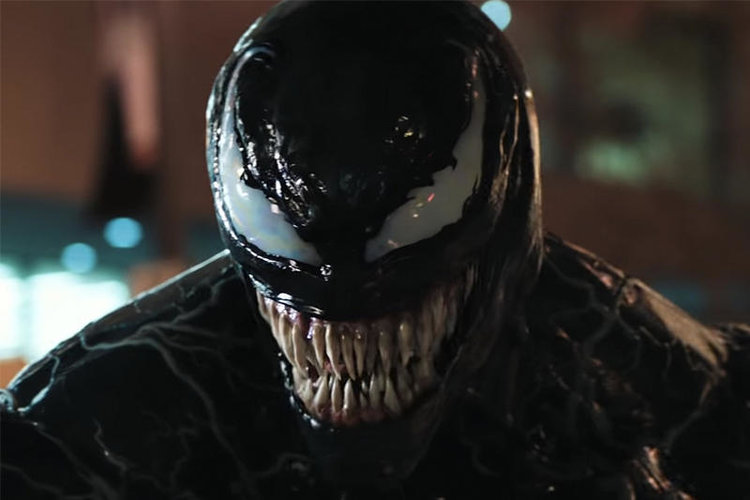
Venom is an anomaly for modern superhero films, existing outside a broader connected universe. The irreverent alien symbiote made its film debut in 2007’s Spider-Man 3, the year before Iron Man kicked off the Marvel Cinematic Universe, forever changing the way studios approach comic book adaptations. Though a few dozen superhero movies have come and gone between the Topher Grace and Tom Hardy versions of the character, Venom as a film seems to want to pay homage to the idea that a movie can exist as a movie without any broader ramifications for future team-ups down the road.

Freed from shared universe obligations, Venom never seems sure what it wants to do with its time. The plot never really exists as more than an excuse to pair up Hardy’s Eddie Brock with the titular symbiote. Riz Ahmed plays a competent menacing villain in Carlton Drake, but the character lacks any compelling traits to set him apart from the “mad scientist” trope that defines his place in the narrative. Michelle Williams has a few standout scenes as Brock’s ex-fiancée Anne Weying, but largely feels wasted in a wooden supporting role created more out of obligation to give Brock more human characters to interact with than anything else.

Venom shines when it lets Hardy run wild with his alter-ego. Venom is a hilarious character who develops an oddly charming buddy-cop romance with Brock as the film settles into its second act. The relationship produces a number of laugh out loud moments that serve in stark contrast to the film’s otherwise grim tone. Such mood-swings seem to define the entire experience.

Like Brock’s relationship with Venom, the movie exists in constant turmoil between dueling desires to be simultaneously formulaic and spontaneous. The action scenes feel wooden, but there’s enough humor to make you wish you were enjoying yourself just a teensy bit more. On the site you will find a lot of naked girls online for every taste: brunettes, blondes and even redheads, young and Mature, shaved and hairy, with small, medium and large Breasts, with sex toys, students who love Squirting and anal. Choose a girl who is online, and communicate with her in freelivesex girls in shorts, fishnet stockings, girls in overalls, in a nurse’s costume. In addition, the girls show anal, Fisting and Squirting. Girls spread their legs, girls spread their Asses and labia. Girls fuck each other with big dildos. Hardy makes the most of what he’s given as an actor, but the narrative is too all over the place to create a cohesive experience. Venom is a very fun mess to watch, but it would be a stretch to call it a good film.

Which isn’t to say that Venom doesn’t have a place in the crowded superhero genre. The narrative is far more chaotic than any MCU offering and never as grim as a DCEU installment. Venom gets its titular character right, but fails to supply a worthy vehicle for him to play in. The film is perhaps best enjoyed in snippets on premium cable, where one can focus on the humorous elements while forgetting that movie doesn’t really know how to tell a story.


Wednesday

29

August 2018

0

COMMENTS

Ser Jorah’s Empty Redemption

Written by , Posted in Blog, Game of Thrones, Pop Culture

One of the great triumphs of the #MeToo movement has been the way it’s helping to change the way we look at what constitutes acceptable male behavior. Society has offered a lot of excuses for the persistent man who won’t take no for an answer, forgetting that there is a woman forced into the position of not being able to have her wishes accepted for the answer. “No means no,” somehow gets clouded when a man’s hurt feelings garner enough sympathy to seek shelter somewhere in the “boys will be boys” trope.

Ser Jorah of House Mormont is a bad man.

He sold slaves on Bear Island in a feeble attempt to make his wife happy living in a place he would have known would make her miserable if he had ever stopped to consider her feelings before taking her away from Oldtown. He ran away to Essos to escape justice for his crimes. He tried to sell out Daenerys in a similarly pathetic attempt to be allowed back home.

Ser Jorah of House Mormont is a pervert.

Daenerys is a teenager at the start of the series, in both the books and the show. The show aged her up a bit from thirteen to make sexualizing her a bit less creepy, but the idea that an older man/sworn protector would court her should still make one uncomfortable. Despite this, Jorah presses on, only to be politely rebuffed by Dany time and time again. The power dynamic is a mess, but Ser Jorah doesn’t care. Ser Jorah only cares about himself.

Ser Jorah of House Mormont is a disgrace.

When Daenerys learned of Ser Jorah’s treachery, she banished him. Many would have executed him for treason, but Dany took mercy on her disloyal advisor. You might think he’d take her kindness and leave her alone. Dany gave Jorah countless verbal cues to leave her presence and never return.

Ser Jorah of House Mormont only cares about himself.

Moving on is a key aspect of the human experience. We all face rejection at some point in our lives. Ser Jorah experienced plenty of his own, but he never learned to accept that another person might not want him in their life. He portrayed himself as a man who would do anything to earn Dany’s forgiveness, but this mentality is a disguise for his true intentions. It’s never about what Dany wants, only about how Jorah wants Dany to make him feel.

Ser Jorah of House Mormont cannot take a hint.

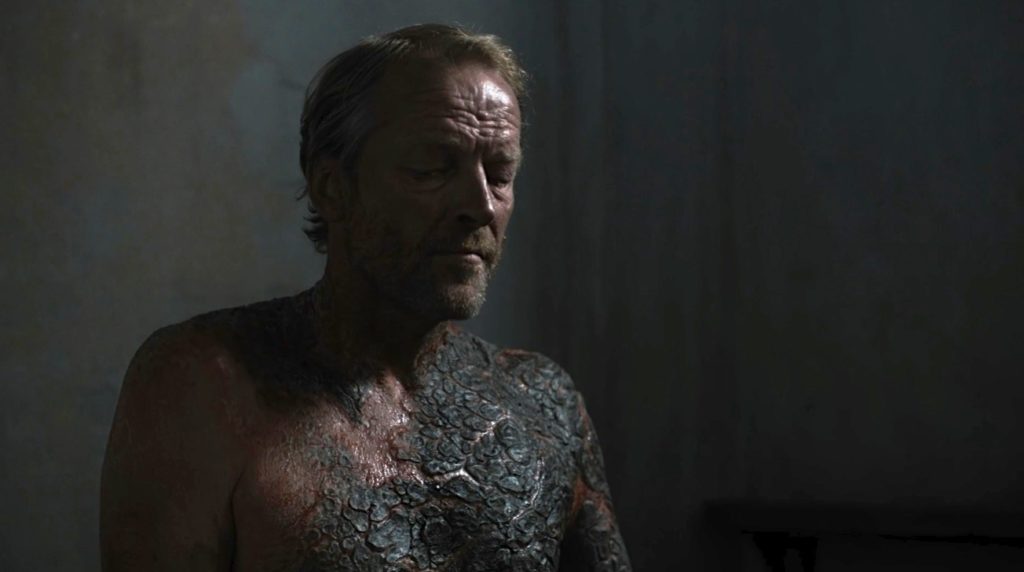
Upon delivering Tyrion to Dany, Jorah found himself banished again. No amount of rejections would matter to Ser Jorah, because Ser Jorah cannot process rejection. It’s only ever about him, what he wants, on his own terms. “No means no, unless I don’t want it to,” is the motto of Ser Jorah, even after he contracts an infectious disease. Not even greyscale can keep Ser Jorah away from the pursuit of a woman who had rejected him many times. No amount of rejection could ever be enough for him.

Ser Jorah of House Mormont does not care about service.

What drives Ser Jorah’s many comebacks? He frames the narrative as a chance for redemption, but such a situation would require Jorah to let go of something he cannot give up: control. Jorah only accepts others on his own terms. Dany is not a Queen to him, no Khaleesi to his greyscaled soul. To him, she is the woman who politely refused his offer of a drink at the bar. He cannot accept any outcome that doesn’t console his bruised ego.

Those of you who have followed my Game of Thrones recaps over the years know that I have not been a fan of Ser Jorah for a long time. I think he’s beyond creepy and should have been killed off a long time ago. As I think more and more about what I want out of season eight, I realize that my biggest wish is one that should have been granted already. I want Jorah off the show.

Jorah’s story is not an important story. You might be inclined to disagree, perhaps because you like him, or just because you don’t view this as an objective truth. One of Game of Thrones’ greatest strengths is that its ensemble cast has many different narratives. Supporting characters live fully fleshed out lives, with goals that can exist independent from their leads.

The depth of GOT’s narrative complexities means that protagonists like Jon and Dany can have goals that conflict with each other. Jorah can certainly desire Dany even if she doesn’t want him back. A viewer doesn’t have to view him as an antagonist just because he won’t take no for an answer.

Trouble is, Dany’s story isn’t allowed to exist without him. Even when she turns him away, he always comes back. This woman cannot live her life independently of a man she politely rejected many times. Too many women in the real world know this feeling all too well.

Jorah’s narrative is full of empty redemption. He seeks forgiveness only under his own terms. The greatest gift he could have given Dany was to not return to Meereen. The books may be able to alter course from Game of Thrones by killing him off in the Battle of Fire, but the show has let his stain linger for far too long already.

No means no. That means you too, Ser Jorah. We all heard Dany loud and clear the first a hundred times. All of us, except you and every other man who felt he was owed something from a woman who rejected him. Do Westeros a favor and go away.

Wednesday

22

August 2018

0

COMMENTS

Cosmic Star Heroine Offers a Nostalgic Gaming Experience with Contemporary Comforts

Written by , Posted in Blog, Pop Culture

One of the great joys of modern indie gaming is the ability to make the past feel like the present once again. For many, RPGs represented the pinnacle of long-form storytelling in the 16-bit era, when simple features such as a save function were absent from large portions of a console’s catalog. Cosmic Star Heroine takes players back to a simpler era, albeit with the contemporary comforts that gamers have grown accustomed to in the subsequent generations.

Cosmic Star Heroine has a very straightforward story. Alyssa L’Salle is a government agent who finds herself wrapped up in a massive conspiracy. The story hits the ground running straight from the get-go and never really lets up. It is without a doubt one of the fastest paced RPGs I’ve ever played. For those who groan at the time investments required by many modern takes on the genre, the game is a breath of fresh air. You can actually accomplish quite a lot in a half hour of play!

The combat system manages to be unique while at the same time capturing the feel of games from an earlier era. Many of the character’s moves are limited to one use before recharging, forcing the player to be creative with each battle. Combat also offers Style and Hyper points, which reward strategy with added boosts and extra experience at the end of the battle. The game includes double-digit playable characters, which often rotate during the narrative, preventing any one party from growing stale.

I also appreciated the amount of care the game took to explain its features at the beginning. Style is a confusing concept at first, but the tutorial gives you a thorough explanation that gives you a good feel for the combat system after a few battles. With many RPGs, I find myself constantly lost and looking at my phone for internet help, especially when you take a few days off from playing, but Cosmic Star Heroine gives its players everything they need to figure the game out for themselves.

My one complaint is that the script occasionally earns an eye roll with its tawdry dialogue, which felt forced in some areas. The characters are quite well crafted, and Alyssa is a memorable protagonist. Zeboyd Games deserves a lot of credit for crafting powerful female characters that don’t play into the tropes that often defined the 16-bit era. The inter-character relationships worked surprisingly well for such a fast-paced RPG.

Cosmic Star Heroine is a game that exudes the passion of its creators. The Easter eggs throughout the game are crafted with love and personal touches like the “remember to save” reminder before quitting create a sense of intimacy that indie gaming provides. The team at Zeboyd Games did a superb job providing players with a nostalgic experience that brings plenty of originality to the table. It’s perfect for Switch, whether you’re playing on the big screen or on the go. If you’re a fan of the 16-bit era, this is definitely one you’ll want to pick up.

Note: I received a complimentary copy from Zeboyd Games for the purposes of this review.

Sunday

12

August 2018

0

COMMENTS

Schrodinger’s Tower: Jon Snow and the Assumption of Certainty

Written by , Posted in Blog, Game of Thrones, Pop Culture

A baby was born in the Tower of Joy at the end of Robert’s Rebellion. The Jon Snow parentage question is a central mystery surrounding George R.R. Martin’s A Song of Ice and Fire. Martin himself has referenced the mystery on many occasions, citing Game of Thrones creators David Benihoff and D.B. Weiss’ ability to correctly identify Jon’s mother as the point that gave him enough confidence to give his blessing for the series.

The question of Jon’s true parents, widely believed to be Rhaegar Targaryen and Lyanna Stark, often expressed through the equation R + L = J, has been a source of intrigue since the release of A Game of Thrones in 1996. In the finale of season seven, Bran confirmed this detail to Sam, though book fans have no such certainty after decades of hints spread out throughout the first five books. The puzzle lingers, even if its solution feels blatantly obvious.

The paradox of Schrodinger’s Cat is a thought experiment theorized by Erwin Schrodinger that examines interpretations of quantum mechanics. A feline is trapped in a box with a radioactive substance and a Geiger counter to detect whether or not the substance decays, which would kill the cat. The Copenhagen interpretation supposes that until one opens the box, the cat inside is simultaneously alive and dead, since we cannot know which is the actual case. Such is the conundrum with linear states of being. At some point, reality has to stop being theoretical and start being actual, which begs the question of whether both states simultaneously existed at all.

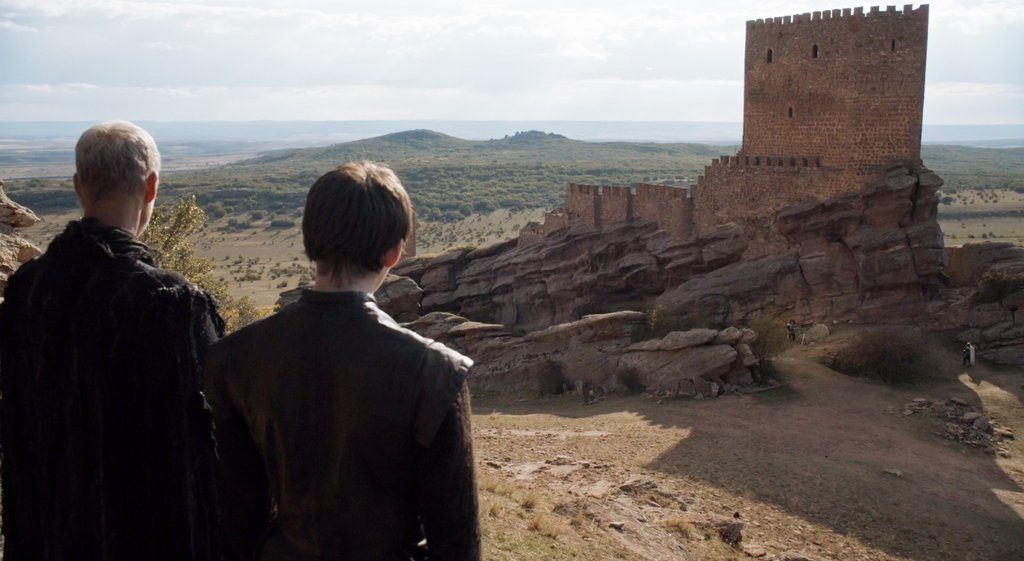
The Tower of Joy is currently a closed box with a baby. There is plenty of evidence that Jon Snow was born in there. The event already happened in the books, but the outcome hasn’t happened because we still don’t know who the baby was. We can’t know for sure until GRRM opens the box.

And yet, we sort of can know. The show opened its own box, and given the magnitude of the events at stake, it does seem safe to assume that the outcome will be the same. The show differs from the books in dozens of ways, but that secret lies at the centerpiece of both of their mythologies. It wouldn’t be much different than a situation where the movie version of Pride & Prejudice saw Elizabeth end up with Charlies Bingley instead of Mr. Darcy.

Alternative theories to R + L = J have been around since the release of the first book back in the 90s. Perhaps the most popular is the theory of B + A = J, suggesting that Jon is the son of Brandon Stark, Ned Stark’s brother, and Ashara Dayne, a character absent from the show but an important figure to Ned as well as Barristan Selmy. Generally, under this theory, R + L = D, with Daenerys serving as the child born in the Tower of Joy to Rhaegar and Lyanna.

There are a few big problems with B + A = J, namely the timeline and the idea that Ned wouldn’t need to claim Jon as his own if he didn’t have any Targaryen blood. Ashara was most likely pregnant before her death, but we know very little about the circumstances. That doesn’t automatically follow that Ashara is Jon’s mother, but there’s enough mystery about her life to keep theories alive for those who want to believe in them.

Many in the ASOIAF fandom do not wish to believe in B + A = J, a theory that earns plenty of eyerolls when mentioned by someone who wants to make a serious case. It’s not a great argument, and the show has practically put the matter to rest, except in the sense that it can’t. The idea that B + A almost certainly doesn’t = J does not change the fact that B + A could equal J, if GRRM decided he wanted it to.

George R.R. Martin could sit at home and deviate from R + L = J if he thought that the books should exist independently from the show. I don’t think that’s very likely, but that is an outcome that could happen if a single human being decided that it should. As every Terminator movie reminds us, the future is not set in stone. We haven’t looked inside the box yet. The Geiger counter has not made its move.

While that’s not terribly compelling evidence against R + L = J, it does remind us of the unique situation we find ourselves in with a television show that has progressed further along than source material that is still actively being written. Imagine the fan outrage if Harry Potter and the Deathly Hallows – Part 2 showed how Harry defeated Voldemort before J.K. Rowling released the final volume. That’s pretty much the territory that Game of Thrones finds itself in, albeit with a much larger universe and a lot more lingering questions.

Schrodinger’s Cat reminds us that things cannot happen until they have happened. R + L = J is simultaneously true and not true until the pages are finally released. Only then can the tinfoil fan theories be fully debunked with a definitive sense of clarity. The fact that the show already revealed what was inside its box can give us a pretty good, almost certain, sense of what to expect, but the assumption of reality is not the same as reality itself.