Ian Thomas Malone

Tuesday

9

July 2019

0

COMMENTS

The Kids Might Be Growing Up, but Stranger Things 3 Appreciates the Present

Written by , Posted in Blog, Pop Culture, TV Reviews

For a show with such an extensive ensemble cast as Stranger Things, time itself functions as a character in its own right. The 80s aesthetics play a crucial role in the narrative, with the series serving as a love letter to the decade, as does the youth of the core performers. A few years have passed since the series debuted in 2016. Most of the cast look older, presenting a challenge for a show that uses childhood nostalgia as its bread and butter.

Season three neither ignores the fact that its characters aren’t the same adorable bunch who saved the world riding around on their bikes, nor tries too hard to force aging into its narrative. The kids are older, yes, but the summer setting allows the series to skirt by without injecting too much reality into a story that already requires a fair amount of disbelief. Stranger Things recognizes that nostalgia allows one to put aside the present, quickly acknowledging its aging characters before doing its best to pretend nothing’s changed.

As with the previous two seasons, the character dynamic is a bit different this time around. While last season kept Eleven (Millie Bobby Brown) away from the boys for the bulk of its run, Dustin (Gaten Matarazzo) finds himself apart from the core group this year. The show uses Dustin’s natural chemistry with pretty boy Steve Harrington (Joe Keery) to its advantage, pairing them with newcomer Robin (Maya Hawke), Steve’s coworker at a mall ice cream shop, and Erica Sinclair (Priah Ferguson), in an elevated role. Erica is easily this season’s breakout character, providing a lot of much needed comedic relief.

Season three features the return of the Mind Flayer, wreaking havoc on Hawkins with its invasive body-snatching. The introduction of a Russian military base gives the season a bit of a Red Dawn feel, along with homages to The Terminator, The Thing, and Die Hard, among others. The nostalgia doesn’t weigh super heavily on the narrative, allowing those who don’t really understand the references to enjoy without missing much. Eggo waffles play a diminished role this year, but a couple of iconic 80s products get a bit of time in the spotlight.

There is a bit of disconnect between the various groups of characters this year, exacerbated by the series’ growing cast. The adults, particularly Hopper (David Harbour) and Joyce (Winona Ryder) feel a bit less essential, though they have plenty of memorable moments alongside Murray (Brett Gelman) and newcomer Alexei (Alec Utgoff), a Russian doctor with a love of Slurpee’s. The plot feels like it could have been streamlined with a smaller cast, but the characters have so much chemistry that it’s hard to complain.

Season three lives in the moment, a fun-filled summer adventure that does its best to ignore the passing of time. With season four expected to be the last, the characters won’t really have to worry about growing up too much longer, relieving any need for the show to be some treatise on aging. Stranger Things packs a lot of heart, a perfect getaway for this time of year.

Monday

8

July 2019

0

COMMENTS

Euphoria’s High Lacks Substance

Written by , Posted in Blog, Pop Culture, TV Reviews

America has changed quite a bit since John Hughes started crafting his iconic narratives about the struggles of teenage life. It’s hard to imagine a group like The Breakfast Club sitting around a circle talking with each other when the option to simply stare at one’s phone presents itself. Teenagers nowadays are exposed to a whole world beyond the classroom, not just the self-portraits of genitals that circulate over dating apps. The characters in HBO’s Euphoria would have little use for the now-legal pot with fentanyl offering a far more potent high.

From an aesthetic standpoint, Euphoria aims to provide a certain kind of visual high, with luscious color schemes that draw the audience into its elaborate sets. The desire to go beneath the surface, to understand the drive that makes these kids behave in such destructive ways, remains present through each episode. Trouble is, the show doesn’t really have anything to say.

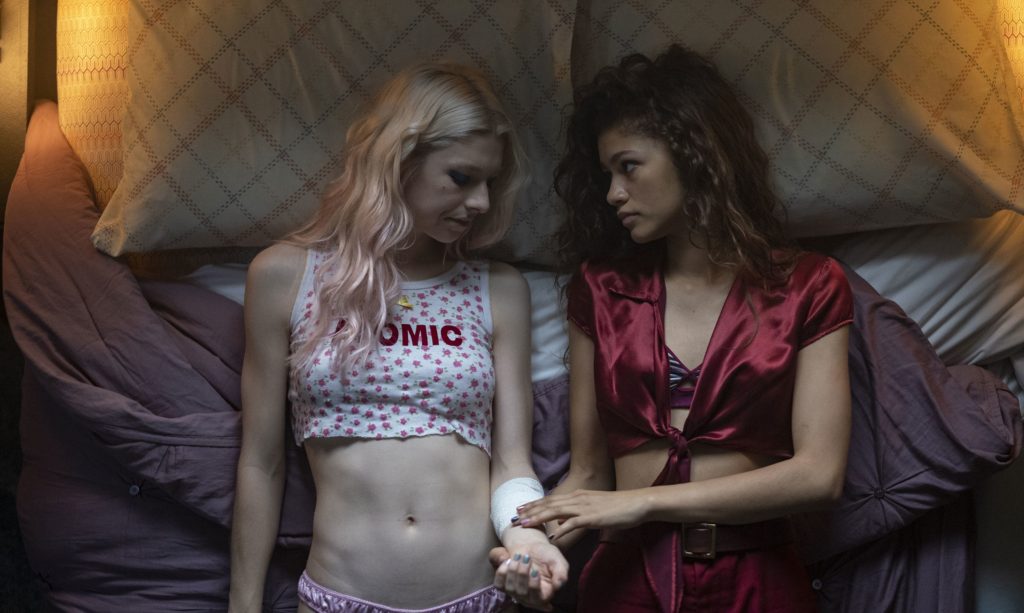
Zendaya anchors the cast as Rue, a drug addict caught in the cycle of addiction. Rue also serves as the show’s narrator, often providing illuminating background on the show’s other characters. Zendaya’s performance suggests a level of depth to Rue that Euphoria seems all too content to leave unexplored. There remains the idea that there’s a hidden complexity lurking behind her detached demeanor, but much of that sentiment feels like undeserved mystique for a show that never bothered to fully flesh out its characters.

A similar kind of dynamic plays out with Hunter Schafer’s Jules, a trans girl with a warm heart and a penchant for picking unworthy men. Schafer is an excellent actress, bringing a sense of awe and wonder to a character desperate to belong in a world that had been previously closed off to her. Trouble is, she’s not really given much to work with.

Euphoria wastes much of Schafer’s talents with its lazy approach to transgender storytelling, far too preoccupied with surface level clichés to present anything original. Jules is less her own character than a vehicle for the trauma of others, a new chapter in the manic pixie dream girl trope. The show misses an easy opportunity to break new ground in the way transgender people are portrayed on screen, instead choosing to spend its time on what an attraction to Jules might mean for another character’s sexuality.

The cast is perhaps too big for its own good. None of the male characters are particularly interesting, to some extent an inevitable byproduct of its splintered focus. Barbie Ferreira gives the strongest performance of the bunch as Kat, a teen eager to explore her sexuality in a world primarily interested in objectifying her. The show would be vastly better off centering its attention around Rue, Jules, and Kat, allowing it to go a little deeper than the tropes it consistently centers itself around.

Euphoria relies too often on shock value as a substitute for substance. There are plenty of things to like about the show, from its strong cast to its stellar production value. The narrative struggles to stand out in a world where plenty of people can look elsewhere besides premium TV to see the kinds of visual once deemed edgy. Very few television shows put full frontal male nudity up on the screen, but like the dick pics it often features, there’s just something oddly uninteresting about that kind of imagery in the year 2019.

Sunday

7

July 2019

1

COMMENTS

The Art of Self-Defense Is a Timely Commentary on Toxic Masculinity

Written by , Posted in Blog, Movie Reviews, Pop Culture, Reviews

The past few years have shined a light on the notion of toxic masculinity, which has played a role in the formation of humanity since before recorded time. Countless think pieces have been written on “incels” and members of the alt-right in an attempt to get to the bottom of what it is that many men seem to fear in this changing world. As a period piece set in the 90s, The Art of Self-Defense isn’t really about the Trump era, but the present looms heavily over the narrative.

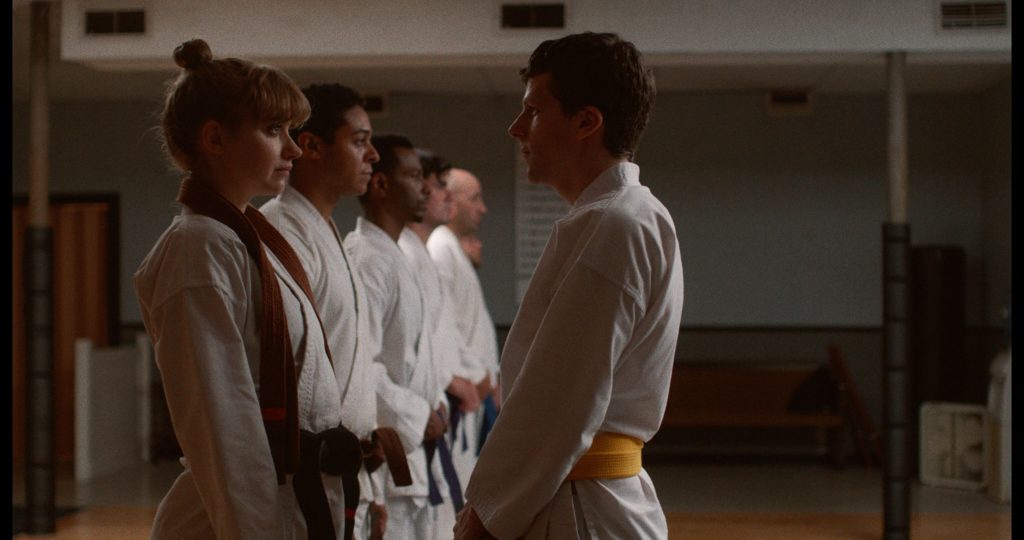
After a horrific mugging leaves him hospital bound, Casey Davies takes up karate in an effort to better protect himself against a world that doesn’t seem to have much of a place for him. He finds community in his local dojo that was absent from his workplace, where he struggled to fit in as an accountant. The real world has its unwritten codes, but the dojo offers a firm sense of structure through its list of rules up on the wall, a code for a soul in need of order.

At first glance, it’s hard not to do an eye-roll at the notion of Jesse Eisenberg playing yet another nervously awkward character. On the surface level, Casey isn’t much different from many of the roles he’s played over the years, but he works exceptionally well for what the narrative calls for. There are plenty of men out there like Casey expecting to be something they’re not, alpha men.

The Art of Self-Defense has an uncanny grasp on comedic timing, a film that makes you laugh out loud when you least expect a joke to come. Eisenberg works exceptionally well opposite Alessandro Nivola, who plays his sensei. The film uses its period setting to craft a kind of parallel reality that’s about as believable as it needs to be.

The film is a timely commentary on masculinity while existing completely outside the present. Director/screenwriter Riley Stearns crafted a narrative that could’ve been written twenty years ago, presenting issues not necessarily in a quest for answers, but to shed light on the destructive habits that society imposes on people who aren’t quite cut out to be macho. Men have been grappling with this dilemma for longer than anyone cares to admit and will likely continue to for the foreseeable future.

While the film excels at its commentary on masculinity, it often seems lost with what to do with Imogen Poots’ Anna, the most skilled student at the dojo. Anna thrives in the male-dominated environment, but the narrative doesn’t have much of a place for her, often squandering a fairly compelling character. The relationship between Casey and sensei makes up the bulk of the film, but it might have benefited from a broader approach to its supporting characters.

The Art of Self-Defense is a wild ride that constantly challenges any expectation one might have going into the film. Stearns crafted a singular world that’s a lot of fun to inhabit, never afraid to inject humor into unsettling themes. The film presents a fresh take on the kind of toxic masculinity that’s been around since the dawn of man, a feat that makes for a delightful summer cinematic experience.

Saturday

6

July 2019

0

COMMENTS

Stunning Visuals and a Quiet Sense of Pacing Give Ari Aster Another Horror Gem in Midsommar

Written by , Posted in Blog, Movie Reviews, Pop Culture

Tragedy can often shine an unsavory light on a person’s true colors, a stress test for relationships that not everyone will rise to the occasion for. The process of picking up the pieces forces one to re-evaluate the remaining strands of a life through a whole new lens. Such is the backdrop for Midsommar, the second film from Ari Aster, who dazzled audiences last year with Hereditary.

Midsommar takes place in Sweden during a summer festival that only takes place every ninety years. For a group of grad students, the chance to tag along with a friend to witness his intimate commune celebrating a tradition little known to the rest of the world is an opportunity of a lifetime. For the outsiders, the secretive cult’s practices are a little more than they bargained for.

Aster’s vision for world building is utterly spectacular. The community he crafted in Midsommar possesses the kind of intricate detail that stays in the mind long after the credits roll. The sets are gorgeous, presented slowly throughout the film in a way that lets you take everything in. The color scheme is also quite beautiful, possessing a calming effect that contrasts well with the sense of horror that slowly unfolds.

The film possesses a strong grasp on the power of dialogue. The second half in particular has many long sequences where the characters don’t say anything at all, allowing the images to speak for themselves. Midsommar often feels like a mixture of a slasher and an art house film, with conventional subplots intertwined with a broader sense of purpose.

Florence Pugh gives a strong lead performance as Dani, a grief riddled young girl trying to figure out the next step in her life. From the start of the film, it’s clear she’s not meant to be with her boyfriend, Christian (Jack Reynor), who takes an interest in studying the culture of the commune, putting him at odds with his classmate Josh (William Jackson Harper). Dani is a bit of a distant protagonist, fitting for a film with a setting that functions as its own character.

With a runtime well over two hours, Midsommar is quite long for a horror movie. There is a purpose behind the slow burn, as Aster moves with a deliberate pace throughout the festival, meant to take place over a nine-day period. The audience is essentially on the same page as the outside students, watching the rituals unfold in a way that feels like real time.

It is perhaps a little too long for its own good, exacerbated by a few subplots that don’t seem to go anywhere and supporting characters who aren’t on screen long enough to make any kind of impact. Dani’s relationship with Christian is a little scattershot, never presented as particularly compelling. The pacing usually works to the film’s advantage, but it could definitely have benefited from a little tightening.

Midsommar is a mesmerizing experience, solidifying Aster as one of the most compelling directors currently making films. It’s the kind of film that’s completely welcoming to its scenery, only to exploit that sense of comfort at every turn. It is simultaneously beautiful and horrifying, one of the most delightful films of the summer.

Wednesday

3

July 2019

0

COMMENTS

Katherine Ryan’s Glitter Room Offers a Hilarious Perspective on Single Parenting

Written by , Posted in Blog, Pop Culture, Reviews

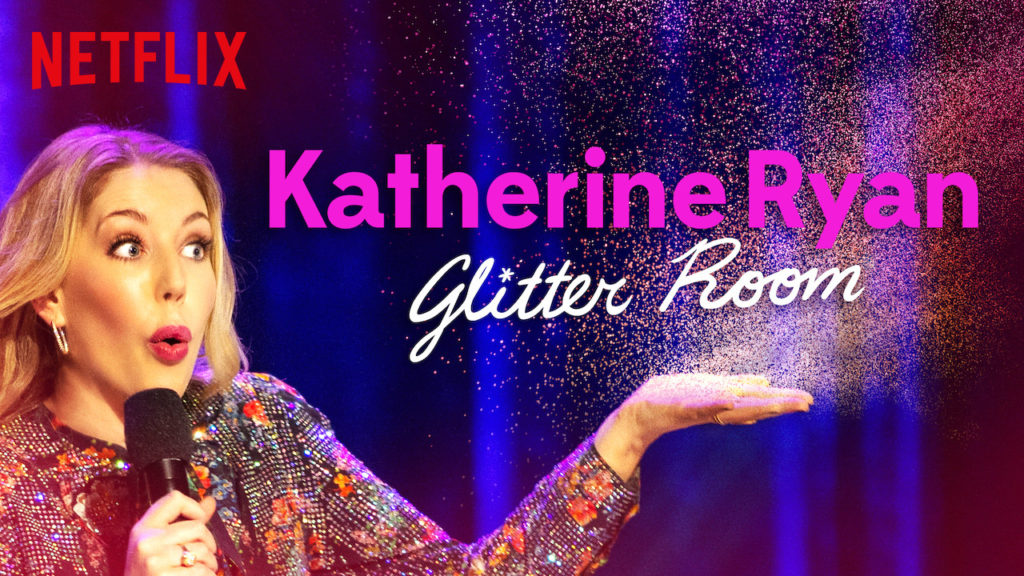
Part of the joy of watching Katherine Ryan perform is the way she tackles the current cultural climate surrounding men and comedy without sounding like she tailored her act to this particular era. Many of her observations about men in Glitter Room, her new Netflix special, could have been made twenty years ago. Ryan speaks not with vengeance about in the injustices brought to light in the #MeToo movement, but rather as a comedian staking her claim in the territory that men have felt comfortable in for decades.

The challenges of parenting as a single mother lie at the heart of Glitter Room. Ryan offers plenty of optimism for women in their thirties that their best days are still ahead. She takes on tropes like obnoxious school bake-sale organizers while staying above the fray of petty school politics herself. Her commentary feels more like an outside observer than an active participant.

The best jokes of the special tended to center around Ryan’s relationship with her daughter, particularly her position as a Canadian mother raising a child in London who is inevitably far more British than she could ever be herself. She’s an engaging storyteller who isn’t afraid to tell plenty of jokes that her daughter will potentially find cringe-worthy down the road. Glitter Room consistently presents as a portrait of her life at this moment, an intimate look at Ryan’s efforts to raise a child while still figuring things out for herself.

Ryan is quite an energetic performer with a keen ability to read a room. Glitter Room is one of the few stand-up specials to make audience interactions a highlight of the program instead of its weakest moments. Her engagements feel natural, enhancing her points while conveying the sense that she hasn’t just planned out each moment.

Some of the jokes do fall a bit flat, particularly when Ryan ventures into popular culture. She doesn’t have particularly anything original to say about the Kardashians, including a swipe at Caitlyn Jenner that felt a bit out of place in the year 2019. She also goes on an extended bit on Hamilton, which superfans of the musical might appreciate but started to feel more like inside baseball as the joke stretched on.

Glitter Room is a very entertaining special that delivers plenty of delectable one-liners. Ryan is a delight to watch with a delivery that feels organic and refreshing. She offers plenty to think about without concerning herself too much with the notion of any broader answer behind the meaning of life. The special had a nice way of making the future feel less about losing one’s youth and more about appreciating the days yet to come.

Wednesday

3

July 2019

0

COMMENTS

Spider-Man: Far From Home Is the Perfect End to Phase Three of the MCU

Written by , Posted in Blog, Movie Reviews, Pop Culture

One of the most impressive feats that the Marvel Cinematic Universe achieved in its third phase was the way it made the relationship between Tony Stark and Peter Parker feel so organic despite their relatively short amount of time on screen together. The mentor/protégé dynamic on display throughout Avengers: Infinity War and the closing moments of Endgame came about as a result of about twenty minutes of footage in Captain America: Civil War and fifteen in Spider-man: Homecoming. Iron Man’s own trilogy had wrapped up within the MCU before Andrew Garfield finished his run as the friendly neighborhood web-slinger.

As part of a giant interconnected universe, Far From Home certainly had obligations to explain the ramifications of Endgame’s earth-changing “blip,” as the film calls it. It can be easy to forget that this film is also the first solo effort in the franchise to have the bulk of its narrative set after the events of Infinity War, as both Ant-Man & the Wasp and Captain Marvel primarily took place chronologically before the massive team-up. The world is a different place since Thanos came to town.

To its credit, Far From Home handles the “blip” thoroughly without letting it become the major driving force of the narrative. Peter, Ned, and MJ, among others, are still in high school, but many of their once-younger peers aged in the five-year gap, creating some awkward classroom dynamics. Set during a European class trip after the school year, the film was able to recapture much of the high school energy that propelled Homecoming while not being bogged down in any of the inevitable post-Endgame weeds spread across New York.

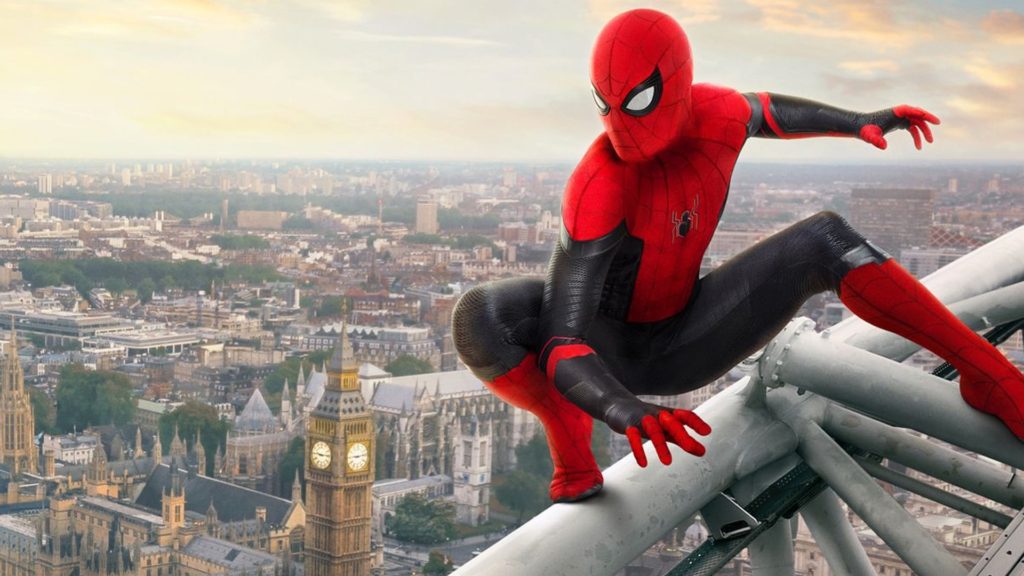
Tony Stark’s presence looms heavily over the narrative. Not only does Peter miss his mentor, but his absence creates a void within the superhero hierarchy that needs to be filled. Nick Fury wants Parker to step up, alongside Jake Gyllenhaal’s Mysterio, an enigmatic sorcerer who flies around with a cloudy dome on his head.

As always, Samuel L. Jackson steals the show in all of his scenes, dropping plenty of memorable one-liners as the battle-hardened elder statesman of the MCU. Far From Home allows itself to have a little fun at Fury’s expense, pitting him against the wise-cracking Parker for a dynamic we haven’t seen throughout his extensive appearances. Tom Holland’s chemistry with Gyllenhaal is another highlight of the film. Parker’s youth compared to all the other superheroes has left him without peers among the other Avengers, but Mysterio’s similar sense of otherness provides a suitable counterpart who can relate to his sense of feeling lost after the events of Endgame.

The action sequences are all well-crafted, though Far From Home excels when Parker isn’t wearing a mask. Peter is a grieving teenager lost in a world that’s demanded quite a lot from him in a short period of time. His efforts to reclaim his youth are easily relatable, with a quieter set of stakes that serve as a perfect counterbalance to the time traveling heist of Endgame. Saving the world is fun and all, but sometimes you just want to be allowed to have a moment with the person you love.

The film does a great job handling the elephant in the room, namely the absence of the other Avengers. While some are understandably unavailable, gallivanting off on other planets, Far From Home manages to address any lingering questions the audience might have for what everyone else is up to while the Elementals wreak havoc on Europe. Perhaps the one exception is Don Cheadle’s James Rhodes, who would have been an interesting addition given his close ties to Stark.

Far From Home closes out Phase Three of the MCU with a delightful story that embraces the human toll that saving the world has taken on the friendly neighborhood web-slinger. It’s perhaps a bit overstuffed at times, juggling Peter’s high school adventures with his obligations to Fury, but it’s a fast-paced narrative that delivers plenty of laughs. For those wondering what the future will hold for a world without Tony Stark or Steve Rogers, the film gives you plenty of reason to think this massive universe is going to be just fine.

Sunday

23

June 2019

0

COMMENTS

Legion Remains One of Television’s Greatest Visual Achievements

Written by , Posted in Blog, Pop Culture, Reviews, TV Reviews

Like its titular character, Legion is a very difficult show to describe. It’s a superhero show without heroes. The morality of David Haller isn’t so much grey as it is rainbow, impossible to decipher yet present in an unmistakable fashion. Legion is quite possibly the most beautiful show on television, with stunning visuals giving the eyes plenty to digest while leaving the mind dazzled and bewildered.

Season three continues the battle for control of David’s mind. The powerful mutant, played by Dan Stevens, seeks the help of a time-traveling mutant named Switch (Lauren Tsai) to help fix his mind after decades of abuse from Amahl Farouk (Navid Negahban). David’s former friends have allied with Division 3 on board an airship, doing their best to manage a situation far beyond any of their control.

As always, Legion remains a difficult show to follow. David’s motives are as elusive as ever, a protagonist seemingly unconcerned with the notions of good and evil. The show offers a remarkable visual portrait of David’s mental health in a constant struggle to unpack the years of abuse from the Shadow King,

The visuals on Legion are out of this world, fitting for a show that often takes viewers outside reality. Stevens’ performance in the lead role often serves as a suitable counterbalance, bringing a sense of calm to all the chaos. For all the times the viewer is left staring at the screen wondering what just happened, David is there to crack a slight smile as he embraces the world around him.

Legion is much better at offering food for thought rather than any sense of concrete answers. The urge to simply sit back and enjoy the ride is contrasted with a narrative that gives you just enough to start to put the pieces together, even if you’re never really left with the idea that the show wants to let you in on its secrets. It’s a journey with an unclear destination, an indecipherable map, and a cast of characters who rarely seem to have any more of a clue than the audience. Simply put, it’s a singularly bizarre piece of television.

As the final chapter in David’s saga, season three does carry the sense that it is headed toward a conclusion. You never quite know what direction each episode will head in, or how many times it’ll alter course, but the power struggle between David and Farouk remains at the core of the series.

Legion is among the finest comic book adaptations in existence, portraying the wildly inaccessible David Haller as faithfully as could possibly be imagined. The show brings out emotions you wouldn’t expect after two years spent redefining all the norms of television. With Disney’s purchase of Fox set to usher in a new chapter of the X-Men, it’s perhaps fitting that the story belonging to one of the most eclectic characters in its universe would come to an end.

For a show that could, in theory, go on forever, having shattered all expectations of time and space, the narrative finds a way to leave its audience feeling satisfied with this three-season arc. David Haller’s world is one that seems impossible to grow tired of, though the confines of television often call for shows this wild to enjoy shorter runs. Legion is one the weirdest shows ever made. Season three concludes a beautifully strange journey that often exists outside the world of beginnings and ends. Few shows can pack in so many different emotions in a single hour.

Friday

21

June 2019

0

COMMENTS

Toy Story 4 Is Another Heartfelt Pixar Gem

Written by , Posted in Blog, Movie Reviews

Few moments in children’s cinema have been as soul-crushingly devastating as the ending of Toy Story 3, where a college-bound Andy passes on his beloved toys to Bonnie for a new generation of adventures. Whether or not that scene should have marked the end of the franchise contrasts with the notion that the series is unlikely to top that level of emotional resonance on the tearjerker scale. Of course, there’s no inherent reason for Woody, Buzz, and co. to be limited to just three movies, beyond the sense of sentimentality that’s been such a strong anchor for the franchise since its debut in 1995.

Toy Story 4 reigns in its pontification on the meaning of being a toy a bit. Philosophy is still a predominant force driving the narrative, as Bonnie’s new arts and crafts creation Forky straddles the line between child’s plaything and literal garbage. Forky’s diminished sense of self-worth presents a broader question as to the continued purpose for Woody, who tries his best to remain a pivotal piece of Bonnie’s life.

Complicating matters is the return of Bo Peep, Molly’s nightlight and Woody’s love interest for the first two films. Bo has been living life as an abandoned toy, fending for herself and her flock in the absence of a child to care for. The cruel world has been unforgiving to the porcelain Bo, but her continued resiliency sheds light on an unexplored reality for the Toy Story universe. Life goes on.

Absent from Toy Story 4 is the sense of comradery that has defined the series. Hamm, Rex, Slinky, Jesse, Bullseye, and the Potato Heads have been largely relegated to cameo roles alongside Bonnie’s other toys. There’s plenty of humor to be found in the film, but the lack of one-liners from the original gang is certainly disappointing for lifelong fans of the franchise. Forky has a lot of funny lines, delivered by a perfectly cast Tony Hale, but he also sucks up a lot of the attention as the main force driving the narrative. For better or for worse, Buzz Lightyear spends most of the film playing second fiddle to a plastic fork.

Toy Story 4 functions as an enjoyable standalone adventure while serving as a worthwhile epilogue to the series. The series has always been Woody’s story first and foremost, but the seminal cowboy projects much of his anxiety in service to others. Here, Woody is allowed to be a bit more introspective as to the way he’s lived his life. Love is not a linear objective, but life has its trajectories that all of us must adapt to.

It’s a cold reality to admit that there’s a world out there beyond play time. It’s easy to relate to the toys in Toy Story because none of us want to envision a life spent sitting in a box in the attic. For many, we fear growing up because it means we have to say goodbye to the comforts and securities we’ve know. There’s always a tomorrow to be had, even in a dusty antique store.

Toy Story 4 isn’t as much of a tearjerker as its predecessors, but the franchise retains a powerful grasp on the emotions of its audience. Growing up is often sad, but that doesn’t need to be a bad thing. As someone who was about the same age as Bonnie when the original Toy Story came out, these movies will always possess the ability to turn me into a nostalgic weeping mess, but that’s not a bad thing. It’s good to feel, to know that even when life is sad, things will be okay.

Monday

17

June 2019

0

COMMENTS

Jessica Jones’ Third Season Is a Boring End to the Netflix Marvel Experiment

Written by , Posted in Blog, Pop Culture, Reviews

The television landscape has changed quite a bit since Daredevil and Jessica Jones premiered in 2015, promising an ambitious crossover between four separate Netflix series interconnected in the Marvel Cinematic Universe. With seemingly every major company looking for a bigger slice of the streaming pie, the relationship between Disney and Netflix was bound to sour, though the idea of rival networks producing content for each other is far from uncommon. The Netflix MCU experiment is ending not by any narrative mandate, but because two companies didn’t have the will to coexist.

Season three doesn’t feel like a final season. With news of its cancellation announced back in February, there’s a bit of disconnect between expectations and reality. Episodes that weren’t necessarily filmed as the concluding arc are delivered to fans as such, unsurprisingly landing with a bit of a thud. This wasn’t supposed to be the end, but we all knew it was ahead of time.

With that in mind, it’s hard to accept the glacier-slow pacing of Jessica Jones’ character development. She’s still a moody detective who seems to care more about bourbon than being a superhero. Much of this is a product of Jones’ personality as a character, but so much has happened to her over the past two seasons with shockingly little growth to show for it on screen.

Krysten Ritter often looks quite bored delivering her lines this season, even after putting aside the deadpan nature of her character. Gone are the powerful zingers that endeared Jones to the audience in past seasons. She looks tired, disinterested, and ready for the end. Her lines are spoken frequently without a hint of enunciation, like she’s reading them off the page for the first time.

Exacerbating this dilemma is the strong character development from the supporting cast. Trish, Malcolm, and Hogarth are all in drastically different positions than season one. Their characters have clearly drawn out arcs that are easy to follow and even easier to get behind. Meanwhile, Jessica is still the same old Jessica. The contrast rarely works to her advantage.

It rarely helps matters that Jessica is often paired with the anemic Erik Gelden, played by newcomer Benjamin Walker. For all the intriguing characters Jessica has shared screentime with, Gelden is very bland and boring. Like the burger Gelden can’t stop ranting about, he’s never as interesting as the show wants him to be.

Like every single season of Netflix’s Marvel series, the pacing problems are a persistent issue. Jones feels a bit sidelined in the early episodes, an issue again exacerbated by the fast-paced plotlines from her supporting players. While serialized TV has become the norm, Jessica Jones is a series that would have benefited immensely from giving its title character a couple of self-contained detective stories each season.

Season three does win plenty of points on the inclusivity front. While the MCU movies have been painfully behind the times on LGBTQ representation, Jessica Jones brings a nuanced approach to queer themes. Hogarth’s sexuality is explored extensively throughout the season. Transgender actresss Aneesh Sheth plays Jessica’s assistant Gillian without any scenes that explore the nature of her gender identity, a radical sense of normalcy that’s often sorely missing from on screen representations of the trans community.

TV shows in the streaming era rarely run more than five or six seasons, with shorter runs increasingly becoming the norm. Three seasons in, the show never has any sense of urgency to make the most of its time. Even if this wasn’t the end, season three meanders far too often to leave any kind of lasting impression. Netflix’s Marvel experiment has had its fair share of misfires, but these characters deserved better than an unceremonious ending.


Saturday

8

June 2019

0

COMMENTS

Pose’s Second Season Is a Triumph of Inclusivity

Written by , Posted in Blog, Pop Culture, Reviews

For all the accolades that Pose received for its groundbreaking first season, a Peabody Award and Golden Globe nomination for Best Drama among others, the series’ greatest triumph has been its portrayal of transgender life as more than the “trapped in the wrong body” trope. Too many other narratives surrounding our community, often spearheaded by cisgender men, struggle to wrap their figurative heads around the idea that many trans people have much bigger things to worry about on a daily basis than our individual histories with gender dysphoria. Our collective history possesses so many rich stories that still need to be told.

Season two takes a three-year time jump to the year 1990. The balls are still the centerpiece of the community and the characters are still struggling to stay afloat in a New York City that’s still very far away from even beginning to reckon with its various injustices. The AIDS epidemic continues to wreak havoc, making funeral parlor visits a necessary aspect of everyday life. The glamour of the balls stands in stark contrast to the ever-present sense of fear looming in the air.

Blanca remains the emotional core of the series, raising up the House of Evangelista with her tireless drive to better herself and her family. Mj Rodriguez gives an Emmy-worthy performance, exploring the nuances of Blanca’s vibrant contrarian personality while retaining a motherly sense of devotion toward her community. Refusing to succumb to her HIV, she serves as an example to all of us to never settle for a reality beneath one’s value as a human being.

Indya Moore was perhaps the breakout star of season one. Angel’s arc this season benefits immensely from the absence of Evan Peters’ Stan, allowing her to pursue her dreams as a model without a loathsome empty suit toying with her emotions. With the world of 1990 setting its eyes on Madonna’s “Vogue,” which finds its origins in ball culture, Angel harnesses her talents to reclaim some of what had been appropriated from their community.

Pose has always been a show with a two-pronged track to its narrative. The personal lives of its characters intertwine with the broader historical context of the era. Sometimes this approach comes across a little clunky, as the scripts often dump large helpings of exposition all at once in a manner that wouldn’t score too many points at the ball. This method does enhance Pose’s ability to deliver teachable moments to an audience that may not be very familiar with the history of the LGBTQ community, but it would definitely benefit at times from a softer hand.

While many period dramas in this current age of TV can meander a bit through their seasons, Pose tends to make each episode count. Often times, the show casts a more natural plot progression aside for grandiose deliverables at the end of its episodes. With a large ensemble cast and a desire to capture cultural moments of the 90s, the show doesn’t have enough time in ten episodes to take things slow. Knowing that prestige dramas these days rarely last beyond four or five seasons, it’s understandable to see them cut a few corners in service to a larger cause, even if some scenes come across as unrealistic or rushed.

The balls remain as fabulous as ever, even if you’re left wondering at times if all the money spent on costumes and trophies might find a better use for an impoverished community. The score is absolutely spectacular this year, enhancing the emotional impact of many of the scenes. The show nails the 90s aesthetic quite well without ever letting it be a distraction.

Pose remains the strongest LGBTQ narrative on television with a second season that lets its heroes shine without ever dimming the lights on the bleak realities of the era. Each episode is filled with laughter, tears, and a whole lot of heart. The plot progression might not always be as graceful as its characters are on the runway, but the show knows better than most that time is limited. Pose makes each moment count.