Ian Thomas Malone

Blog Archive

Tuesday

12

September 2023

0

COMMENTS

Classic Film: Made in Hong Kong

Written by , Posted in Blog, Movie Reviews, Pop Culture
There’s a certain timeless feeling to being young in a world that’s been raped and pillaged to the brink of destruction by the twisted wrought of capitalism. Film often sells its audience on the idea that we can break free of that cycle through a kind of a-ha moment, as if coming of age instills upon us new superpowers to transcend the limitations of our decaying planet. The 1997 film Made in Hong Kong, the first release after the region’s handover from the United Kingdom to China, explores the lives of a few teens living on the outskirts of society, barely scraping by, with no hope for the future.

Autumn Moon (Sam Lee) is a high school dropout working as a debt collector for a local gang run by Fat Chan (Chan Tat-Yee). Autumn is a feisty young kid, with spikey hair that matches his aggressive demeanor, but often displays a softer side as well. Autumn looks after Sylvester (Wenders Li), a mentally disabled kid who is frequently bullied, while being haunted by a love letter left behind by a peer Susan (Amy Tam Ka-Chuen) before she committed suicide. Autumn’s father left his family for a mistress, while his mother (Doris Chow Yan-Wah) abandons him early in the narrative.

The main action of the film centers around Autumn’s budding relationship with Ping (Neiky Yim Hui-Chi), who lives with her mother in a housing complex where Autumn makes his collections. Ping needs a kidney transplant she can’t afford, putting Autumn at odds with his employer, who controls her family’s debts. The memory of Susan ever-present in his thoughts, Autumn challenges Fat Chan’s grip on their community in a mostly futile effort to beat back the unrelenting tides barely letting any of them tread water above the surface level.

Director and screenwriter Fruit Chan crafts a beautifully bleak tragedy that’s bound to resonate with anyone who understands the natural primal rage that surfaces upon a realization that the cards will always be stacked against them. An ultra-low budget indie shot mostly on leftover 35 mm film, the cinematography possesses a natural feel that makes Hong Kong itself into a character within the slow-burn narrative. There’s a certain claustrophobia to the housing complex that perfectly explains the older character’s nihilistic outlook at their inescapable panopticon.

The film primarily uses non-professional actors, most making their feature-length debut. Lee brings such a raw chaotic energy to Autumn that you can’t help but root for him, even if he’s a little over the top for his own good. Chan mostly centers the 108-minute runtime on his characters, a gamble that pays great dividends in the third act. Made in Hong Kong is the kind of film whose emotional impact creeps on you, a subtly moving treatise on teen angst up against insurmountable odds.

The timing of the film’s release with the 1997 handover leads to natural comparisons, but the relatability of Chan’s work extends far beyond the geopolitics. Children are often told to work hard for the promise of upward mobility. The crony capitalism unleashed on the world has far different plans for the proletariat. Autumn lives his life like a kid with no future. He’s not exactly wrong in that regard, but the great power of the film manifests through the innate desire to root for him anyway.

Saturday

22

July 2023

1

COMMENTS

Futurama enters the streaming age without missing a beat

Written by , Posted in Blog, Pop Culture, TV Reviews

Futurama owed its original revival to two elements of the television landscape that are very much no longer in play. Riding the same wave of Adult Swim popularity and DVD sales that saw Family Guy returned to network television, Futurama was originally resurrected as a series of four direct-to-DVD movies that were restructured to comprise a fifth season on cable network Comedy Central, which later commissioned two additional seasons (the exact number of Futurama seasons is a bit tricky to pinpoint). The streaming era has largely replaced both the DVD market and original programming on basic cable, a new normal that the industry is still very much figuring out how to navigate.

While television has changed quite a bit since Futurama aired its most recent finale in 2013, the adult animated comedy scene has largely remained the same. There’s a certain irony in the old cliché about The Simpsons being past its prime when shows like South Park, Family Guy, Bob’s Burgers, and American Dad! have all blown past the range of the former’s consensus golden age. Futurama, along with the recently resurrected Aqua Teen Hunger Force and the upcoming revival of King of the Hill, aims to defy the recent string of unsuccessful nostalgia grabs that has plagued live-action continuations of former hits shows.

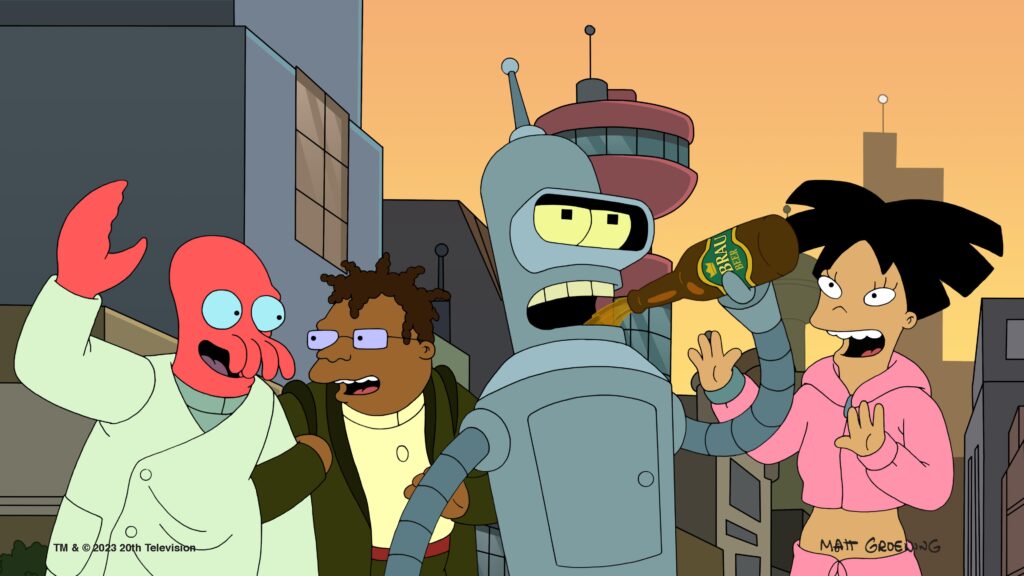
The first six episodes of Futurama’s upcoming eighth season that were provided to critics demonstrate a show unflustered by the passage of time. Our world has changed a lot since the show introduced us to the 31st century, but the Planet Express team largely carried on in the year 3023 with business as usual, with a few key exceptions. Futurama has always conducted itself with a greater degree of sincerity than most of its animated contemporaries. Season eight gives its characters space to grow without compromising the core foundation of the show.

The episodes are a great blend of character-centric storytelling and the zanier adventures that defined the early days of the show. Topical subjects like streaming TV, cryptocurrency, and monopolistic capitalism are covered with varying degrees of success, in some cases the humor barely scratching the surface of the available material. The voice cast hasn’t lost a beat. Their banter constantly makes you smile like you’re in the company of old friends.

Futurama’s narrative approach lends itself well to the passage of time, with much of the humor tied to the situational comedy of the story rather than straight one-liners or popular culture references. Fan favorites such as Bender and Dr. Zoidberg receive plenty of jokes, but the show gives the entire ensemble plenty of time to shine as well, including many favorites from the recurring bench. The show pokes plenty of fun at itself as well, a well-deserved victory lap of sorts for those of us who have rooted for Futurama’s success over the years.

Season eight is not likely to garner many new converts, but Futurama still has plenty of gas left in the tank. Longtime fans who weren’t too fond of the Comedy Central years are probably best sticking to the original run. The streaming era carries no real mandate comparable to the finite amount of timeslots available for a programming block like Fox’s old “Animation Domination.” Futurama certainly has far less mileage than any of its contemporaries. Season eight might not be genre-defining television, but it’s great to have these characters back for another round of adventures.

Monday

10

July 2023

0

COMMENTS

Mission: Impossible – Dead Reckoning Part One is popcorn entertainment from a franchise that’s starting to show its age

Written by , Posted in Blog, Movie Reviews, Pop Culture

There is a certain irony in Tom Cruise’s mission to singularly save cinema, his marquee franchise itself owing its origins to television. Seven entrees in, Mission: Impossible bears little in common to either its 1960s small screen source material or its 1996 cinematic debit. The world itself has less space for the kind of spectacles Cruise likes to stage on the biggest screens possible, many preferring the cozy comforts that the original show provided fifty years ago to the kind of antics that require a trip to the box office. The last few Mission films have sought to up the ante, defying the passage of time itself not just through consumer trends, but the age of Cruise himself.

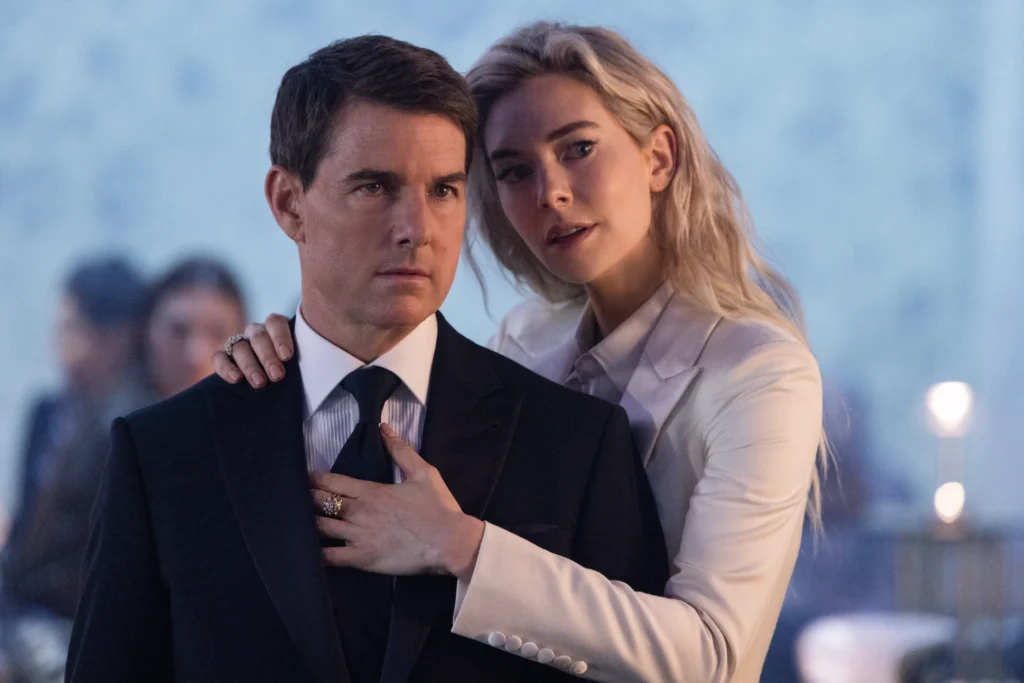
As its gravity-defying trailers suggest, Mission: Impossible – Dead Reckoning Part One brings all the action that have defined the series since at least its second installment, more carefully refined in the years since Ghost Protocol set the gold standard for blockbuster filmmaking. Ethan Hunt (Cruise) and friends, alongside new ally Grace (Haley Atwell), find themselves pitted against an experimental AI program called “The Entity,” capable of breaching all intelligence and defense networks in the world. Ethan and co battle numerous forces, including an enigmatic figure from his past Gabriel (Esai Morales) for control of a key that controls the computer aboard a sunken Russian submarine.

Director Christopher McQuarrie, in his third outing at the Mission helm, finds a weird balance between the previous two films. Dead Reckoning is tighter than the often-free wheeling Fallout, without the glamour and pizazz of Rogue Nation. The narrative isn’t exactly challenging to follow, but the script is so bogged down with exposition dumps that the audience is perpetually forced to confront its many holes. McQuarrie’s competent craftsmanship is perpetually at odds with the reality that this film isn’t as fun as it could have been, a frantic experience lacking the unadulterated joy of its predecessors.

Cruise’s supporting cast is largely comprised of returning players, including franchise mainstays Luther Stickell (Ving Rhames) and Benji Dunn (Simon Pegg) alongside newer additions Isla Faust (Rebecca Ferguson) and Alanna Mitsopolis (Vanessa Kirby). The weirdest throwback comes in the form of Eugene Kitteridge (Henry Czerny), last seen in the original film, stepping into the role of shady boss more recently occupied by Angela Bassett and Alec Baldwin, neither of whom returned. The bloated roster gives newcomers Morales, Atwell, and Pom Klementieff less time to shine, but the supporting cast does an excellent job working around Cruise, who continues to defy his age as a first-rate Hollywood action hero.

The film’s unwieldy 163-minute runtime is not exactly helped by the Part One in its title, a clunky overstuffed caper that does a lot less with its narrative than earlier entries managed. Dead Reckoning Part One exists in a peculiar space, a first-rate production that makes a strong case for the power of practical effects in the modern era, providing genuine spectacle in every sense of the word. Cruise’s broader mission to save cinema is on full display, a film that rarely pauses to take a breath.

Dead Reckoning Part One is excellent summer entertainment, one of the best cinematic experiences of the season. It is also the first Mission movie in over a decade with absolutely zero claim of superiority to the ones that came before it. To some extent, that might be expected. Cruise, Rhames, and Pegg are all showing their age in a way that hardly rang true the last time around, but the film often feels like it’s running on autopilot going through familiar motions. You can get the sense that the additions of Atwell and Klementieff were at least in part designed to inch the franchise toward a future without Ethan Hunt, despite Cruise’s intentions to continue with the character into his eighties.

The Mission: Impossible franchise has outlived plenty of industry fads over the decades. Part of the key to its success has been its ability to reinvent itself over the years. As its title suggests, there’s still a second half to the story of Dead Reckoning. Part One demonstrates that Mission still has gas left in the tank, but might be in need of a tune-up sooner rather than later.

Friday

9

June 2023

0

COMMENTS

Classic Film: Cold Water

Written by , Posted in Blog, Movie Reviews, Pop Culture

There’s a certain timeless angst to the toils of youth. Puberty floods the body with a sea of hormones few individuals are equipped to handle. An enhanced sense of freedom shields the broader panopticon from view, a lot of ideas for the future without many means to execute them. Set in the 1970s, the 1994 French film Cold Water (original title L’eau froide) captures teenage angst through a series of seemingly inconsequential yet powerful moments in its characters’ lives.

The film largely deploys a stream-of-consciousness approach centered on its two leads, Christine (Virginie Ledoyen) and Giles (Cyprien Fouquet). The two have an easy sense of chemistry, united by a common love of mischief. When Christine takes the fall for a shoplifting exercise gone wrong, her parents send her to a mental institute, her newfound sense of freedom promptly snatched away.

Director/writer Olivier Assayas centers the emotional anchor of his narrative at an abandoned rural chateau, which becomes the site of a small teenage rave. Utilizing a soundtrack powered by Janis Joplin, Leonard Cohen, Bob Dylan, Nico, and Alice Cooper, the film captures the relatable essence of being a teenage free spirit, alongside its shortcomings that would be lost of the youth, but not necessarily the audience. It’s easy to feel free when the drugs are flowing and the music’s blasting. Possessing actual agency is a far different story.

Ledoyen and Fouquet are fun to watch together, each carrying their fair share of the film’s emotional weight in an otherwise sparse narrative. Assayas keeps things tight with a 92-minute runtime that doesn’t overstay its welcome or allow the audience’s sympathies to shift to the more reasonable adults in the room. As its title suggests, most grand ideas of youth could do with a bit of cold water splashed to buff them out.

Assayas delivers a timeless slice of youth, powered by two emotionally raw performances from his young actors, as well as a killer score. Cold Water doesn’t necessarily reinvent the genre, but it’s a compelling narrative to spend time with. Many adults can relate to the passions exhibited in the film, even if we might cringe a bit from seeing too much of ourselves on the screen.

Thursday

8

June 2023

0

COMMENTS

Pride Film: Weekend

Written by , Posted in Blog, Movie Reviews, Pop Culture

LGBTQ people often have a tendency to develop extremely close bonds with intimate partners in short periods of time. For a community that knows ostracization and stigmatization all too well, the high of a new crush can supersede any concerns for the longevity of such passion, a mandate to live in the present without worrying about a tomorrow that brings almost certain doom. “No day but today” is less a mantra than a steadfast rule for survival.

The film Weekend follows one of those casual, curiously intense encounters between two homosexuals on very different life trajectories. Russell (Tom Cullen) is a lifeguard with many reservations about his sexuality, preferring the anonymity of a gay club to more flamboyant, public settings. He meets Glen (Chris New), an artistic free-spirit, who keeps a collection of audio recordings of all of his hookups in an effort to unpack the difference between the people they are, and the individuals they aspire to be within the world of hookup culture. Glen’s imminent emigration to America puts a speedy timetable on their courtship, the two spending most of the weekend together partaking in the expedited bonding ritual that LGBTQ people know all too well.

Director/writer Andrew Haigh crafts an intimate portrait of Nottingham queer life that already feels like a bit of a time capsule barely a decade down the road from its 2011 release. The script’s stream-of-consciousness execution carries a degree of authenticity that any LGBTQ person would recognize. Cullen and New possess a keen sense of chemistry that works well for the film’s intentions, two people who don’t need to be perfect for each other in the long haul when the next 48 hours will suffice.

The narrative does spend quite a bit of time on the nature of the closet, often at the expense of a much more interesting examination of gay hookups as a whole. Haigh produces one of the best defenses of the fleeting temporality that often defines gay relations, a film that captures the joys of hookup culture alongside its many real tropes. People who live existences defined by repression naturally find euphoria through the release of the pressure valve. Gay relationships are often way too intense right from the start, but that’s also part of the magic of finding someone who sees you, for you.

The real crowning achievement of Weekend is that it genuinely feels like a gay movie made for gay people. Despite its fascination with LGBTQ-101 mainstays like the closet, the film also earnestly unpacks the natural baggage that comes with trying to find yourself amidst a world that constantly encourages queer people to partition off parts of ourselves for the comfort of the world around us. Haigh doesn’t look away from the vibrancy of that reality within his narrative, but he works without the constraints of straight comfort oozing from the finished product either.

Weekend is some of the most effective lived-in LGBTQ storytelling presented on film. You may not want to emulate the courtship of Russell and Glen to see the appeal in these fleeting encounters that often mean the world to gay folk. You don’t have to spend forever with someone to feel the weight of their presence in your life. Sometimes, a weekend is more than enough.

Monday

5

June 2023

0

COMMENTS

Spider-Man: Across the Spider-Verse is a gorgeous sequel that’s firmly rooted in comic book lore

Written by , Posted in Blog, Movie Reviews, Pop Culture

Much of the superhero canon relies on throughlines developed decades ago, a lush if not rigid tapestry that’s defined the framework of storytelling that can draw newcomers in without alienating longtime fans. You don’t need to read hundreds of Batman or Spider-Man books to know that both heroes carry on their crusades in service to vows taken in the wake of dead relatives, just as The Man of Steel defines his life’s mission by his family’s creed that “The S stands for hope.” Part of what’s refreshing about newer heroes like Miles Morales is that the younger generation lacks such strict parameters, granting them more freedom to define their own journeys.

Spider-Man: Into the Spider-Verse largely succeeded off of its ability to bring a genuine sense of awe and wonder to the most over-saturated genre in the entire film industry, along the way winning the Academy Award for Best Animated Feature. Nearly five years later, Spider-Man: Across the Spider-Verse finds itself amidst a sea of multiverse-related movies, none quite achieving the visual splendor of its own predecessor. The endless variety that the very concept of a multiverse suggests creates certain lofty standards to deliver material that challenges its audience’s very definition of reality.

Across the Spider-Verse is quite possibly the most beautiful animated film ever made, a powerful testament to the sheer might of blockbuster filmmaking in possession of more than an iota of ambition. The innate appeal of a comic book likes in its ability to illustrate new worlds or fresh perspectives in every passing frame. No more has ever felt more like a comic book than Across the Spider-Verse, a sentiment that certainly applies to its less-than-earth-shattering premise.

The film largely picks up about a year and a half after the events of Into the Spider-Verse. Miles (Shameik Moore) is struggling to balance his scholarly ambitions with his extra-curricular web-slinging endeavors, along with an overbearing mother (Luna Lauren Vélez) who thinks New Jersey is too far away from Brooklyn for college while simultaneously allowing her son to board at a high school across the borough. On Earth-65 Gwen Stacy (Hailee Stenfield) remains at odds with her police officer father (Shea Whigham), joining up with the multiverse-hopping group the Spider Society, led by Miguel O’Hara (Oscar Isaac) and Jessica Drew (Issa Rae).

The bulk of the narrative centers around familiar comic book territory, namely Miles’ place in the larger Spider-canon, as well as the effect of his secret identity on his broader life. Directors Joaquim Dos Santos, Kemp Powers, and Justin K. Thompson juxtapose their fairly straightforward story with a non-stop barrage of breathtaking sequences, the kind of animation that makes you not want to blink for fear that you might miss something. The film pays homage to every single era of Spider-lore without ever coming across like it’s pandering to nostalgia.

Peter Parker’s presence looms large over the film, even if the characters and his many variations largely take a backseat throughout the narrative. Peter B. Parker (Jake Johnson) barely appears, Across the Spider-Verse is firmly caught in the original spider’s gravity, an awkward if not understandable dynamic. The film’s gargantuan 140-minute runtime covers plenty of plot without ever feeling like it’s overstuffed, a feat almost as impressive as its ability to keep a steady barrage of trippy animation that never gets old.

It is hard to shake the contrast between Miles’ desire to carve out his own path and Across the Spider-Verse’s insistence that his movie carries around the full weight of the franchise’s baggage. Can Miles ever truly own his own story when fans wait for a glimpse of 1990s relics such as O’Hara or Ben Reilly? The film firmly focuses on the questions of fate and agency, while never truly selling the idea that Miles could actually ever break free of the world defined on Peter Parker’s terms. A movie that tries to please everyone inevitably loses a bit of its own voice in the process.

Across the Spider-Verse is a singular superhero film, one of the few that tries to be a comic book more than a blockbuster. It’s one of the most beautiful sights to behold on the big screen, a triumph of ingenuity at a time when the genre itself is starting to buckle. For its subversive visuals, the narrative does not try to deconstruct the comic book so much as embody its chaotic power. Its narrative may not break the wheel, but it might leave you with a new appreciation for the way the wheel is designed in the first place.

Thursday

1

June 2023

0

COMMENTS

The Innocent offers a fresh take on the heist genre

Written by , Posted in Blog, Movie Reviews, Pop Culture

The older you get, the more you realize how little of life follows anything resembling a rubric. Time never waits for you to get your feet comfortable in its waters. You can spend all day licking your wounds inflicted upon various grievances, or you can throw caution to the wind and help your new father-in-law rob a caviar shipment in the parking lot of a truck stop diner, as the French film The Innocent centers its eclectic narrative around.

Abel (Louis Garrel, who also directed the film and co-wrote the screenplay) is a sad man. He’s upset that his mother Sylvie (Anouk Grinberg), a prison drama teacher, married one of her soon-to-be released students Michel (Roschdy Zem), another addition to a long list of questionable life decisions. His fairly sterile existence as an aquarium educator is occasionally buoyed by updates on the Tinder adventures of his coworker/best friend Clémence (Noémie Merlant), who serves as both an object of jealousy and a painful reminder of his wife, who died in a car accident while he was behind the wheel. One could argue that Abel has a right to be moody about his life’s circumstances, but the people around him are getting a little tired of his sad sack schtick.

Abel grows suspicious of his mother and Abel’s new flower shop, correctly surmising that Michel has acquired the funds through dubious methods. His shoddy efforts to spy on Michel with Clémence lead to both being wrapped up in the heist required to fund the new floral endeavor. Abel and Clémence are required to stage a dramatic confrontation in the diner to engage the driver long enough for the robbery to take place. Through make-believe, Abel finds an unexpected crash course in agency.

The Innocent thoroughly marches to the beat of its own drum, a tender comedy that finds ample meaning within the simple mechanics of narrative. Garrel commits his film wholeheartedly to the structure of the heist genre, a classic of French cinema, but he uses that space for vivid character studies, a moving commentary on grief and resentment. The four principal characters possess vibrant personalities that shine through a kind of interpersonal conflict with each other that doesn’t lend itself well to taking sides. The screenplay never forces the audience to see matters of right and wrong, but to accept the messiness of life.

Both as the director and in the lead role, Garrel has a knack for bringing out the best in his cast. Grinberg and Zem constantly defy expectations of their characters to challenge Abel’s preconceptions, undoubtedly shared by many in the audience. Merlant elevates the role of Clémence beyond the parameters of the manic pixie dream girl trope she certainly orbits. The abundant zaniness feels oddly grounded, a dynamic it sustains through its 100-minute runtime.

The Innocent is a charming narrative that leaves a strong impression, the kind of story your mind will want to chew on for a while. It doesn’t exactly reinvent the wheel of the heist genre, but its offbeat humor and quirky characters are fun to be around. Society is not generally taught to treat criminals with empathy, but Garrel makes a strong case for looking beyond one’s preconceptions.


Friday

5

May 2023

0

COMMENTS

Guardians of the Galaxy Vol. 3 is a satisfying, imperfect sendoff

Written by , Posted in Blog, Movie Reviews, Pop Culture

The MCU has often struggled to define itself in the post-Endgame, post-Snap, landscape. The only films to truly center themselves in the aftermath of the universe-shattering carnage were 2019’s Spider-Man: Far From Home and 2022’s Doctor Strange in the Multiverse of Madness, with the other cinematic and television offerings either focusing on new characters, or doing their very best to move on as if the very fabric of society hadn’t been fundamentally altered by Thanos’ mission. No single hero was responsible for the Snap quite like Peter Quill (Chris Pratt), whose selfish punching of Thanos on Titan allowed the monster to regain control of the situation and defeat the Avengers/Guardians team up.

The fallout of Quill’s behavior and the death of prime timeline Gamora (Zoe Saldana) seemingly laid out a pretty solid narrative rubric for The Guardians of the Galaxy Vol. 3 to follow, one that might have been at odds with director James Gunn’s vision for the conclusion of his trilogy. The 2018 cancellation/subsequent un-cancellation of Gunn following juvenile tweets put a fair amount of distance between Endgame and Vol. 3 that might have made a direct follow-up a little awkward so many years down the road, squarely in Phase Five of the MCU. Fortunately for Gunn, Marvel found a clever way to put some distance between the Guardians and their last team up, keeping them fresh in the audience’s minds with fluffy appearances in Thor: Love and Thunder and The Guardians of the Galaxy Special.

Vol. 3 picks some peculiar territory to structure its narrative around. The film doesn’t exactly ignore the awkward reality that its Gamora isn’t from the first two Guardians, but rather Endgame’s alternate 2014 timeline. Gamora is both dead and not dead, a dynamic that might have made for an interesting main plot if Gunn hadn’t decided that Rocket (Bradley Cooper) would make a better core instead.

The film’s plot is near-incoherent, mostly centering around the team’s efforts to save Rocket after he was gravely injured in the opening sequence, an embedded kill switch interfering with his treatment. Rocket’s starring role is mostly conveyed through flashback sequences, a peculiar dynamic for the final film in the trilogy, even after putting aside the fact that Rocket and Nebula (Karen Gillan) were the only two Guardians to feature prominently in Endgame.

After the friction of the team in Vol. 2, which carried over into Infinity War, it’s a little weird that Gunn didn’t want to have most of the team intact throughout the narrative here. With Gamora off the team, there’s a lot of strain on Nebula, Mantis (Pom Klementieff), and Drax (Dave Bautista), all previously comic relief characters, to carry the narrative. All three actors do admirable jobs pushing against the confines of their comedic tropes, though never quite succeeding in breaking the mold completely. The fact that Mantis and Drax are both coming off one-note starring roles in the Holiday Special doesn’t help their performances here either. Gunn’s comedy is largely childish and pedantic, though occasionally supplying some earned laughs through his script.

Pratt gets off to an extremely wooden start, demonstrating next to no dramatic range in an early scene with Mantis, unpacking his feelings. He does course-correct later in the film, having some touching moments with Saldana that do earnestly engage with the fallout of Infinity War. Gillan and Cooper provide most of the emotionally satisfying moments in the film, displaying both characters’ immense growth throughout the franchise. Groot (Vin Diesel) is largely a non-entity, though Gunn does deserve credit for deploying the fan-favorite tree-humanoid sparingly.

Similarly, newcomer Adam Warlock (Will Poulter), perhaps the best cult character in Bronze Age Marvel Comics lore, is introduced with restraint. Poulter gives Gillan and Bautista a run for their money for the mantle of best comedic timing, but Gunn never loses sight of the reality that Vol. 3 is not really Adam’s movie. That cast is way too big, even with a 150-minute runtime, but Gunn has a way of making things feel grounded amidst all the chaos.

The special effects are among the best in MCU history, gorgeous practical sets that are ripe for Gunn’s style of filmmaking. The cinematography isn’t limited by Disney’s clownish love affair with its hideous StageCraft technology. For the first time in ages, watching a Marvel movie on the big screen actually feels like a big deal.

There’s a certain endearing quality to Vol. 3’s inherent messiness, an imperfect sendoff fitting for a team of misfits. The timing frequently feels off. The fact the film is easy to follow doesn’t excuse the incoherence of its narrative. Each Guardians film has been worse than the one that came before, but there’s no denying that this team is fundamentally fun to spend time with.

The first two Guardians had the luxury of existing with a broad degree of independence from the broader MCU. Years removed from their last solo outing, the pacing clearly bristles at the idea that there are any factors to consider beyond those within Gunn’s immediate control, a man overly concerned with reigning supreme inside his own sandbox. Vol. 3 is not a stellar sendoff by any means, but Gunn delivers some of the most ambitious filmmaking of the MCU’s post-Endgame era. Maybe, considering how bad things have been for Marvel lately, that’s enough.

Tuesday

25

April 2023

0

COMMENTS

Classic Film: All I Desire

Written by , Posted in Blog, Movie Reviews, Pop Culture

The allure of the American dream has never been super compatible with the realities of agency. The charm of 1950s suburbia, with its white picket fences and heteronormativity, pushed women into their preordained roles, with little concern for any desires contrary to the picturesque image of a happy life. For many, their only true choice was conformity or exile.

The 1953 film All I Desire centers its narrative on a woman stifled by her lack of agency over the course of her life. Naomi Murdoch (Barbara Stanwyck) is a vaudeville actress barely scrapping by in her career. Having abandoned her husband and three kids for a life in the theatre, Naomi faces her dwindling prospects with an understandable disdain for the cards she’s been dealt. A letter from her middle child Lilly (Lori Nelson) requesting her presence at a high school play gives Naomi the chance to go back home, to see all that she left behind for a chance at fame that never panned out.

Based on the 1951 novel Stopover, director Douglas Sirk crafts a subversive family drama that challenges the idealism of suburbia. Naomi’s abandonment of her family put a great strain on her husband Henry (Richard Carlson) and eldest child Joyce (Marcia Henderson) to keep their household together. The close-knit town of Riverdale, Wisconsin is too small for secrets, the ramifications of Naomi’s old affair with Dutch Heinemann (Lyle Bettger) resurfacing a decade later like no time had passed at all.

Stanwyck largely carries the narrative through its brisk 80-minute runtime, bringing a much-needed natural degree of sympathy to the complex protagonist. Naomi is not a very likable person, but Stanwyck never tries to endear her to the audience, instead focusing on the carnage that ensues when people are forced to grapple with pre-programmed existences. You don’t need to like Naomi to understand why she did what she did or feel the pain of someone forced to retrace their steps through hostile territory.

The narrative itself leaves a lot to be desired. Henry and Joyce are both fascinating characters who don’t get much of a chance to shine. Henry’s relationship with Sara (Maureen O’Sullivan), Lily’s drama teacher, plays second fiddle to a more predictable pairing, refusing to muddy the waters of interpersonal conflict. All I Desire could have been a damning indictment on the forced idealism of suburbia, instead conforming to a 1950s audience who weren’t ready to see the dream of the middle class crushed before their eyes.

The film’s overwhelming desire to play it safe undercut what could have been a masterpiece. Instead, All I Desire rests comfortably as a lesser entry in Sirk and Stanwyck’s storied canon. There is some staying power in the themes presented, a contemporaneous indictment against the idealism that is still hoisted up nostalgically as peak Americana. Everyone would be well to remember that the 1950s had plenty of problems too.

Wednesday

19

April 2023

0

COMMENTS

The Mandalorian Season 3 Review: Chapter 24

Written by , Posted in Blog, Star Wars, TV Reviews

Last season’s finale reduced grown adults to tears, not simply for the nostalgia of deep fake Luke, but because the show had invested heavily in the arc of its characters. Season three began with a quest for Mando to take a bath because he once took off his helmet, only to conclude with the retaking of Mandalore and the radical rollback of his people’s fanaticism, reuniting with the sect of their religion that likes a little vitamin D on their faces. The show rarely seemed interested in cohesive plot progression, or the relationships between its lead characters.

To some extent, “Chapter 24: The Return,” might have been dead on arrival. The Mandalorians might be forgiven for not knowing there was some giant secret Imperial base on their homeworld, though no one seems to wonder what happened to the Tie Fighters who blew up Bo-Katan’s base on Kalevale back in the third episode of the season. For a warrior people, the Mandalorians don’t seem terribly interested in making plans.

We the audience, know nothing about their strategy. We didn’t even really know how many of them there were until the closing sequence of the episode, where maybe a hundred or so Mandalorians attended Bo-Katan’s celebratory bonfire. The show doesn’t need to stage a giant battle sequence that wouldn’t fit in the budget, but it also made no effort to explain why anyone would think leaving a single person aboard their Imperial Light Cruiser was a good idea, sacrificing their best ship to a handful of fighters.

Why did this happen? Who thought this was a good idea? Until last episode, the only times we’d seen groups of Mandalorians in action was in service to saving people in need. Heroism can carry a certain undercurrent of stupidity when you’re risking yourself to save others. These past two episodes have shown the Mandalorians acting like reckless fools for no higher purpose. No wonder they lost their homeworld. They don’t seem like very smart people.

The sheer recklessness of the Mandalorians undercuts the emotional turmoil of Mando seeing Grogu in danger. Mando was 100% complicit in the poor strategic planning that got them there. The fight sequence utilizing R5-D4 to operate the shields was some of the show’s most impressive choreography, though poorly served by the droid’s continued cowardly antics.  In most other episodes, that battle alone could have carried the entire episode.

Everything wrong with Disney’s love of StageCraft was on full display with the air battle between the Mandolorians and the jet troopers. The frantic cinematography couldn’t do much to salvage the cheap special effects. The choreography conveyed no cohesive story, just blurs, and laser blasts. Everything felt cheap, rushed, and narratively empty.

The return of Moff Gideon was as anticlimactic as the destruction of the darksaber. It’s clear the show only brought him back because they needed something for the finale. The darksaber, rarely ever used on the show, served as little more than a plot device because the people who worked on The Clone Wars thought it would be fun to see on a live-action show.

There’s a certain irony in Gideon’s efforts to wield the force in an episode where a baby who abandoned his Jedi boarding school displayed an uneven relationship with his own abilities. The narrative trope of the child prodigy struggling with their gifts falls a bit flat when Grogu probably would have been better off training with Luke for most of the season instead of doing practically nothing with Mando. He could have even shown up at the finale like he did in The Book of Boba Fett, which would have actually given the show some weight.

The episode’s conclusion aimed to pack an emotional punch, but the narrative to adequately sell any beauty in Mando adopting Grogu. As rushed as things felt with Mando leaving Mandalore to live on Nevarro, an episode after the Mandalorians left Nevarro to live on Mandalore, three episodes after the Mandalorians left that unnamed desert planet to live on Nevarro, the closing scene accomplished one important objective. This show knows it’s time for a reset.

The season three finale was an embarrassing, sloppy conclusion to a season defined by narrative laziness. This show has lost its way. Thankfully the fix is rather easy, if only the writers could develop something resembling an attention span. Time will tell if viewers stick around to find out.