Ian Thomas Malone

Friday

10

November 2023

1

COMMENTS

The Marvels is a charming trainwreck

Written by , Posted in Blog, Movie Reviews, Pop Culture

Many think pieces are written about the floundering state of the Marvel Cinematic Universe over the past few years. For a company with decades of material and thousands of characters at its disposal, there is really no fundamental reason why one of media’s biggest franchises couldn’t weather the loss of a few of its top stars. People like Robert Downey Jr., Chris Evans, and Scarlett Johansson may be A-list celebrities, but Disney has all the money in the world to pay top tier talent to come play in its sandbox. The only problem is the whole company doesn’t seem to know what to do with its toys.

The Marvels is a movie without a soul. There is no plot here. Fans can sit and grumble about the idea that MCU Disney+ series such as Wandavision and Ms. Marvel are essentially homework to understand the principal leads of this film, but even the most dedicated Marvel comics readers would be confused by the narrative, anchored by a gender-swapped niche villain Da-Benn (Zawe Ashton) from the 1990s.

As a character, Carol Danvers (Brie Larson) has only held the title of Captain Marvel since 2011, previously assuming the Ms. Marvel moniker now held by Kamala Khan (Iman Vellani). Without a steady solo book of her own, Danvers mostly served as a backbencher on Avengers books. Fittingly, her most noteworthy comic arc prior to assuming the Captain moniker came when Rogue, a member of the X-Men, permanently absorbed her powers, the latter reaching levels of popularity that far exceeded the former. Captain Marvel occupies a sliver of the Marvel cosmic realm that’s been far more thoroughly explored by other heroes such as Thor, the Silver Surfer, The Guardians of the Galaxy, and her own namesake Mar-Vell. Marvels co-lead Monica Rambeau (Teyonah Paris) actually became the first female comic book character to wear the mantle of Captain Marvel back in 1982, a layer of lore that the film at least attempts to honor.

All of those facts may sound overly complicated, but not more so than anything found in the most beloved Thor or Guardians films. Danvers, Khan, and Rambeau are all fun characters with exceptional chemistry. Vellani in particular is perhaps the greatest performer of the post-Endgame era, bringing the bubbly infectious energy to Kamala that made her Ms. Marvel book such a treat throughout creator G. Willow Wilson’s run. Khan’s Jersey City is such a living, breathing character, highly reminiscence of the early days of The Amazing Spider-Man back in the 1960s.

Director Nia DeCosta does a lackluster job with a loaded deck. You can’t really blame her for how cheap The Marvels looks, paling in comparison to the two, ostensibly smaller-scale television shows that set up Rambeau and Khan. The film relies solely on a few practical sets, some that look like they literally dragged over from The Mandalorian with little more than a paint job, and the same bland StageCraft that’s sunk the last few Marvel releases and much of its Star Wars output. The camera shots in the action sequences are exceedingly frantic, wrecking most of the scenes designed to carry this wreck. Somehow, against all odds, the film’s lean 105-minute runtime feels bloated and overwrought, a paint-by-numbers embarrassment from a company that cannot seriously claim to care about art. Its penchant for humor aside, the MCU is now thoroughly a joke.

The original sin of 2019’s Captain Marvel was its relative apathy toward exploring Danvers as a person. Rambeau’s presence allows for the modest exploration of found family, a theme that feels a little hollow with everything else going on. Nick Fury (Samuel L. Jackson) and Khan’s family (Zenobia Shroff, Mohan Kapur, and Saagar Shaikh) provide ample comic relief that makes you wish all of them could have been deployed in service to something more grounded in Kamala’s world. Thankfully, Fury’s last appearance in the meandering slog that was Secret Invasion is largely irrelevant here, though that exposes a deeper issue. The Marvels sort of briefly tries to pretend like it cares about the Kree and the Skrulls, adding more confusion to an audience already bound to struggle with the large, empty scope of this disaster.

There are times when the pacing relaxes and the audience can have a bit of fun with the characters, but the narrative never loses the sense that something is fundamentally missing. The film never stops to establish its stakes at any point, streamlining an experience that’s hard to enjoy when you can’t stop wondering why any of this matters. The truth is, it doesn’t.

This movie has no use for its villain besides sheer obligation. It’s unclear how many members of the audience would be able to name Da-Benn five minutes after leaving the theater. This is hardly a movie, but rather content to be digested and forgotten. Everyone involved deserves better.

Many recent Marvel movies have struggled with the size of their casts, each release hellbent on throwing out tons of new characters at the expense of the existing ones. Carol may have been pegged to lead The Avengers someday, but more than a half-decade after her debut, we still know next to nothing about her. Ironically, The Marvels has a more intimate cast than many of the newer films, giving its three leads, the Khan family, and Fury plenty of time to shine. The movie’s fundamental issue is far simpler than any existential crisis facing this franchise. Charisma cannot cover up a nonexistent narrative and shoddy filmmaking.

Wednesday

8

November 2023

0

COMMENTS

Priscilla showcases Sofia Coppola’s uniquely suited talents for its subject matter

Written by , Posted in Blog, Movie Reviews, Pop Culture

There is no other figure in our country’s culture who embodies the full picture of Americana, all its beauty and its excess, quite like Elvis Presley. The towering heights achieved by the King of Rock and Roll are matched only by his conflicted humanity. Elvis managed to be larger than life and all too human simultaneously, a reality manifested in his courtship of his wife Priscilla from an unprecedented position of power as one of the most sought-after individuals on the face of the earth.

It is quite odd that Elvis, serving in the Army at age twenty-four, took a special interest in a fourteen year old girl barely starting her freshman year of high school. The film Priscilla explores the makings of Priscilla Wagner well outside the typical male gaze through which a woman like her would have been perceived back then. As the daughter of one of the most accomplished directors in the history of cinema, Sofia Coppola knows better than most how the world enjoys projecting its fantasies and shortcomings on any woman bold enough to throw herself out there.

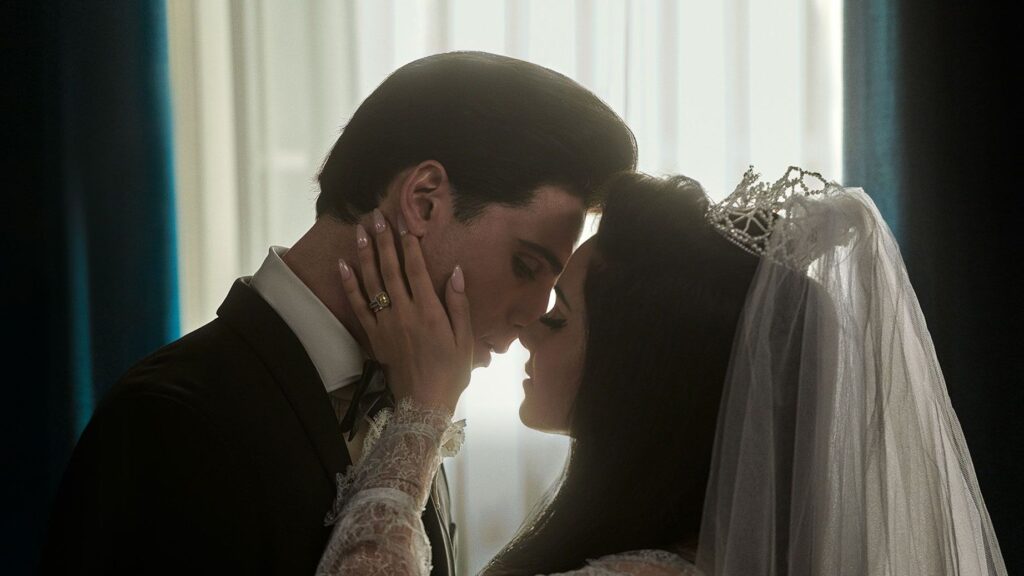
There is a natural proclivity to assign a sort of mystique to Priscilla (played by Cailee Spaeny). Coppola and Spaeny work in tandem to never lose sight of the basic reality of the power unbalance between a young child and one of the biggest celebrities the world has ever seen. One can accept the intentions of Elvis (Jacob Elordi) as genuine and honorable, but there’s no getting around the fact that it is an extremely strange dynamic only made less weird through Presley’s ability to bend any environment to his whim, setting up Priscilla in Memphis with his father and grandmother to watch over her as she finished her studies at a local Catholic school. Trying to do things above board does not make any of this normal.

Coppola delivers a sleek narrative well-suited for her skills, a surface-level reading of a drug-addicted superstar who owes most of his success to the phalanx coddling his every move while safeguarding the means of production. Elordi and Spaeny are mesmerizing together, the former capturing all of Elvis’ charisma while never downplaying his darker tendencies. Spaeny confidently navigates that awkward space between spouse and plaything, forever at the whims of the entire orbit around her. Rarely known for subtlety, Coppola does rather cleverly deploy the Memphis Mafia as a perpetual panopticon that Priscilla is forced to grapple with as she struggles to find her place in Elvis’ life. For a film with practically zero fleshed-out supporting characters, the peanut gallery paints a vivid picture in the absence of any voice of its own.

At 112 minutes, Priscilla is among the longer entries in Coppola’s portfolio, surpassed only by Marie Antoinette, her only other attempt at hovering in the atmosphere of a biopic. It’s hard to argue that she uses the time well, meandering on the same points for most of the narrative while skipping out on the points that would have given her protagonist some agency amidst her broader objective to browbeat the audience into submission regarding the monotonies of Graceland. The third act leaves a lot to be desired, though Coppola does align her film with a broader truth about Elvis that people often forget.

For all the mystique surrounding Elvis, the man himself is not terribly complicated. Elvis possessed unparalleled charisma, but the presence of Colonel Tom Parker, who never appears in the film, took raw talent and transformed it into an industry. The man was a drug addict who spent much of his career coasting off the fame acquired in his youth, already on the downturn by the time a fourteen-year-old Priscilla came into his life. Elvis is every bit the commodity that Graceland itself became after his death. He undoubtedly loved Priscilla, while gradually using his star power to control and abuse any sense of agency she might have felt. Love is complicated. Elvis Presley is not. For all its flaws, Priscilla understood that innate truth better than most.

Wednesday

8

November 2023

0

COMMENTS

Remy & Arletta is a powerful indie portrait of young queer affection

Written by , Posted in Blog, Movie Reviews, Pop Culture

High school narratives are in many ways better suited for adults who have been through the hellish ordeal that is the American education system than the children who may be inclined to see their own present as the most pivotal point in their lives. For many, especially members of the LGBTQ community, high school is something to be survived. Any notion of thriving should come with the requisite understanding that life is not defined by anything that happens during those chaotic four years.

The film Remy & Arletta centers its narrative on a young woman juggling a particularly challenging set of circumstances. Remy (Micaela Wittman, who also penned the screenplay) is trying to make it through high school while sharing a motel room with her controlling alcoholic mother Eilene (Amy Benedict). Remy’s best friend Arletta (Riley Quinn Scott) tries to offer her some sanctuary amidst her unstable family life, but something deeper is at play. With an easy, natural chemistry between the two, Arletta develops feelings for Remy in that shaky grey territory between puppy love and codependency, two teenagers in way over their heads with little else going well in their lives but their relationship with each other.

Shot on a nano-budget, director Arthur de Larroche crafts a first-rate production that stands far above any limitations presented by the realities of filmmaking through a brisk seventy-one minute runtime. The film mostly belongs to Wittman, whose Remy is relatable and genuine, earning both the sympathies and frustrations of the audience through a few of her decisions. High schoolers often feel like they’re carrying the weight of the world under normal circumstances. Remy’s life is a mess, and yet she still perseveres, chasing her dreams while lugging around more emotional baggage than anyone that age should ever have to carry.

Remy & Arletta presents an authentic take on the unique challenges of queer high school romance while never caving to the fantasies that young people often project onto their worldviews. There’s a reason most of us look back on our high school tenures and cringe. High school is in many ways a great canvas to fling as much stuff on as possible before college and the real world whisk you away to less hormonal pastures, a privileged perspective that sadly not afforded to people in Remy’s situation.

The real triumph of the film is Wittman’s ability to remind her audience of the whimsical feelings that young queer love can bring to any of us blessed, or cursed, enough to have experienced it for ourselves. Remy & Arletta stands out for its grounded and earnest take on a highly chaotic time in American teenage life. High school shouldn’t be the defining chapter in anyone’s life, but the film makes a wonderful case for the beauty of those fleeting moments we once clung to, when we were young.

Sunday

5

November 2023

0

COMMENTS

U-Haul

Written by , Posted in Podcast

ITM offers a passionate defense of the LGBTQ sensation known as U-Haul. Is it a bad idea to rush into emotional entanglements that make you feel like you’re floating on the moon? Hey, if you find something that makes you happy in this modern landscape, roll with it. Life’s too short to deny yourself a beautiful U-Haul. 

Friday

27

October 2023

0

COMMENTS

The Deep End

Written by , Posted in Podcast

ITM has had quite the eventful stretch. With someone new in her life, Ian unpacks the nerves and calming effects of being thrown into The Deep End. As scared as she feels, the idea of having something worth feeling anything about is cause enough for celebration. The deep end isn’t such a scary place to be as long as someone remembers to throw you a paddle. 

Friday

20

October 2023

0

COMMENTS

Effort

Written by , Posted in Podcast

ITM had a magical date last night with a woman. A major recurring theme of this show over the past two years has been ITM’s fleeting connection to her bisexuality. Ian unpacks her date and the value of bringing your best, earnest effort to new connections, to throw yourself out there in our vast scary world, eager and ready to savor that precious LGBTQ joy we all hold so dear to ourselves. Maybe she’s a little smitten with the sapphic bug, but isn’t that the whole point of this thing of ours (bisexual casa nostra)?

Wednesday

18

October 2023

0

COMMENTS

Discretion

Written by , Posted in Podcast

We’re back! ITM delivers a case against one of her least favorite elements of LGBTQ life, that thing called discretion. A lot of people used to wish that gay people could keep things in the bedroom or the pesky closet. ITM doesn’t think that suits an adorable transsexual, and she’d like the era of discretion to come to a much-needed end. 

Thursday

14

September 2023

1

COMMENTS

Bottoms captures the zeitgeist of the queer high school experience

Written by , Posted in Blog, Movie Reviews, Pop Culture

There’s a beauty to the ugly chaos of high school that few are masochistic enough to appreciate. The coming of age genre often possesses a messy relationship with the high school setting, reasonable adults possessing enough sense to recognize that the rabid hormonal snake pit is not a very good place to come into one’s own skin. Some of the best high school comedies are the ones that don’t try for morals or learning or anything positive of the sort, except perhaps for the idea that hedonism is a virtue worth celebrating every once in a while.

Society has been slow to accept the notion that women deserve to live for pleasure too. The film Bottoms structures its narrative around a very simple premise. Two lesbians start a school fight club to impress their crushes and get laid, a timeless, beautiful tale that transcends gender and sexuality. Like most hormonal teenagers, PJ (Rachel Sennott) and Josie (Ayo Edebiri) are not capable of thinking through the ramifications of any of their batshit crazy ideas, instead letting their freak flags fly and rolling with the punches, quite often literally.

Director Emma Seligman, who co-wrote the screenplay with Sennott, quickly establishes a singular rhythm for her narrative. Rockbridge Falls High School is in many ways just like any other school. The principal is vapid and tyrannical, the teachers are aloof, and most of the students talk at each other without caring what anyone else has to say. PJ and Josie quickly draw the ire of the school football team, the latter at odds with star quarterback Jeff (Nicholas Galitzine) over the affections of Isabel (Havana Rose Liu). The natural clash between jocks and outcast lesbians is a beautiful dynamic rarely explored in film, something that Seligman and Sennott mine for comedy gold.

The script is laugh-out-loud hilarious, paired marvelously with the comedic timing of the cast. Everyone commits to the bit in this absurd, although not unrealistic, depiction of high school life. Sennott and Edebiri have a natural, often unspoken chemistry between the two. Veteran NFL star Marshawn Lynch puts in a masterful supporting effort as Mr. G, the faculty advisor for the fight club.

Perhaps the most impressive achievement of Bottoms is the narrative’s full immersion in the LGBTQ experience without ever pandering to the vapid idea of “visibility” or wasting its lean 88-minute runtime on lame gay-101 explainers that have bogged down the genre. Seligman’s work is the rare queer comedy that’s solely focused on being funny. The hero’s journey of PJ and Josie is eminently relatable to anyone who’s spent more than ten minutes in high school. This film deserves a lot of credit for being able to recognize that without trying to hold its audience’s hand.

Bottoms is one of the greatest high school narratives of the twenty-first century, a triumph of queer cinema. The discourse surrounding LGBTQ representation in film often paints the American public as needing to wade into the pool slowly, a promise of a more inclusive future that rarely seems concerned with ever living in the present. Seligman paints her portrait of high school as an artist who understands that we’ve always been there. Modern cinema desperately needs more filmmakers with her abounding sense of confidence. Bottoms is, quite simply, a masterpiece.

Tuesday

12

September 2023

0

COMMENTS

Classic Film: Summer Hours

Written by , Posted in Blog, Movie Reviews, Pop Culture

There’s a magic to summer as a child that never quite loses its touch as the years go on. The months of July and August carry a certain timeless aspect that hardly holds up against the chaotic realities of our world, except in memory. You can’t go back to the way things were in your youth, but a return to the familiar, seemingly immortal, settings of your summer adventures can certainly breathe life into the idea that you might.

The French film Summer Hours (original title L’Heure d’été) centers its narrative around the end of a family’s summer magic. Family matriarch Hélène Berthier (Édith Scob) spends the last few years of her life seemingly trying to put her estate in order, a lifetime of devotion to her artist uncle, Paul Berthier. Her oldest son Frédéric (Charles Berling) is mostly entrusted with preserving the estate, split equally with his siblings Adrienne (Juliette Binoche) and Jérémie (Jérémie Renier), both of whom now live abroad. The death of Hélène puts her idyllic wishes into jeopardy, as neither Adrienne nor Jérémie wish to keep the house in the family, exacerbated by the heavy estate tax imposed for its impressive collection of art.

Director and screenwriter Olivier Assayas crafts a rich narrative devoid of the typical family squabbling you’d expect when an estate needs to be broken up. There are certain sympathies reserved for the gatekeepers, namely Frédéric and Éloïse (Isabelle Sadoyan), the family’s longtime housekeeper, but the film doesn’t stretch to indict the very reasonable opinions of the siblings who accept the reality that their lives have taken them far away from France. Hélène’s own perspective of her legacy is deliciously murky, her delusions of grandeur toward her uncle surfacing on more than a few occasions.

Berling mostly anchors the narrative on the perpetually put-upon Frédéric, facing fire from three generations of his family. Frédéric is relatable, the through-line from the past to the present, thrust into a family-stabilizing role for lack of any other alternative. Berling does a fantastic job endearing himself to the audience through his abounding grace, eliciting sympathy for his rather privileged family.

Assayas keeps a comfortable rhythm to his pacing, matching the laid-back nature of summer with a slow burn that savors the quieter moments of its conflict. The film looks around for some padding to buff out the third act of its 103-minute runtime, but the narrative hardly drags either. The only true antagonist, beyond the estate tax, is time itself.

There are more than a few moments of genuine beauty hidden in Summer Hours’ quiet narrative. The film likely carries greatest appeal for people who can relate to the impermanence of our formative years, but Assayas doesn’t exactly lean on nostalgia to get his point across, always looking toward the future. Time only moves in one direction. Summer can feel like forever, until September and all the obligations of the real world come crawling around.

Tuesday

12

September 2023

0

COMMENTS

Classic Film: Made in Hong Kong

Written by , Posted in Blog, Movie Reviews, Pop Culture

There’s a certain timeless feeling to being young in a world that’s been raped and pillaged to the brink of destruction by the twisted wrought of capitalism. Film often sells its audience on the idea that we can break free of that cycle through a kind of a-ha moment, as if coming of age instills upon us new superpowers to transcend the limitations of our decaying planet. The 1997 film Made in Hong Kong, the first release after the region’s handover from the United Kingdom to China, explores the lives of a few teens living on the outskirts of society, barely scraping by, with no hope for the future.

Autumn Moon (Sam Lee) is a high school dropout working as a debt collector for a local gang run by Fat Chan (Chan Tat-Yee). Autumn is a feisty young kid, with spikey hair that matches his aggressive demeanor, but often displays a softer side as well. Autumn looks after Sylvester (Wenders Li), a mentally disabled kid who is frequently bullied, while being haunted by a love letter left behind by a peer Susan (Amy Tam Ka-Chuen) before she committed suicide. Autumn’s father left his family for a mistress, while his mother (Doris Chow Yan-Wah) abandons him early in the narrative.

The main action of the film centers around Autumn’s budding relationship with Ping (Neiky Yim Hui-Chi), who lives with her mother in a housing complex where Autumn makes his collections. Ping needs a kidney transplant she can’t afford, putting Autumn at odds with his employer, who controls her family’s debts. The memory of Susan ever-present in his thoughts, Autumn challenges Fat Chan’s grip on their community in a mostly futile effort to beat back the unrelenting tides barely letting any of them tread water above the surface level.

Director and screenwriter Fruit Chan crafts a beautifully bleak tragedy that’s bound to resonate with anyone who understands the natural primal rage that surfaces upon a realization that the cards will always be stacked against them. An ultra-low budget indie shot mostly on leftover 35 mm film, the cinematography possesses a natural feel that makes Hong Kong itself into a character within the slow-burn narrative. There’s a certain claustrophobia to the housing complex that perfectly explains the older character’s nihilistic outlook at their inescapable panopticon.

The film primarily uses non-professional actors, most making their feature-length debut. Lee brings such a raw chaotic energy to Autumn that you can’t help but root for him, even if he’s a little over the top for his own good. Chan mostly centers the 108-minute runtime on his characters, a gamble that pays great dividends in the third act. Made in Hong Kong is the kind of film whose emotional impact creeps on you, a subtly moving treatise on teen angst up against insurmountable odds.

The timing of the film’s release with the 1997 handover leads to natural comparisons, but the relatability of Chan’s work extends far beyond the geopolitics. Children are often told to work hard for the promise of upward mobility. The crony capitalism unleashed on the world has far different plans for the proletariat. Autumn lives his life like a kid with no future. He’s not exactly wrong in that regard, but the great power of the film manifests through the innate desire to root for him anyway.