‘You Can See Everything’ review: one of the most mesmerizing films of the twenty-first century
Written by Ian Thomas Malone, Posted in Blog, Movie Reviews, Pop Culture
If you spent a lot of time in grad school studying the humanities, the idea of a documentary not really being all that different from a fictional narrative doesn’t seem like pretentious hogwash. A documentary filmmaker edits down large swaths of footage to meet the confines of a feature-length runtime. What you’re seeing is not truth necessarily, but a perspective on truth.
Elizabeth Holmes is currently serving out an eleven-year sentence for multiple counts of wire fraud. She chose to spend large portions of her final weeks of freedom being filmed by comedian Nathan Fielder, best known for his shows Nathan for You and The Rehearsal. At the time, Elizabeth Holmes had not spoken to the media for almost a decade. There’s a certain irony in a woman about to serve a prison sentence for business fraud, opening her doors to a man who built his fame with a show about business pranks that dance along the line of fraud, something the documentary itself addresses about halfway through.
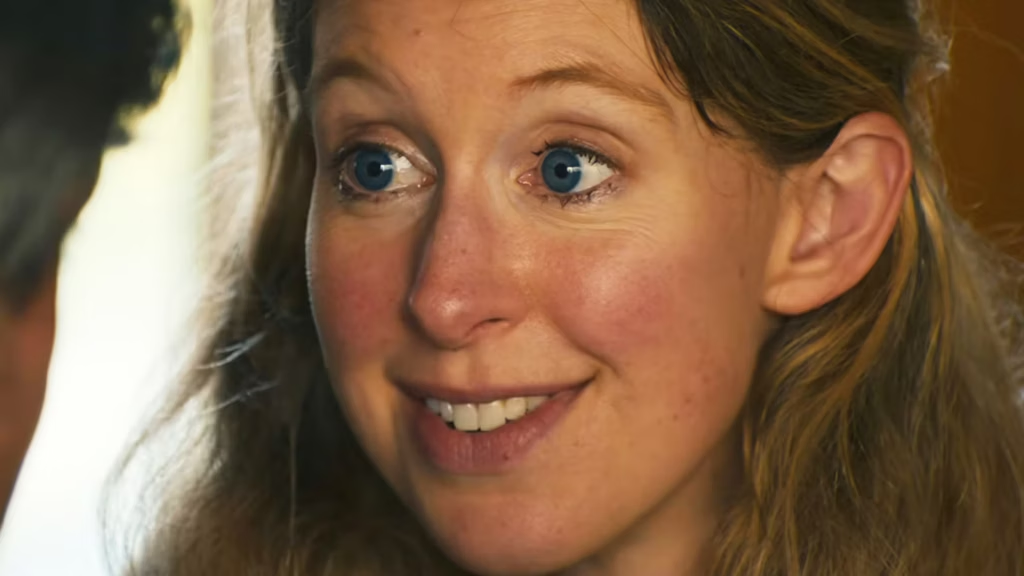
You Can See Everything spends a good chunk of its three-hour runtime as a sort of hangout piece. We watch Holmes, and her husband William “Billy” Evans, whom she met in 2017, after Theranos was revealed to be a fraud but before the SEC charges, as they raise their young children at a rental home in San Diego. The mundaneness of family life serves as a sort of metronome against the imposing portrait of Holmes’ dreamy blue eyes, constantly on full display through Fielder and co-director Lance Oppenheim’s use of close-ups and oversaturated color palettes.
At no point in the documentary is anything provided to prove Holmes’ innocence, which she and her husband protest repeatedly throughout the film. The closest moment plays out like a comedy skit, so absurd in its execution that you’re never quite sure if she believes her own bullshit. Many documentaries are ostensibly about finding the truth, but You Can See Everything asks a more important question. Does truth even matter?
Elizabeth Holmes was convicted of her crimes. Every appeal failed. If she had evidence to the contrary, her very expensive lawyers would have provided it by now. It’s fairly safe to say that it doesn’t exist.
Guessing Holmes’ motivations for filming is a risky endeavor for anyone to undertake. The United States of America is currently being governed by a man who frequently expects hundreds of millions of people, if not billions, to believe lies that basic reality debunks, particularly the results of the 2020 election. Holmes, or Donald Trump for that matter, is not the first to invite an audience into a post-truth world.
But Holmes did want her story out there, as the documentary reveals once it takes a more introspective turn, full of Nathan Fielder-style antics. I’m not sure there’s anyone on the planet who could tell you why, maybe not even Holmes herself. The most obvious answer is that she wants to garner sympathy for herself.
Fielder starts to bend the nature of reality itself as he wrestles with this question. Holmes is sympathetic. She’s clearly also a con artist of a truly elite variety, but much of recorded history has had plenty of figures who make us feel uncomfortable with our own sympathy for the devil.
Holmes is never particularly clever with her attempts at obfuscation. Evans lacks any semblance of grace, a figure whose effort to control the narrative invites natural comparisons to Theranos cofounder Sunny Balwani, who was in a romantic relationship with Holmes for eleven years. Evans, who comes from immense family wealth, could have had plenty of other romantic partners. Instead, he hitched his wagon to a woman who owes 450 million dollars in restitution to her victims.
Control is a central theme of You Can See Everything. Evans attempts to manipulate Fielder repeatedly throughout the film, in several instances well past the point of absurdity. History is full of grifters who thought they could con anyone, even a figure like Fielder, who built a career off reframing the audience’s perception of reality.
A documentary film is, at its essence, its directors’ stated version of the truth. Most films about criminals like Holmes would hinge on a certain level of trust for the documentarians, in this case Fielder and Oppenheim. We’re spending three hours with this narrative in large part because we have faith in the people who put this all together.
You Can See Everything really starts to upend the entire genre when Fielder, who is very much a character in his own right, starts to challenge the faith the audience might have in him. With Holmes behind bars, you’d think the film would lose steam. It’s often a sign of a flailing narrative when a film starts becoming about itself.
But that’s also a part of documentary filmmaking that we don’t really think about all too much. There’s a reason the judiciary often fights to keep cameras out of courtrooms. People behave differently when they know they’re being filmed.
There’s always a motive for someone like Holmes to participate in something beyond her control, a notion she and her husband never fully accept, even as Fielder fights to protect the credibility of his work. You Can See Everything isn’t satisfied simply exploring that concept. The film wants its audience to think about Fielder’s place in it all as well, doing its very best to lay every single card on the table.
Documentary films are occasionally revealed to be complete bullshit, or highly misleading. One could get all academic and point out that documentaries receiving wide theatrical releases by major studios like A24 are not exempt from the levers of capitalism that govern most art. As Rudy Giuliani once said, truth isn’t truth.
What sets You Can See Everything apart from pretty much any film ever made is its insistence on unraveling every single layer of its own existence with a sense of earnestness that no one would expect given all the players involved. The point isn’t to get to the bottom of Elizabeth Holmes, if there even is a bottom. The point isn’t even to flip the mirror on the audience, an understandable magic trick from a man like Nathan Fielder.
The world is full of people like Elizabeth Holmes. Millions upon millions of people have sympathy for a complete con artist, long after their lies are made abundantly clear to anyone with half a working brain. You Can See Everything doesn’t teach us why, but the time spent down the rabbit hole is one of the most profound intersections of delusion and power ever captured on film. It’s a breathtakingly beautiful deconstruction of basic reality. There is nothing else like it.