‘Jackass: Best and Last’ review: a clip show farewell to a fine American institution
Written by Ian Thomas Malone, Posted in Blog, Movie Reviews, Pop Culture
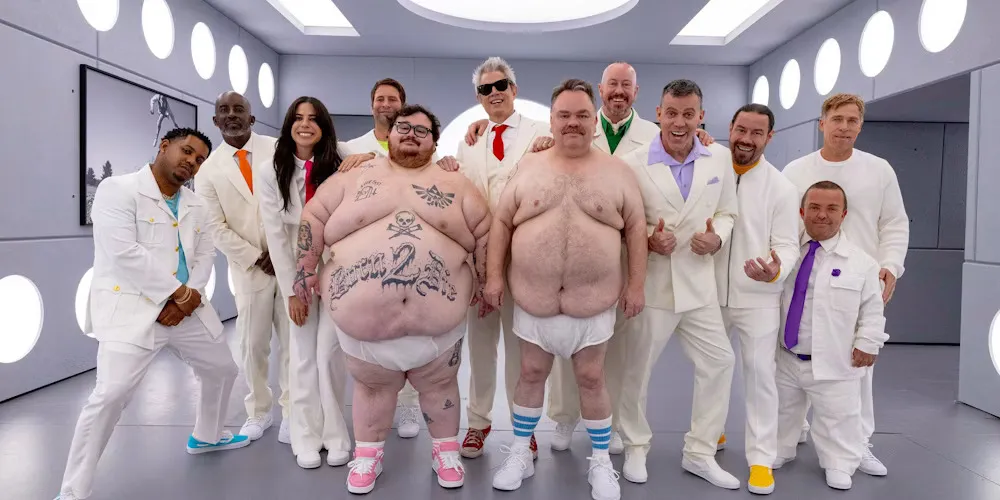
There’s a tendency by many aging comedians to proclaim that the humor that launched their careers could never be made today. Rainn Wilson recently attempted that train of thought with regard to The Office, as if a network comedy truly contained any material that wouldn’t be celebrated in Trump’s America. You never hear that kind of talk from the Jackass crew, who were successfully taken off the air after a campaign from right-wing culture warriors.
As 2022’s Jackass Forever showed us, some comedians can age with grace and maturity, even without straying too far from their roots. Jackass: Best and Last is a victory lap of sorts. The film is largely a clip show with highlights from the crew’s career, interspliced with some new footage featuring the newer crew that was introduced on the last go-around.
There’s something oddly charming about watching Johnny Knoxville, Steve-O, Chris Pontius, and the rest of the gang age. As Steve-O noted in the film, concussions hit differently when you’re pushing fifty. Knoxville took quite the hit back from a bull in Forever.
The crew is largely retired from dangerous stunts in Best and Last. “Best” and “Last” are distinctly separate concepts here. The best parts of the film come mostly through the “greatest hits” portion of the program, revisiting old memories. Aside from a few unaired clips, the romp down memory lane should be a little familiar to anyone going to a theater to watch the fifth Jackass movie.
The clip show dynamic is a little awkward at times, replaying moments that anyone could stream at home. The new cast is largely sidelined, with only Sean “Poopies” McInerney, Zach Holmes, and Jasper Dolphin getting much of anything to do. Rachel Wolfson and Compston “Dark Shark” Wilson (Jasper’s father) are nothing more than background characters.
Jackass: Forever had a degree of intimacy that could be explained by the pandemic, limited to closed sets without any stunts on location. Best and Last keeps them mostly confined to the Paramount Lot. Almost every new stunt is centered around butts or genitalia. Of the original main cast, only Ehren McGhehey and Dave England participate in any extreme stunts that any one of them might have attempted in an earlier era.
The OG crew has been through a lot. It’s understandable that they’d want to take a step away from the dangerous stuff, but that’s also why the new people were brought in. Jackass Forever proved that there was life left in this franchise. Best and Last doesn’t really try to be much of anything other than a victory lap.
There’s a lot of joy to be had watching a Jackass career retrospective that almost forgives the inherent laziness of the premise and the complete irrelevance of the newer crew. Bam Margera, who was fired from Forever, and Ryan Dunn, who passed away in 2011, feature prominently, giving an extra layer of emotional depth to the experience. Despite a joke by Pontius that he wasn’t in touch with his emotions, there’s a lot of obvious love here that radiates through the screen.
But there’s also the awkward reality that one new scene is nearly always followed by several romps that longtime fans have already seen. At one point, Steve-O announces that he wants to be the MVP of the movie, as other cast members laid better claim to films of Jackass past. This film has no MVP, or any interest in leaving a mark of its own.
Despite that, despite its lack of originality, despite the sidelining of nearly everyone who showed up to play in Forever, Best and Last somehow essentially achieves its objective. While several cast members muse to Knoxville that he’s threatened to end the franchise before, this does really feel like the end of the line. More than that, it feels like it should be the end. There’s nothing forward-thinking about any of these proceedings.
Jackass is not a sentimental franchise, but there’s something beautiful in watching all of this come together. The “manosphere” has warped the meaning of American masculinity, but the Jackass crew achieved something that the far-right could never imagine. They grew up.
Preston Lacy set up the waterworks late in the third act, as the crew talked about watching footage of themselves from decades past. Soft-spoken in his delivery, he merely says that he misses Ryan Dunn. You’re not supposed to cry watching something like Jackass, but it’s hard to make it through the credits without feeling the weight of a quarter-century of these antics coming to an end.
Jackass: Best and Last is not a great movie. At times, it feels more like a television special. Even if it may not impress, there’s a lot of joy to be had watching these guys bring their odyssey to a close. America has changed a lot since the early 2000s. The Jackass boys did too. The world may not have necessarily needed the last two installments, but there’s something wonderful to be found in the men they grew to be.