Classic Film: Wild at Heart
Written by Ian Thomas Malone, Posted in Blog, Movie Reviews
The timelessness of The Wizard of Oz is not a particularly complex notion. Judy Garland’s performance as Dorothy is eminently relatable across generations. We all want to feel at home, whether that’s a physical place, or in the arms of a man who talks like he’s doing an Elvis impersonation.
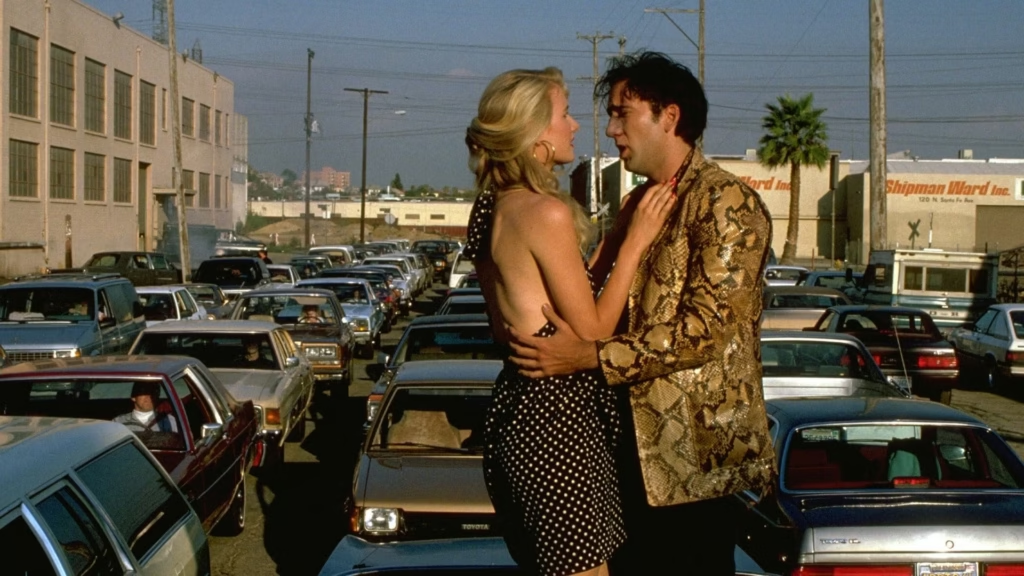
David Lynch’s 1990 film Wild at Heart is an unwieldy homage to one of the crown jewels of cinema. Swapping out for Dorothy and co. are Lula Fortune (Laura Dern) and Sailor Ripley (Nicolas Cage), two young people hopelessly in love. Sailor is sentenced to jail for five years after killing an assailant who attacked them with a knife, hired by Lula’s mother, Marietta (Diane Ladd). The two resume their romance after Sailor gets out, breaking his parole with a road trip to California.
The film finds its Lynchian weirdness on the road, with plenty of surrealistic visuals to keep Lula and Sailor company on the way to California. Not content to see her daughter run off, Marietta sends her boyfriends Johnnie Farragut (Harry Dean Stanton), a private detective, and Marcello Santos (J.E. Freeman), a gangster, after them. To make money for the trip, Sailor links up with unhinged criminal Bobby Peru (Willem Dafoe) for a robbery, one of many questionable decisions he makes along the journey.
Wild at Heart is a beautiful film to look at. The cinematography is top-notch. Lynch is clearly having the time of his life, supplementing the eerie road imagery with spooky visuals of his own. Dern brings an infectious chemistry to Lula, commanding every scene, sometimes with a single facial expression.
Part Wizard of Oz homage, part tribute to soap opera melodramatics, Lynch never really figures out how to tackle his adaptation of Barry Gifford’s novel of the same name. The screenplay is a mess. Dern and Cage both show up to play, but they’re rarely given anything to work with. They carry a few scenes on chemistry alone, but it’s hard to shake the feeling that neither really understands what their director is going for.
Lynch has a lot of interest in the scenery, but he doesn’t explore his characters at all. We learn almost nothing about Lula or Sailor, a dynamic that grows tiresome across the film’s unwieldy 124-minute runtime. Lynch’s preoccupation with violence doesn’t deliver the expected shock value. Often, it just feels like he’s being opaque for the sake of being opaque.
Oddly enough, having done little to earn such dramatic payoff, Lynch largely sticks the landing. The third act has a lot to say about the power of love to cut through life’s endless noise, a fitting dynamic for a film that’s mostly parlor tricks from a man capable of better. He leans on The Wizard of Oz a little too much for any of this to be particularly impressive, but Lynch almost makes up for his work’s inexplicable mundaneness.
Wild at Heart won the Palme d’Or at the 1990 Cannes Film Festival, despite being met with loud boos at its premiere. Maybe those boos came from pearl-clutchers who objected to the film’s graphic violence and sexual content. Maybe they were just very bored.
There is some joy to be had watching the two lovebirds go at it, despite everything that life throws at them. Time demands a lot from us. True love can still win out. It’s never too late to fight for another tomorrow.
Part of what makes David Lynch so iconic is his ability to create such singular worlds. Wild at Heart has a script that was in desperate need of additional work. The end result is such a half-baked experience, especially when compared to the rest of his filmography. Despite all that, even though this movie is not particularly good, Lynch’s effort is hard to get out of your head. Even in failure, he crafted something worth watching.