Classic Film: Batman & Robin
Written by Ian Thomas Malone, Posted in Blog, Movie Reviews, Pop Culture
Superhero movies have become so ubiquitous that it feels weird to imagine a time thirty years ago, when one film almost took down the whole genre. Warner Bros.’ original Batman series was a landmark moment for the entire industry, proof that the Dark Knight had commercial appeal beyond comic books and the campiness of the Adam West television series from the 60s. After the success of Batman Returns, perhaps the genre’s finest hour, the levers of capitalism demanded a more commercial-friendly caped crusader than Tim Burton’s dark take on the character could provide.
Batman Forever, director Joel Schumacher’s first effort at the helm of the franchise, signaled a pivot toward a take on Gotham that was more appealing to small children, and the toy companies that catered to them. Michael Keaton’s cerebral Bruce Wayne was swapped out for Val Kilmer, while Tommy Lee Jones and Jim Carrey introduced the kind of comedy into the franchise that evoked notes of Adam West and Burt Ward. Schumacher also brought back Batman’s beloved sidekick Robin, a detested figure among filmmakers who only want the most serious, adult Batman possible.
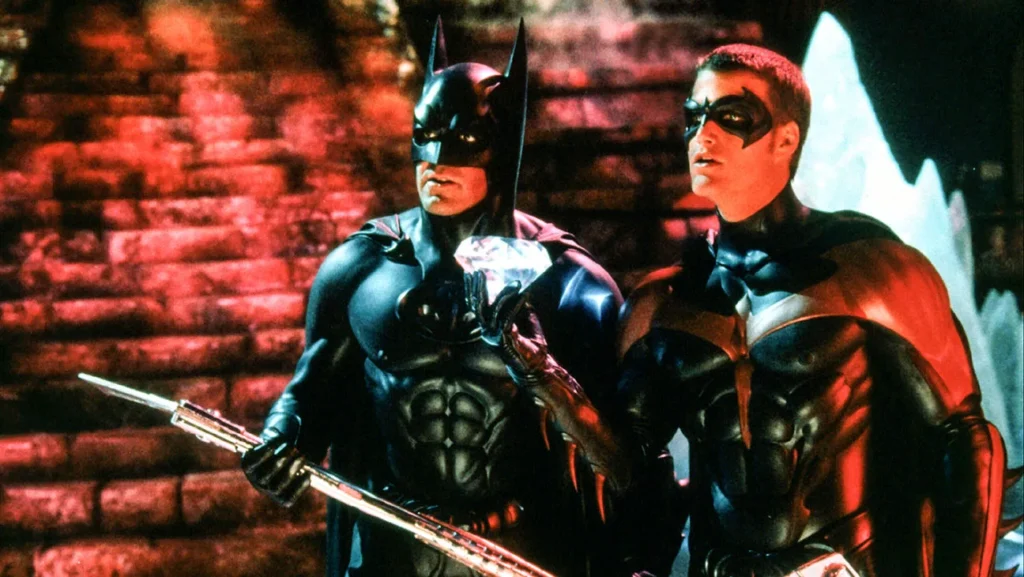
Schumacher’s follow-up tossed any remaining remnants of Burton’s worldbuilding out the window of the Batmobile. Batman & Robin is not the kind of film made for artistic purposes. From the very first action sequence, playing hockey with a diamond on a makeshift rink in the middle of the Gotham museum, one notion is abundantly clear. This movie exists to sell toys.
Batman & Robin is one of the most intimate superhero movies ever made, a soap opera in every sense of the word. At its heart, it’s a love story on three separate levels. Pamela Isley (Uma Thurman) wants to rid the world of its pesky humans who terrorize the environment. Dr. Victor Fries (Arnold Schwarzenegger) wants to save his wife amidst an American healthcare system that doesn’t care about its citizens.
The beating heart of the film is a rivals-to-lovers story between master and apprentice. George Clooney’s take on Bruce Wayne essentially splits the difference between Keaton and Kilmer, the cerebral nature of the former and the pretty boy charm of the latter. Robin (Chris O’Donnell) is not quite his ward, instead embodying the more adult Nightwing version of Dick Grayson. Clooney and O’Donnell are less than ten years apart in age, adding to the melodrama when Bruce tries to instill life lessons upon the kid he later addresses as a brother.
Schumacher, proudly openly gay decades before many in Hollywood considered it normal, injected his signature flamboyant aesthetic into most of his work. The sexual tension between Bruce and Dick is clearly his priority in the movie, dispelling with Batman’s normal detective work in favor of added melodrama. Schumacher covers his tracks in a number of clever ways.
Many of the cinematic Batman adaptations have felt the need to treat Bruce Wayne like James Bond, usually including a love interest who disappears by the next film. Julie Madison (Ella Macpherson), Batman’s very first love interest from back in the 1930s, got the nod for Batman & Robin. Her two scenes leave no impression whatsoever, Bruce Wayne lacking any of the romantic chemistry with Madison that he has with Grayson.
Upon her transformation into Poison Ivy at the hands of Dr. Jason Woodrue (John Glover), himself an apex villain of DC Comics, Isley functions as the perfect beard for Bruce’s love affair with his own ward. Poison Ivy possesses a pheromone dust which makes most of Gotham fall in love with her, including Batman & Robin.
Bruce and Dick have several arguments over the course of the film. At first, the arguments center around the nature of family, Batman still getting used to not being a lone wolf. Alfred (Michael Gough, who, along with Pat Hingle were the only two actors to appear in all four films in the original Batman series). Alfred’s heart lies with the youth, including Grayson and his niece Barbara Wilson (Alicia Silverstone, playing a variation of the character unique to the film).
As the film goes on, Poison Ivy’s pheromones serve as meager cover fire for the film’s obligatory nods to compulsory heterosexuality (also known as comphet). Batman and Robin are clearly in love, Grayson serving as the aging twink desperate for the approval of his mentor, himself conflicted with the reality that being a family means more than adventurous nights out. You have to care about people during the day, too.
Schumacher’s work is light-hearted, doing injustice to the potentially powerful themes of climate change and the shortcomings of the American healthcare system. Neither Poison Ivy nor Mr. Freeze has the same menacing touch as The Penguin, but Thurman and Schwarzenegger showed up to play. Schwarzenegger is the only one well-served by the film’s terrible script, penned by Akira Goldsman, who later won an Oscar for A Beautiful Mind.
People often say that puns are the lowest form of humor. Mr. Freeze puns are genius. Who doesn’t want a lovesick doctor to drop lines like “Revenge is a dish best served cold,” while they’re trying to destroy the planet?
The early 2000s ushered in this era of serious superhero movies that drew parallels to reality. While plenty of competent filmmakers produced great art, these stories come from comic books. They’re supposed to be ridiculous.
You know what’s actually far-fetched? Bruce Wayne is a billionaire who spends his time running around on rooftops, spending all his money on fancy gadgets, and making his butler stay up all night watching the Batcave. This is not an ethical man, but rather, a rogue billionaire who treats Gotham like his own personal playground.
Bruce could have helped the environment. He could have invested money in curing the MacGregor’s syndrome that affected Nora Fries, and later Alfred. He doesn’t do that, because he doesn’t actually care. Who is the real villain?
Schumacher caught a lot of flak for the film’s heavy commercialization. Is that really his fault? Warner Bros. gave him a mandate. He followed through, not always cooperatively either.
At one point, Poison Ivy remarks that she’s not a fighter, which is why her action figures come with Bane (Robert Swenson). This film knows exactly what it is: a product. Capitalism slowly eroded the perfect Batman crafted by Tim Burton, but Schumacher wasn’t content to let it destroy his work’s ample artistic merit.
The film does have its issues. Clooney’s lack of confidence ends up being an asset, another layer to Batman’s love story with Robin. The screenplay is genuinely horrible. The film fell into the trap of prioritizing new heroes at the expense of developing its existing characters, an issue that still plagues the genre to this day. There is a motorcycle race that serves no purpose other than to introduce Coolio into the DC universe.
Maybe Clooney wasn’t having so much fun trying not to sleep with his ward. Thurman and Schwarzenegger are clearly having the time of their lives. Thurman’s performance in particular is as infectious as Poison Ivy’s pheromones. She’s far more cartoonish than Catwoman, but just as commanding in each scene that she’s in.
Some people want a very serious Batman. That doesn’t mean there’s something wrong with Mr. Freeze yelling at his henchmen for falling to sing along to music from The Year Without a Santa Claus. Villains are allowed to have fun too, a reality that plenty of subsequent films forgot about.
Batman & Robin is one of the gayest mainstream blockbusters ever released. Schumacher gave us nipples on the Batsuit, and close-ups on codpieces that nobody knew we needed. People laughed, sure, but this film dared to do something different.
Plenty of gay relationships are just as messy as Batman & Robin, but there’s beauty in chaos. Part of the queer experience is learning to let people in. You can’t save a city by yourself. Schumacher’s homoerotic toy commercial is a messy ride, but there’s so much joy to be had in this masterpiece of camp. So, it isn’t very serious. Who cares?