
Ian Thomas Malone

avatar Archive

Monday

5

January 2026

2

COMMENTS

‘Avatar: Fire and Ash’ review: Cameron finally proves his critics right with this dull slop

Written by , Posted in Blog, Movie Reviews, Pop Culture

The Avatar franchise is often referred to as the most culturally irrelevant billion-dollar franchise. James Cameron directed three of the four highest-grossing movies of all time. Does it really matter if you don’t see tons of kids trick-or-treating as forgettable scantily clad blue aliens?

Cinema-obsessed philosophers can pontificate what it means for society that billion billion-dollar film contains a bunch of characters with forgettable names, a plot that resembles the love child of Ferngully and Dances With Wolves, and draws out little emotion from its audience when the credits roll besides relief that they can finally use the bathroom. None of that really has to matter. All we should really care about concerning Avatar: Fire and Ash, the third film in the franchise, is one simple question. Is this film any good?

Fire and Ash picks up right where The Way of Water left off. Jake Sully (Sam Worthington) and Neytiri (Zoë Saldana) are still mourning their son’s death. Jake grows worried that Spider (Jake Campion), the human son of Quadritch (Stephen Lang), who was human in the first film before being resurrected as a Na’vi Recombinant, can’t survive in their environment without his breathing mask. An effort to bring Spider to other humans is disrupted by the Mangkwan, a clan of exiled volcano-dwelling Na’Vi. The Mangkwan leader Varang (Oona Chaplin) allies with Lang and his human handlers, still after whale brain juice and colonizing the planet, to terrorize Sully and his family once again.

The Way of Water premiered thirteen years after its predecessor. Cameron’s second film on Pandora had a lot of natural goodwill going for it, the lengthy gap between installments serving as a natural palate cleanser. The Way of Water was chock-full of technological breakthroughs. Whatever shortcomings existed in its narrative were easily washed over by the breathtaking nature of the cinematography, underwater special effects that had never been done before.

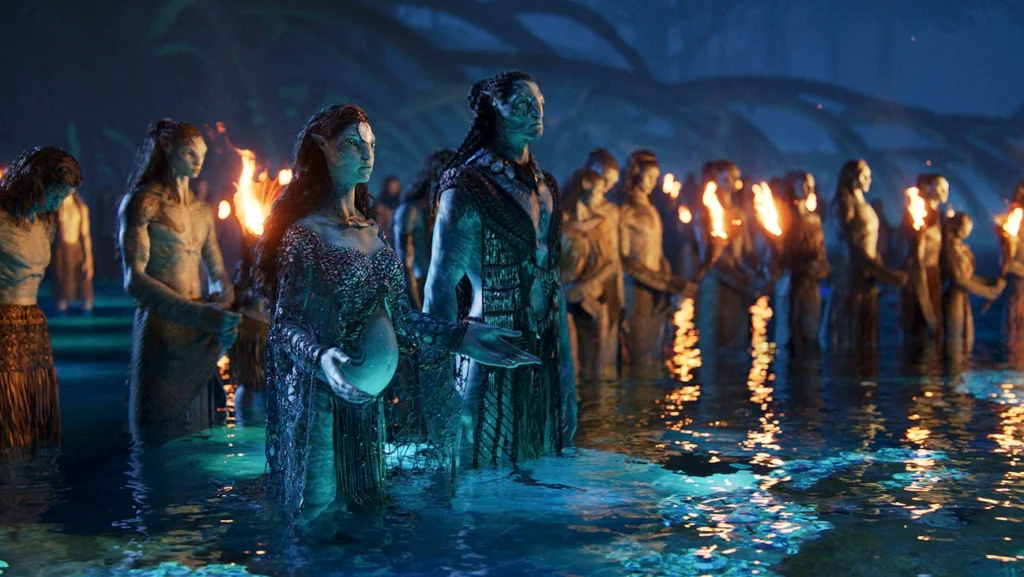
Fire and Ash comes just three years after The Way of Water. Pandora is still a beautiful place, with some of the best special effects in the industry, but it’s not a new place. We’ve been here before.

Complicating matters even worse is the fact that we’ve seen this story before. Fire and Ash is essentially a mash-up of the first two movies. Viewers are once again treated to a giant battle over colonization.

Fire and Ash struggles to overcome the clunky child custody case at the core of its narrative, a story otherwise content with playing a medley of Pandora’s greatest hits. Spider’s arc follows a lot of the same beats as Sully’s journey in the original Avatar. He’s a human who wants to be Na’Vi, caught between a biological father who is now a Na’Vi, and an adoptive Na’Vi father who was once human. To complicate matters worse, Cameron throws in a parallel to the Binding of Issac that seriously undercuts Sully as a character.

The Way of Water spent a lot of time building out Sully’s family, and the water-based Metkayina people. Putting aside the cliches, their family and their world felt alive, something worth the three-hour-plus investment that these films ask of their audiences. Fire and Ash doesn’t really care much about any of that development. The ball isn’t moved forward so much as it’s punted into the ocean.

Instead, we get a lot of repetitive scenes and clunky exposition. The idea of the Mangkwan is mildly interesting, but Cameron does nothing with them. Varang is a one-dimensional secondary villain in a film content to reuse the same big bad for the third movie in a row.

Aside from the heavy emphasis on Spider, the kids play second fiddle this time around. Lo’ak (Britain Dalton), Jake’s surviving son, gets barely any arc. Kiri (Sigourney Weaver) is still weird, a dynamic that isn’t exactly helped by having a 76-year-old woman play a teenager. Avatar has a lot of characters with confusing names, but Fire and Ash doesn’t give many reasons to care about a single one of them.

James Cameron has made at least two of the greatest sequels of all time, in Aliens and Terminator 2. The Way of Water defied all the naysayers who looked to the whole franchise with a collective shrug. Sadly, that appears to be the very same energy Cameron brought with him into Fire and Ash.

197 minutes is quite a long time for most audiences to stay engaged. Fire and Ash’s similarly long predecessor managed to circumvent this dilemma quite well with its strong pacing that still found time to embrace the quiet moments of its narrative. Here, Cameron hasn’t done enough legwork to keep things running smoothly. It’s too easy for the mind to wander amidst a film that’s largely running on autopilot.

Fire and Ash isn’t a terrible film, though easily Cameron’s worst since Piranha 2, his directorial debut that he mostly disavows. In some ways, it’s something worse, a validation of everything that’s been said about the Avatar franchise. Not every movie needs to be a cultural behemoth. Our society is essentially moving on from any strand of a collective consciousness as it is.

But a movie does need to give its viewers some semblance of satisfaction for having made the investment. A lot of time and money went into making this complete bore. For decades, Cameron’s films have wowed audiences around the globe. Sadly, there’s nothing new here.

 

Friday

16

December 2022

0

COMMENTS

Avatar: The Way of Water eclipses its predecessor in its breathtaking splendor, albeit with a similarly lackluster narrative

Written by , Posted in Blog, Movie Reviews, Pop Culture

Somewhere along the way in the years since 2009 came along a theory that no one cared about Avatar, a thesis that any individual could prove for themselves through their own apathy. Putting aside the massively expensive Pandora-themed addition to Disney’s Animal Kingdom Theme Park, the idea of staying power for a film that sat atop the all-time box office leaderboard never made a ton of sense. Is Titanic similarly irrelevant because fewer people dress up as Jack and Rose at Halloween than the minions from Despicable Me?

Avatar’s perceived lack of cultural capital can be explained in a few ways. The film failed to immediately establish a connected universe at precisely the same moment that big franchises began to entirely consume the box office, an association that feels fairer to make given that James Cameron already pulled off that feat decades earlier with The Terminator. The 3-D technology that the film dazzled its audiences with failed to maintain a firm stronghold in theatres. Cameron’s technical wizardry could also only go so far as to cover up Avatar’s generic plot that played like a hybrid of FernGully: The Last Rainforest and Dances with Wolves.

What people may have underestimated with regard to the delay between Avatar: The Way of Water and its predecessor is the way that the box office landscape would move away from mandating the kind of technical prowess that made Avatar such a hit in the first place. CGI has undoubtedly become cheaper to produce, but that quality has not always translated onto the final product, with countless superhero narratives settling for bland, gray color palettes projected onto green screens in soundstages that are so tiny the actors can barely even walk around. Awe and wonder was always Avatar’s greatest asset. Modern blockbusters rarely aim for that high of a bar.

The Way of Water does not have a particularly interesting story. Jake Sully (Sam Worthington) and Neytiri (Zoe Saldaña) have their happy life among the Omaticaya disrupted when the RDA returns to Pandora ten years later. Colonel Miles Quaritch (Stephen Lang) has had his conscience cloned into an avatar, along with various other commandos who were in the first film. Jake self-exiles his family to the water-based Metkayina clan when Quaritch captures the human Spider (Jake Champion), his sort-of-son who was adopted by Jake and Neytiri after the events of Avatar. The forest-based Na’vi struggles to adapt to their new ocean surroundings, a sense of belonging remaining elusive until they can truly learn the ways of water.

Cameron often seems conflicted with the idea that his fun on Pandora might need to function as something resembling a narrative you would find in a movie, a notion that might be a problem if not for the film’s breathtaking beauty. The cinematography continuously feels like footage that would be happier in a Planet Earth-style documentary, where David Attenborough’s voice could quickly remove the need for any pesky characters and those things called storylines. Pandora is such an immersive experience itself that you

The Way of Water largely operates as an ensemble piece, with Saldaña and, to a much lesser extent, Worthington ceding most of the spotlight to the next generation. Their four children, Neteyam (Jamie Flatters), Lo’ak (Britain Dalton), Kiri (Sigourney Weaver, playing a much different role than Dr. Grace Augstine in the original film), and Tuk (Trinity Jo-Li Bliss) form the emotional core of the narrative in a quite satisfactory manner, even if few in the audience will remember any of their names. Cameron manages to carve out complete storylines for practically every character, though Saldaña feels like an odd afterthought. The Metkayina play second fiddle to Cameron’s preoccupation with worldbuilding.

The gargantuan 192-minute runtime largely flies by, Cameron rarely losing his pulse on the pacing until halfway through the third act. There is some unnecessary exposition here and there, the price of admission to see the work of a vision-obsessed man incapable of editing himself. The notorious control freak Cameron can’t be told what to do, but you almost can’t really blame him when he constantly delivers some of the best visuals ever to play in a movie theatre. Cameron’s intense devotion to Pandora seamlessly translates onto the screen, making it easy to forgive the superfluous nature of his storytelling. This man never stops trying to prove he’s the greatest technical filmmaker currently making movies, often making a quite compelling case.

The climax of The Way of Water often feels like a composite of Titanic, The Abyss, and The Terminator, carrying on a bit too long to merely coast on its gravitas. There is a natural sense of audience fatigue after three hours of continuously jaw-dropping visuals, only for a finale to drag its feet toward a predictable conclusion, the only element of the film that’s not a major improvement on its predecessor. Cameron does succeed in making his film truly embody the meaning of the word epic, a movie to be survived on top of being enjoyed.

Skeptics who deem Avatar irrelevant will find plenty to scoff at in The Way of Water. The thirteen-year wait produced one of the most beautiful movies of all time, a feat of tremendous ingenuity, especially regarding underwater motion capture technology. There is a genuine thrill to watching such spectacular imagery on the screen, dazzling cinematography that reminds us all of this medium’s tremendous power when operating on all cylinders. The underwhelming narrative can’t detract too much from the joy of watching Cameron play with his craft. If only more blockbusters could aim for the stars in such a determined fashion.