‘The Drama’ review: Zendaya and Pattinson salvage a charming, underwhelming romcom
Written by Ian Thomas Malone, Posted in Blog, Movie Reviews, Pop Culture
Society has a weird way of selectively clutching its pearls regarding morality. We’ve celebrated bad people for years, villains we love to hate. But social issues, like gun violence and abortion, exist in this space, where people second-guess the suitability of the subject matter for artistic purposes.
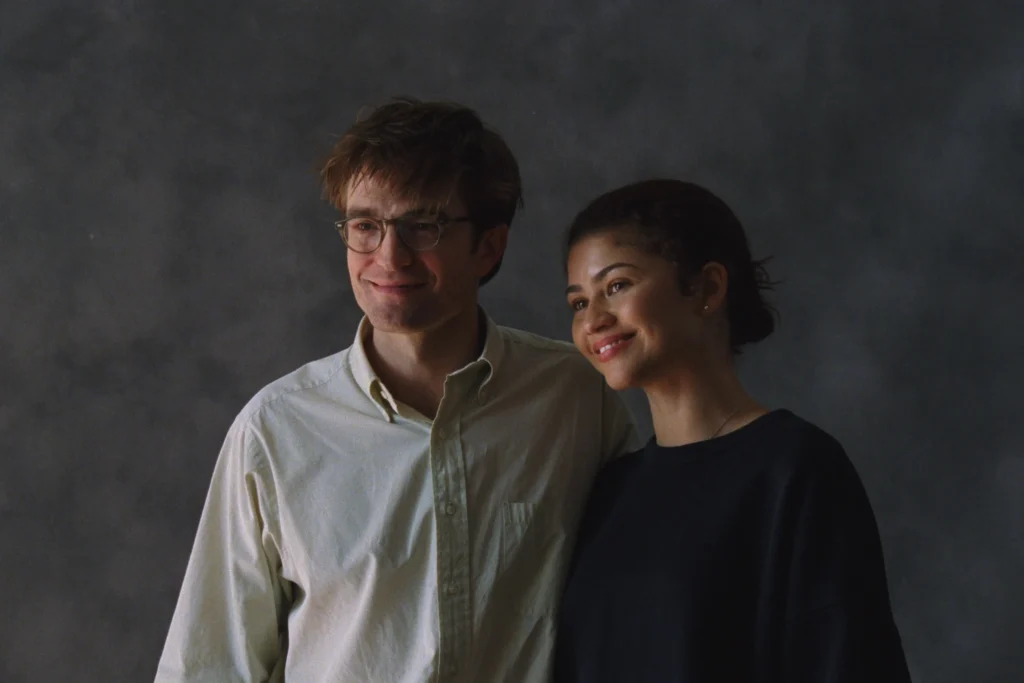
The Drama is a film that basks in the taboo nature of its material. Charlie (Robert Pattinson) is a British museum curator living in Boston. He notices Emma (Zendaya) reading a book. Rather than engage her in a normal conversation, Charlie lies about having read the book.
The narrative takes a time jump to right before Charlie and Emma’s wedding. At a wine tasting that seemed a little too close to the wedding, the two get drunk with their best man and maid of honor, each sharing the worst thing they’d ever done. The relatively harmless crude game took a turn when Emma revealed that as a child, she’d planned and almost carried out a school shooting.
Director Kristopher Borgli is clearly having the time of his life exploring the messy nature of love, set against the backdrop of the most heinous hypothetical many could think up. Plenty are familiar with the concept of “love makes you do crazy things,” but that whole dynamic takes on a different meaning when love is making you forgive crazy things. The narrative essentially exists in a level deeper than that, as the entire case against Emma amounts to a thought crime, something she came close enough to achieving that she became deaf in one ear from rifle practice, but not actually something she went through.
Charlie, on the other hand, has more tangible deficiencies. He’s a liar. His friends who are judgmental of Emma have also done bad things in their lives. The Drama works best as a narrative when it allows itself to explore the inherent messiness in watching not great people judge someone who is probably a psychopath.
Zendaya brings such a quiet intensity to Emma that really sells the whole experience. Her performance highlights Emma’s vulnerabilities that draw you in, even if you don’t trust her in the slightest. Charlie’s infatuation with her, and his reluctance to cut her from his life, make perfect sense.
In Zendaya, Borgli found an actress capable of eliciting all the nuance from Emma needed to make everything work. His screenplay and narrative choices betray a lack of confidence. Early on, Emma reveals that Charlie was her first real crush, having met him at the age of 28, a sequence clearly meant to convey a personality disorder.
Frequently throughout the film, we see a younger Emma (Jordyn Curet), sometimes alongside Charlie. We see some of Emma’s motivations, lonlieness and a desire to belong, not dissimilar from alt-right fare centered on the manosphere. At times, it feels like Borgli is simply throwing stuff out into the ether as possible explanations for Emma’s character rather than exploring her through the mechanics of the material itself.
Emma’s revelation consumes the whole film, a layered thought experiment that isn’t explored with nearly the same depth with which it was created. There’s a lot of fun to be had in watching Charlie wrestle with his emotions. Pattinson is perfect for the way, infectiously charming while wielding the kind of ego necessary to entertain the thought of staying with Emma.
We see Charlie’s personality deficiencies mostly through the prism of his relationship to Emma. We don’t learn much about Charlie himself. Borgli shows a bit of Charlie and Emma’s work lives to get a glimpse of who they are outside of their relationship, but the scenes border a bit on filler. These characters are fun to watch, but they’re not really convincing people.
Borgli also has nothing interesting to say about school shootings, somehow completely removing politics from potentially the most politically charged topic in the country. At one point, Charlie wonders how many other Americans think about mass shootings, considering how many we have each week. This observation would be more compelling if it went anywhere.
Zendaya and Pattinson have enough chemistry to buoy the experience, but The Drama lacks depth. This is a really interesting subject, explored solely at the surface level. As a filmmaker, Borgli has a lot of impressive technical skills and a firm grasp on the pacing of his work. The 105-minute runtime flies by.
School shootings are a part of American life. There is no reason we shouldn’t be able to tackle this subject in our art, even if some people find that notion gauche. Art is not supposed to be comfortable.
But the best art also has a perspective. The Drama has a really engaging hook. It has brilliant lead performances by two actors at the top of their games. If only it had something more interesting to say.