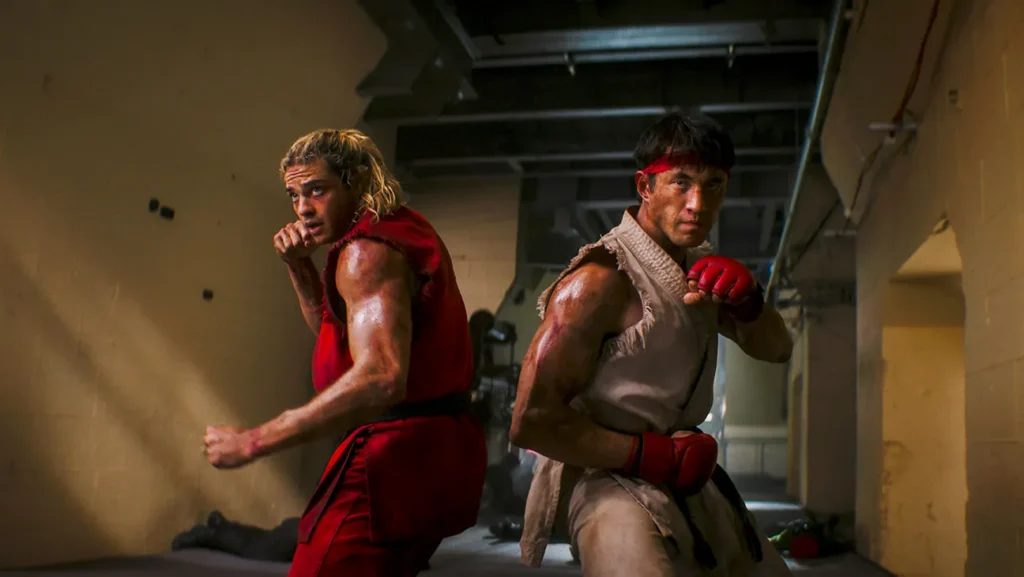
An arcade game like Street Fighter is basically a blank canvas for any filmmaker to adapt. The franchise doesn’t really have much of a plot, besides the obvious. There should be lots of fighting. Street Fighter II is one of the most iconic video games ever made, with a colorful roster of players that generations know and love.
Despite the seemingly endless possibilities, Street Fighter, like its more infamous contemporary Mortal Kombat, has struggled mightily with adaptations to the big screen. 1994’s Street Fighter was a narrative mess, carried by the enthusiasm of many of the performers. 2009’s The Legend of Chun-Li was pretty much just a mess, without any of the charm that gave its predecessor cult status.
2026’s Street Fighter possesses the kind of narrative that makes you wonder if it knows it’s supposed to be a movie. Director Kitao Sakurai demonstrates immense technical prowess with regard to the film’s aesthetics. The whole experience is like a high-definition time capsule to the 90s, a lived-in world that seems like it would be fun to spend time in.
Unfortunately, the narrative is just a complete disaster. The script has no idea how to endear any of its characters to the audience. This dynamic is made abundantly clear in the first fifteen minutes, when the song “What’s Up” by 4 Non Blondes is deployed three separate times. If your film needs to rely that badly on a six-month-old viral TikTok moment, something has gone very wrong.
The film’s basic plot is that there’s a second World Warriors Tournament, organized by franchise baddie M. Bison (David Dastmalchian). While Ryu (Andrew Koji) is the franchise star, the film centers itself more on side piece Ken Masters (Noah Centineo). The friendship between the two supplies the closest thing to an emotional core of this disaster.
The World Warriors Tournament is presented as a front for Bison’s efforts to capture Ryu, and his immense power. The unimportance of the tournament is a big wet noodle that the film struggles to handle. We’re introduced to all the famous warriors from the game, almost none of whom matter.
We barely get to see any of them fight. The action sequences are frantic and hard to follow. While the rest of the film has a charming 90s aesthetic, the set for the tournament has a hideous color palette. As the host of the tournament, Don Sauvage, Eric André tries to inject some personality into the proceedings, but there’s no way around how awkward it feels for a live-action Street Fighter to constantly announce that various fighters have forfeited their place in the tournament.
Dastmalchian is the only actor besides André who seems to be having any fun at all. The film has absolutely no idea what to do with Chun-Li (Callina Liang) besides the vague notion that she should be important. Thanks to a couple of gratuitous close-ups, Chun-Li’s backside gets more of a personality than the rest of her body.
The film settles on depicting Ken, its lead, as a washed-up loser, coasting on his past reputation to make a living. Another actor might have been able to make this work, but Centineo just doesn’t have the stage presence to make up for how awful this script is. The film can’t articulately communicate Ryu’s friendship with Ken at all. There is some payoff for his arc in the third act, but it’s too little, too late.
To some extent, Centineo’s lackluster lead performance isn’t really his fault. These are all one-note characters. Of the supporting players, Cody Rhodes comes the closest to pulling off the assignment as Guile, but the script gives him little to work with.
The film’s biggest botch-job comes at the expense of Vega, played by masked country singer Orville Peck. The sound mixing has no idea what to do with Peck’s luscious South African accent. There is no consistency in the delivery of his lines, which are hard to understand in nearly every instance. The film is perfectly fine to treat the few women characters as eye candy, but Vega, played by a flamboyantly gay man, is kept covered up, at odds with many of his costumes in the game.
At several points in the film, it feels like the studio is editing four separate movies. The two-hour runtime does no favors to the absolute slog of a narrative, which asks its audience to care about Ryu being harvested for his powers when we were never really given a reason to care about him as a person. Part of the fun of Street Fighter is fighting with all sorts of characters. The use-value of Ryu’s power level is not a compelling storyline.
Street Fighter is slop masquerading as a motion picture, a film that truly has no idea how to tell a story. Somehow, it manages to make both of its predecessors look like they belong in the Criterion Collection by comparison. Worst of all, it looks like it was made by someone who loves Street Fighter while every narrative decision seems hellbent on putting off anyone who ever played the game. It’s an excruciatingly bad experience.